The Midnight Breach of Warsaw: How Poland’s Constitutional Tribunal Became the Epicenter of a Democratic Crisis

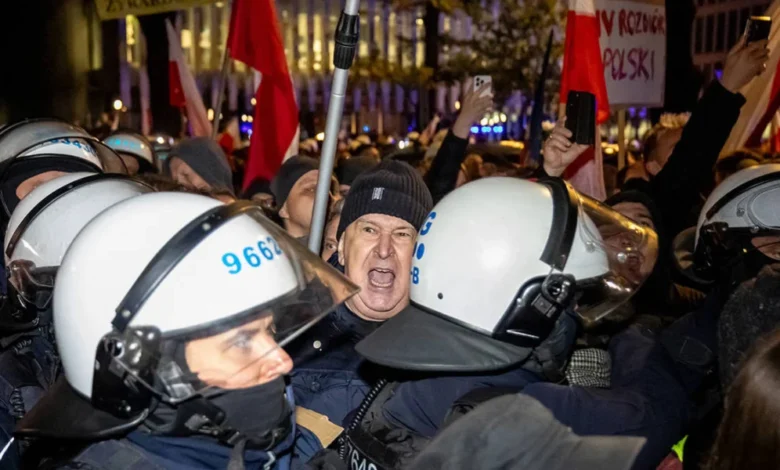
WARSAW — In an unprecedented escalation of political hostilities within Central Europe, Polish President Karol Nawrocki and a cadre of right-wing populist allies executed a late-night raid on the country’s Constitutional Tribunal. Captured on video and rapidly circulating across global digital networks, the footage depicted political figures and associates forcibly breaching the tribunal’s facilities under the cover of darkness. The physical altercation involved shoving aside sitting magistrates, including an elderly female judge who attempted to bar their entry.
The incident has sent shockwaves through European capitals, drawing swift condemnation from democratic watchdogs, constitutional scholars, and international legal bodies. While the Kremlin and far-right nationalist factions across the European Union have openly praised the maneuver, mainstream democratic institutions view the breach as a direct assault on the separation of powers and the rule of law. By targeting the constitutional court—an institution historically designed to act as the ultimate check on executive and legislative overreach—the populist faction has thrust Poland back into the international spotlight regarding the fragility of its democratic architecture.
Background Context and Institutional Vulnerability
To understand the gravity of the midnight breach, one must examine the pivotal role the Constitutional Tribunal plays in modern democratic governance. Often described as the institutional firewall distinguishing a pluralistic democracy from an authoritarian regime, the tribunal holds the exclusive authority to review legislation against Poland’s constitution.
Over the past decade, Poland has been locked in a protracted constitutional struggle. Previous populist administrations initiated sweeping judicial overhauls that critics argued systematically dismantled the independence of the judiciary by packing courts with political loyalists. The recent actions by President Nawrocki and his associates represent a continuation—and intensification—of this institutional capture. When political actors resort to physical intimidation and nocturnal intrusions to secure control over judicial bodies, the foundational premise of an independent judiciary ceases to function.
Chronology of Events
The escalation leading up to the late-night raid developed across several tense weeks of political gridlock following disputed appointments and legislative maneuvers regarding the tribunal’s leadership.
- Late October 2026: Tensions mount between the executive branch and remaining independent members of the Constitutional Tribunal regarding the validation of recent legislative acts and jurisdictional oversight.
- Early November 2026: Rumors circulate that judicial staff and independent magistrates intend to secure administrative records and digital archives to prevent unauthorized access by politically appointed successors.
- November 3, 2026 (Night): Polish President Karol Nawrocki, accompanied by political allies and security personnel, arrives at the tribunal headquarters in central Warsaw.
- Midnight – 2:00 AM: Surveillance footage and mobile phone videos capture the group forcing entry into the building. Confrontations ensue with on-duty security and judicial staff, culminating in the physical removal of magistrates blocking access to administrative offices.
- November 4, 2026 (Morning): Video footage goes viral globally, prompting emergency press conferences by opposition leaders, legal associations, and international human rights monitors.
Supporting Data and Democratic Index Metrics
Poland’s ongoing struggle with judicial independence has been extensively documented by international indexes tracking democratic health. According to data compiled by the V-Dem (Varieties of Democracy) Institute, Poland experienced one of the steepest declines in liberal democracy scores in Europe during the late 2010s and early 2020s.
Furthermore, reports from the European Commission under the Rule of Law framework have repeatedly flagged Warsaw for non-compliance with European Union judicial standards. Financial sanctions and frozen recovery funds have previously been deployed by Brussels to pressure Polish authorities into reversing measures that compromise judicial independence. The events of November 3 threaten to reignite these financial and diplomatic penalties, potentially isolating Poland further within the European bloc.
Official Responses and Stakeholder Statements
The fallout from the incident has triggered sharp divisions across the political spectrum, with domestic and international actors issuing rapid evaluations of the breach.
Domestically, opposition parties have characterized the event as an unconstitutional coup against the judiciary. In a joint statement, leading opposition figures demanded immediate criminal investigations into the conduct of the president and his entourage, asserting that immunity should not protect individuals who engage in violent trespass against state institutions.
Conversely, supporters of President Nawrocki have defended the action, framing it as a necessary intervention to purge the judiciary of holdover magistrates appointed by previous governments. Far-right and populist commentators across Europe have echoed these sentiments, celebrating the assertion of executive power over what they term an "activist judiciary."
International reactions have been notably severe. Representatives from the Council of Europe’s Venice Commission issued an urgent communiqué reiterating that the physical coercion of judges represents an intolerable breach of democratic norms. European Union officials in Brussels have signaled that the incident will be factored into upcoming rule-of-law evaluations, warning that systemic attacks on the judiciary carry profound consequences for Poland’s standing within the community of nations.
Broader Impact and Implications
The breach of the Constitutional Tribunal extends far beyond the borders of Poland, serving as a case study in the modern vulnerabilities of democratic states. Political scientists note that contemporary democratic erosion rarely takes the form of classic military coups; instead, it frequently involves the gradual or abrupt subversion of courts, electoral boards, and media regulators from within.
By utilizing physical force rather than legislative reform to assert control over the constitutional court, Polish populists have crossed a psychological and political Rubicon. This normalization of intimidation tactics risks emboldening similar movements globally, signaling to aspiring authoritarians that institutional barriers can be breached with impunity.
As Poland navigates the aftermath of this crisis, the resilience of its civil society, the independence of its remaining lower courts, and the pressure exerted by international allies will determine whether the rule of law can be restored or if the nation faces a deeper descent into democratic backsliding.