Brent Oil Plunges Below $100 as Growing Diplomatic Hopes Easing Supply Fears

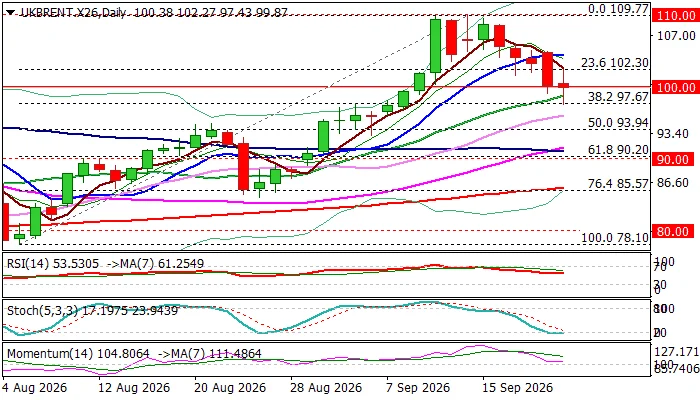
Crude oil markets experienced a significant and prolonged downward correction this week, with international benchmark Brent crude falling into negative territory for the fifth consecutive trading session. Extending its sharp bear-leg from the formidable $100 resistance zone—where multiple upside rejections occurred earlier in the month—Brent breached the psychological $100 per barrel threshold on Tuesday. This dramatic shift in market sentiment has erased more than $10 from crude valuations over a span of just a few days. The primary catalyst behind this sudden reversal is a wave of renewed optimism surrounding potential diplomatic breakthroughs in the Middle East, which investors hope will avert further geopolitical escalation and ease the persistent supply tightness that has plagued global energy markets for months.
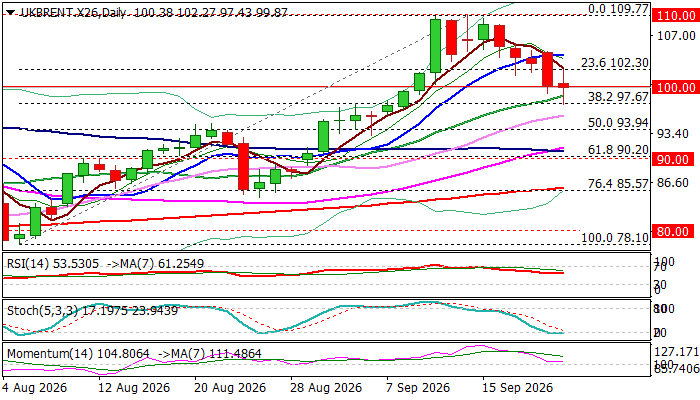
The steep downward trajectory has dismantled several key technical supports, shifting the short-term market structure from bullish consolidation to aggressive corrective selling. Having peaked near the $110 zone earlier in the month, prices have steadily formed a lower trading platform. The recent descent pierced the crucial Fibonacci support level at $97.67, which marks the 38.2% retracement of the broader upward wave from $78.10 to $109.77. This violation further cements mounting bearish signals on the daily charts, following the earlier breakdown below the 10-day moving average (10DMA) currently situated at $104.24, and the definitive loss of the $100 psychological floor.
Technical analysis reveals that fading positive momentum has severely dented the previously robust bullish daily studies. A sustained and clear break below the $100 handle is now viewed by market technicians as confirmation of a fresh negative signal, which will likely keep intense downside pressure on prices in the immediate term. Nonetheless, market participants remain acutely aware that technical indicators are currently secondary to macro-level geopolitical developments, which will ultimately dictate the trajectory of oil prices through the remainder of the quarter.
Geopolitical Catalysts and the Diplomatic Push
The dramatic deflation of crude prices is intrinsically tied to shifting diplomatic currents in the Middle East. For months, global energy markets have priced in a substantial risk premium due to the looming threat of supply disruptions stemming from geopolitical friction involving key producers, most notably Iran and various Gulf states. However, recent days have witnessed a flurry of diplomatic activity aimed at de-escalating tensions.
Market optimism surged following indications that high-level dialogue could materialize on the sidelines of the upcoming United Nations General Assembly meetings. Specifically, market watchers are closely monitoring the prospects of engagement between United States and Iranian officials. Concurrently, intense diplomatic pressure is being exerted by Gulf cooperation nations, which have actively stepped up mediation efforts to forge a peaceful resolution and stave off a deeper regional crisis that could cripple international trade routes and energy infrastructure.

Energy analysts remain cautiously optimistic regarding these diplomatic overtures. However, seasoned observers maintain a pragmatic stance, fully cognizant of the fact that both sides continue to maintain maximalist demands. These entrenched positions present formidable obstacles to meaningful negotiations, meaning that any sudden breakdown in talks could easily trigger a violent snap-back in energy prices.
Chronology of the Recent Market Correction
The unfolding of the current bear leg in the oil market can be traced through a distinct sequence of technical and fundamental milestones over the past two weeks:
- Early September Resistance Peak: Brent crude repeatedly tests the $110 resistance zone, encountering strong selling pressure and forming a lower platform that signals exhaustion among bullish market participants.
- Mid-September Breakdown of Short-Term Averages: Prices begin to slide, dropping below the 10-day moving average at $104.24 as early reports of renewed back-channel diplomatic talks begin to circulate among commodity traders.
- The Psychological Breach: Amid a growing consensus that diplomatic avenues may prevent catastrophic supply disruptions, selling accelerates, pushing the benchmark below the critical $100 threshold.
- Tuesday Support Penetration: Brent extends its losses for the fifth consecutive day, cracking the 38.2% Fibonacci retracement level at $97.67 and confirming a broader shift in market momentum.
Key Support and Resistance Levels
For traders and institutional investors navigating this volatile landscape, technical parameters remain vital for risk management. Current charts outline the following precise technical boundaries:
Resistance Levels:
- $102.30 (Immediate minor resistance)
- $104.24 (10-day Moving Average)
- $104.88 (Intermediate recovery barrier)
- $106.00 (Upper boundary of the recent corrective range)
Support Levels:
- $97.67 (38.2% Fibonacci retracement level)
- $95.02 (Next major psychological and technical cushion)
- $93.94 (Intermediate downside target)
- $91.45 (Strong medium-term support zone)
Official Responses and Market Stakeholder Reactions
While political leaders have kept their cards close to their chest regarding the specifics of upcoming UN-linked meetings, energy ministers from several Gulf nations have issued coordinated statements emphasizing stability. Representatives from key Organization of the Petroleum Exporting Countries (OPEC) member states have reiterated their commitment to maintaining market equilibrium, signaling that producer nations are keen to avoid demand destruction caused by runaway inflation and prohibitive fuel costs.
Meanwhile, major consumer nations and central banks have welcomed the relief in energy markets. Persistent high crude prices have been a primary driver of global inflationary pressures over the past year, forcing monetary authorities to maintain aggressive interest rate stances. The recent drop below $100 offers a potential psychological and economic reprieve for industrialized economies struggling with slowing growth and elevated cost-of-living metrics. Industrial consumers, airlines, and logistics firms have begun expressing cautious relief, though many maintain extensive hedging strategies to protect against the inherent volatility of the commodity space.
Broader Macroeconomic Implications and Outlook
The retreat of Brent crude below the $100 mark carries profound implications for the global macroeconomic landscape. For months, energy-driven inflation has complicated the policy decisions of the U.S. Federal Reserve, the European Central Bank, and other major monetary institutions. A sustained decline in oil prices, should it hold, would substantially alleviate headline inflation figures, potentially giving central banks the breathing room needed to pause rate hikes or consider future policy easing.
However, the fragility of the current supply-demand balance cannot be overstated. While diplomacy has successfully defused the immediate risk premium, underlying structural deficits remain. Global inventories are still hovering near historically low levels, and any failure in the impending diplomatic talks—or any physical disruption to key maritime chokepoints such as the Strait of Hormuz—could instantly reverse the recent losses.
Furthermore, prolonged lower prices could impact capital expenditure plans among major upstream oil producers. While short-term price relief is welcomed by consumers, underinvestment in exploration and production fields historically plants the seeds for future supply crunches and subsequent price spikes.
As the market looks ahead to the unfolding diplomatic engagements at the United Nations, traders are bracing for heightened intraday volatility. The ability of Brent crude to either stabilize above the $97.67 Fibonacci support or succumb to further technical selling will largely depend on the tangible outcomes of these high-stakes international negotiations. Until a concrete diplomatic framework is established, energy markets will remain a headline-driven environment where sentiment can shift fortunes in a matter of hours.