Warsh’s “Dose of Accommodation” Overread? 2-Year Yield Runs Ahead of Fed Futures

The global financial markets are navigating a complex landscape of central bank communication, shifting fixed-income dynamics, and volatile commodity pricing following a pivotal Federal Open Market Committee (FOMC) meeting. Federal Reserve Chair Kevin Warsh introduced a substantial macroeconomic puzzle during his post-meeting address, characterizing the central bank’s latest decision to raise interest rates as the removal of “a dose of accommodation” from the broader United States economy. This singular phrase immediately sparked a cascade of hawkish interpretations among institutional investors and currency strategists, sending shockwaves through the short-term Treasury market and the Dollar Index.
However, despite the sharp repricing observed in front-end bond yields and foreign exchange rates, Federal Funds futures have demonstrated a curious detachment, signaling that market participants anticipate an acceleration of near-term tightening rather than a significantly higher terminal rate for the entire cycle. This divergence between surging front-end yields and subdued long-term futures expectations has laid bare a fragile equilibrium. As financial institutions parse the granular details of Chair Warsh’s commentary alongside labor market resilience and sticky energy pressures, the ultimate trajectory of global monetary policy hinges on a critical upstream variable: whether international benchmark Brent crude can sustain its position above the psychological $100-per-barrel threshold.

Deciphering the Hawkish Pivot: Warsh and the Language of Accommodation
To understand the current volatility across asset classes, market analysts have had to dissect the precise vocabulary deployed by Federal Reserve leadership. During the post-FOMC press conference, Chair Kevin Warsh repeatedly emphasized that the adjustment to the federal funds target range—currently sitting at 3.75% to 4.00%—was merely removing accommodation. According to macroeconomic theory and historical central bank lexicon, describing an interest rate band as accommodative implies that monetary policy remains actively supportive of economic activity, sitting well below the elusive “neutral rate” where policy neither stimulates nor restricts growth.
This characterization carried profound implications. If a 4.00% upper bound is still deemed supportive, the Federal Reserve’s policy stance has considerably further to travel before it enters genuinely restrictive territory. Evercore analyst Krishna Guha noted that the deliberate and repeated use of the term “accommodation” could not be dismissed as mere semantics. BNP Paribas strategist James Egelhof advanced a similarly aggressive reading, suggesting that if current rates are still supportive, persistent inflationary pressures will ultimately compel the central bank to push borrowing costs well beyond what current forward curves imply.
Yet, this literal interpretation creates an operational challenge for fixed-income strategists. The neutral rate of interest—often denoted as $r^*$—is notoriously difficult to pin down, functioning more as a theoretical range than a fixed numerical target. When questioned on the matter, Chair Warsh acknowledged that academic comparisons to the neutral rate serve as a useful intellectual framework for policymakers, but he declined to afford the concept decisive operational weight in justifying the central bank’s immediate actions.
This nuanced stance effectively granted markets a clear direction of travel without forcing leadership to commit to a definitive stopping point. UBS strategist Jonathan Pingle highlighted the practical asymmetry embedded in this communication strategy: the Fed’s reaction function appears increasingly insensitive to modest labor-market softening, pointing to a resilient 4.1% unemployment rate and healthy job openings data as proof that employment mandates are not currently being compromised. By signaling a higher threshold for declaring policy restrictive, Warsh successfully instituted a hawkish bias while retaining maximum tactical flexibility.
Fixed-Income Divergence: Futures Reprice Pace While Treasuries Surge
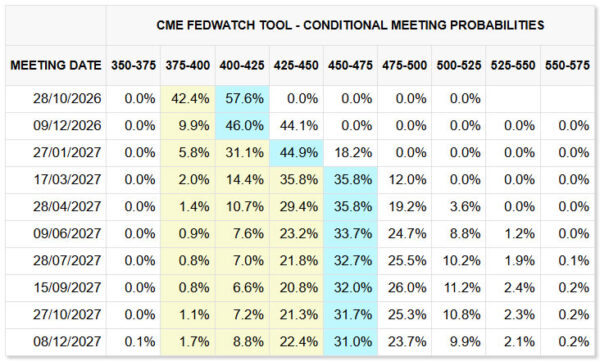
The market’s reaction to this hawkish messaging manifested in an immediate, yet structurally uneven, repricing across fixed-income instruments. In the derivatives market, Federal Funds futures adjusted rapidly at the very front of the curve. The implied probability of another consecutive rate hike at the upcoming October 28 FOMC meeting climbed sharply from 44.0% prior to the meeting to 57.6% immediately afterward. This shift reflects a growing consensus that the central bank is prepared to act with greater urgency to stamp out lingering price pressures.
However, a closer inspection of the longer-term distribution reveals that the broader policy horizon remained remarkably anchored. The modal probability bucket for December 2027 held steady at 4.50% to 4.75%, moving only marginally from 30.4% to 31.0%. Furthermore, calculating the probability-weighted average expected policy rate across a 24-month horizon yielded an aggregate figure hovering near 4.50% both before and after the central bank’s announcement. In essence, the derivatives market repriced the timing of tightening—pulling expected hikes forward—without significantly lifting the ultimate destination of the cycle.
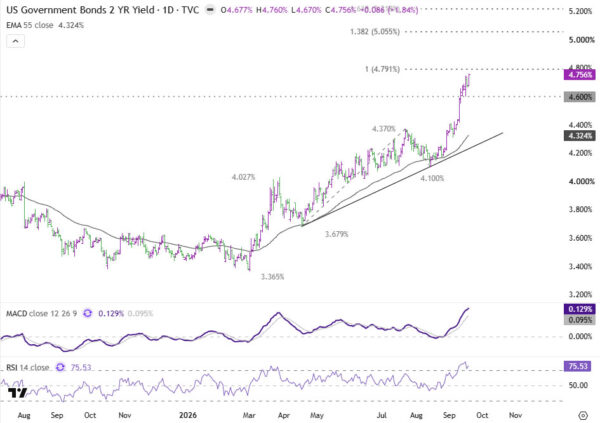
This measured restraint in the futures market contrasted sharply with the violent reaction observed in the physical Treasury market. The 2-year Treasury yield surged by 12.6 basis points to settle at 4.756%, dwarfing the relatively muted moves further out the curve, where the 10-year yield rose by a mere 3.1 basis points and the 30-year yield actually declined by 2.9 basis points.
This atypical curve movement—where the shortest maturity experiences the most extreme repricing while long-term bonds rally—contradicts the classic patterns associated with fiscal credibility shocks or duration-risk concerns, which typically exert upward pressure on the long end. Instead, the behavior of the 2-year yield points exclusively to concentrated near-term policy anxiety. With the 2-year yield trading approximately 26 basis points above the calculated 4.50% average expected policy rate over the next two years, technical indicators such as the daily Relative Strength Index (RSI) pushing above 75 suggest that the front end is rapidly testing the absolute limits of current policy confirmation.
Currency Markets at a Crossroads: The Dollar Index Tests Resistance
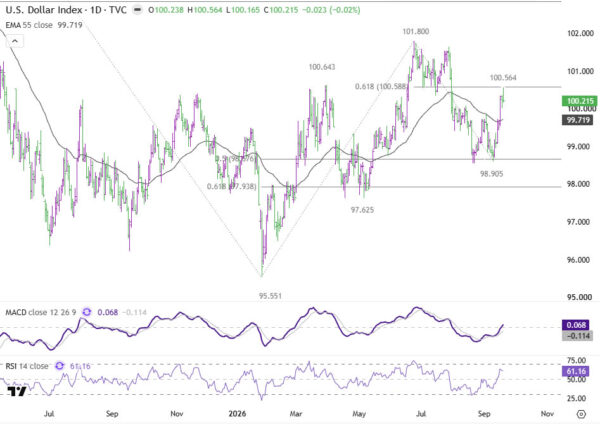
The explosive momentum in short-term yields naturally translated into significant foreign exchange volatility, propelling the Dollar Index (DXY) higher. Having previously carved out a double bottom structure between 98.56 and 98.91, the greenback rallied aggressively, breaking past key psychological barriers to touch a high of 100.56.
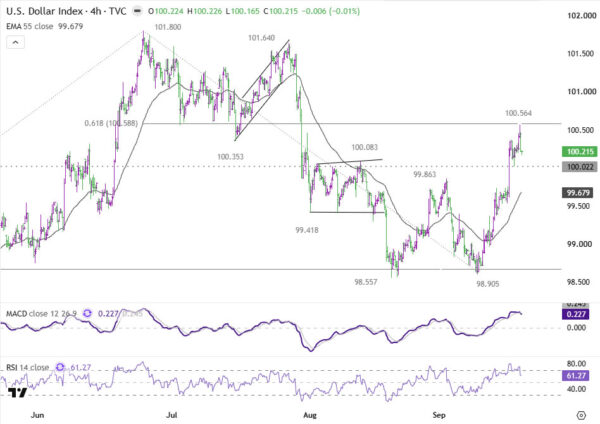
Despite this powerful recovery, the rally encountered immediate technical resistance, stalling almost precisely at the 61.8% Fibonacci retracement of the broader downward swing from 101.80 to 98.90, which sits at 100.58. Market structure indicates that the immediate tactical bias for the dollar remains constructive as long as the index holds above immediate support at 100.02. A decisive, volume-backed break above the 100.58 resistance zone would clear a path for the currency to retest its previous cycle high of 101.80.
Conversely, the sustainability of this dollar strength is inextricably linked to developments in the fixed-income complex. Should the 2-year Treasury yield face rejection at its 4.791% to 4.800% resistance ceiling and subsequently breach support at 4.600%, the foundational support for the dollar’s rally would quickly erode. A corresponding breakdown in DXY below 100.02 could trigger a sharp technical pullback toward the 4-hour 55 exponential moving average, currently situated near 99.68. For a true macro breakout to materialize, cross-market synchronization is required; currency bulls will need to see the 2-year yield definitively clear 4.800% alongside a concurrent upward shift in the Fed funds futures curve.
The Upstream Catalyst: Brent Crude and the $100 Threshold
While central bank rhetoric and sovereign debt curves dictate daily sentiment, the fundamental macro variable driving the entire chain of events lies in the energy markets. International benchmark Brent crude functions as the ultimate upstream input, determining whether inflation will remain structurally elevated and thereby forcing the Federal Reserve to extend its tightening campaign.
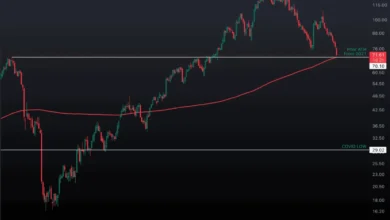
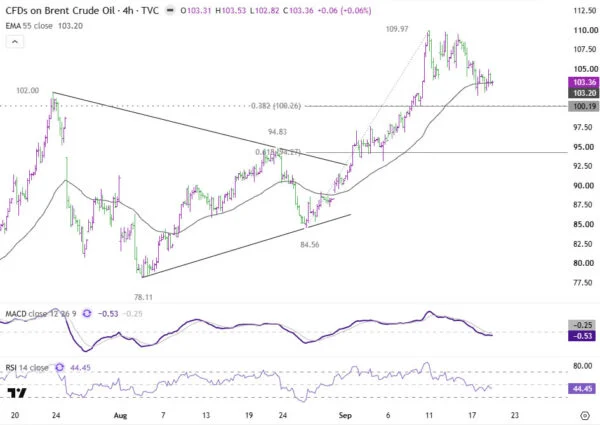
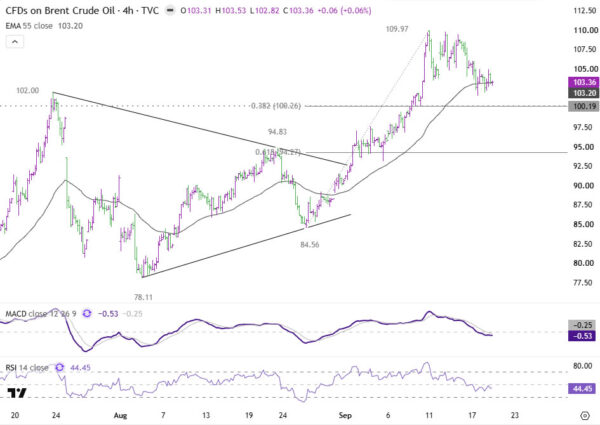
Brent crude recently retreated from a late-week peak of 109.97, though technical analysts emphasize that this downward correction has not yet disrupted the broader bullish market structure. A formidable technical support zone has formed between the psychological $100 level and the 38.2% Fibonacci retracement of the major advance from 84.56 to 109.97, located at 100.26. The convergence of a round-figure milestone and a key mathematical retracement endows this region with substantial technical and psychological significance.
As long as the $100 to 100.26 support band holds firm, the recent retreat from 109.97 remains classified as a routine correction within a larger upward cycle originating at 84.56. A renewed bullish breakout clearing 109.97 would immediately reopen the technical trajectory toward the 119.50 cycle high. However, a clean, sustained break beneath the $100 floor would serve as the first concrete warning that the energy correction is deepening. A subsequent breakdown below the 61.8% retracement level at 94.27 would provide definitive evidence that the broader structural uptrend has reversed.
Macroeconomic Implications and Chronology of the Market Sequence
The unfolding macroeconomic narrative follows an unusually clear transmission sequence. The foundational shock originated in the boardroom of the Federal Reserve, where Chair Kevin Warsh’s calculated rhetoric reframed the central bank’s policy stance as actively accommodative. This communication successfully altered market psychology, prompting an aggressive repricing of front-end debt instruments.
The chronology of the resulting market reaction highlights the interconnected nature of global asset classes:
- Central Bank Communication: Chair Warsh characterizes the latest rate hike as the removal of accommodation, establishing a hawkish baseline that discounts labor market softening.
- Derivatives and Yield Response: Fed Funds futures price in an accelerated timeline for near-term hikes, while the 2-year Treasury yield surges past technical resistance to test 4.756%.
- Foreign Exchange Impact: The Dollar Index rallies on the back of yield differentials, running directly into major Fibonacci resistance at 100.58.
- Upstream Energy Resolution: The entire macroeconomic architecture awaits the outcome of Brent crude’s test of the $100 to 100.26 support corridor.
If Brent crude successfully defends its support level and stages a rebound, energy-driven inflation pressures will persist, validating the hawkish implications of Warsh’s commentary and forcing long-term futures to catch up with front-end yields. Under this scenario, the 2-year Treasury yield would likely clear its 4.800% resistance barrier with genuine policy confirmation, propelling the Dollar Index toward its prior highs.
Alternatively, a breakdown in energy prices below $100 would alleviate upstream cost pressures, removing the necessity for aggressive monetary tightening and paving the way for a sharp mean-reversion across bond and currency markets. For now, institutional investors remain locked in a waiting game, monitoring technical inflection points across the energy, debt, and foreign exchange complexes to determine the true ceiling of the current tightening cycle.