Gold Shatters Records: Spot Prices Surge Above $5,200 Amid Safe-Haven Demand and US Dollar Depreciation

Gold spot prices have officially entered uncharted territory, surging past the historic threshold of $5,200 per ounce for the first time in history. Driven by a potent combination of macroeconomic reallocation, a structurally weaker United States dollar, shifting monetary policy expectations, and persistent geopolitical friction, the precious metal has appreciated by more than 20% since the beginning of the year. This dramatic rally marks a watershed moment for global commodity markets, reflecting a profound shift in how institutional and retail investors perceive risk, currency stability, and the future trajectory of global finance.
The remarkable ascent of gold is not merely a localized commodity spike; it is symptomatic of a broader, systemic repositioning away from traditional dollar-denominated assets. As market participants navigate a late-cycle economic environment characterized by heightened volatility, inflationary crosscurrents, and shifting political landscapes, the traditional safe-haven characteristics of gold have reasserted themselves with unprecedented force.
The Anatomy of a Crisis of Confidence in the US Dollar
At the core of the current gold bull market is the precipitous decline of the US dollar. Currently hovering near a four-year low, the greenback is facing what many currency strategists describe as a nascent crisis of confidence. For decades, the US dollar has reigned supreme as the undisputed global reserve currency and the ultimate store of value. However, recent shifts in official fiscal and monetary discourse—marked by an apparent tolerance for currency depreciation among policymakers—have fundamentally altered market psychology.
The prevailing narrative in international financial capitals is that Washington is increasingly comfortable with a weaker dollar as a mechanism to support domestic manufacturing and ease export pressures. This perceived policy pivot has dealt a psychological blow to holders of dollar-denominated debt and cash equivalents. Consequently, institutional capital has aggressively rotated out of the greenback and into non-dollar stores of value.
Because gold and the US dollar maintain a historically strong inverse relationship, the weakness in the American currency has translated into relentless, structural buying of spot metals. Central banks, sovereign wealth funds, and large asset managers have steadily increased their bullion allocations, insulating their portfolios against the diminishing purchasing power of fiat currencies.
Federal Reserve Policy Expectations and Declining Yields
Adding fuel to the fire are evolving expectations surrounding United States monetary policy. While the Federal Reserve has maintained a cautious approach to immediate rate adjustments, market positioning has decisively tilted toward a lower-rate trajectory over the medium term. This anticipated policy easing has gained momentum as markets look ahead to the confirmation of a new Federal Reserve chair, whose policy leanings are widely anticipated to favor a more accommodative stance.
The prospect of declining nominal and real yields drastically reduces the opportunity cost of holding non-yielding physical assets. In a high-interest-rate environment, investors often favor yield-bearing instruments such as Treasury bonds over gold, which incurs storage costs and offers no coupon. However, as the yield curve slopes downward and real interest rates compress, the relative attractiveness of gold surges.
This monetary shift is further underscored by recent economic indicators. Weak consumer confidence readings, combined with definitive signs of softness in the labor market, have reinforced the argument for policy normalization and eventual easing. These macroeconomic headwinds for the broader US economy serve as powerful tailwinds for the precious metals complex, validating the bullish thesis held by long-term investors.
Geopolitical Friction and the Persistent Safe-Haven Premium
Beyond monetary and currency dynamics, geopolitical risks continue to provide a durable, impenetrable layer of support for gold prices. The contemporary global landscape is fraught with structural instabilities, ranging from protracted regional conflicts and shifting military alliances to escalating trade frictions and economic fragmentation.
In times of elevated geopolitical tension, capital naturally flees toward safety. The current market cycle has seen numerous instances where geopolitical flashpoints have triggered swift, momentum-driven spikes in spot gold prices. Crucially, unlike previous eras where such spikes were temporary, the current market has consistently held its gains. This sticky price action indicates deep underlying conviction among market participants, who view geopolitical volatility not as a transient shock, but as the defining characteristic of the new global order.
Technical Price Analysis: Bullish Momentum Remains Unchecked
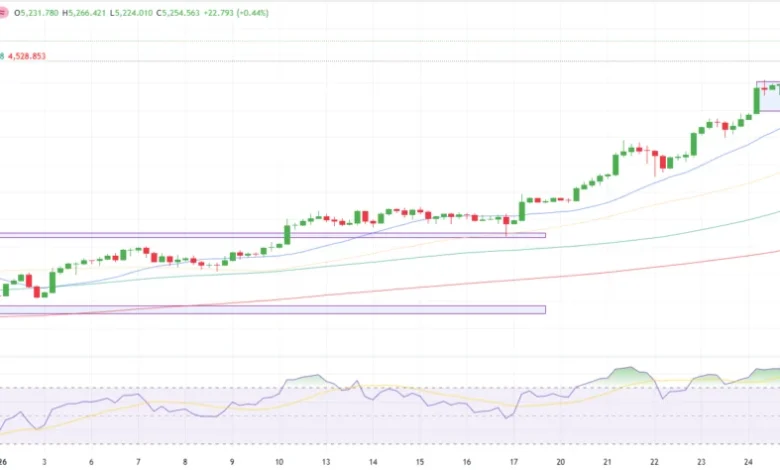
From a technical perspective, the market shows little sign of immediate exhaustion, despite trading in heavily overbought territory. On the 4-hour chart, spot gold prices are comfortably positioned above a tightly stacked sequence of key moving averages, signaling an exceptionally strong and resilient bullish trend.
Market analysts are closely monitoring the $5,300 level as the next psychological and technical upside target. While minor, localized profit-taking is anticipated as the asset approaches these round numbers, the broader structural configuration favors continued accumulation.
Should the market experience a corrective pullback, technical support is well-defined. The initial line of defense is expected around the order block zone near $5,100. Below that, the 20-period moving average, currently tracking near $5,060, offers a formidable dynamic barrier. Further downside protection is anchored by the major psychological support level at $5,000. Unless prices find sustained acceptance below the 20-period moving average, the technical bias for spot gold remains firmly anchored in a "buy-the-dip" paradigm.
Broader Market Implications and Future Outlook
The milestone breach of $5,200 per ounce carries profound implications for global financial markets, portfolio management, and the architecture of international trade. For institutional investors, the relentless strength of gold underscores the necessity of robust diversification strategies in an era of sovereign debt expansion and currency debasement.
As central banks worldwide continue to diversify their foreign exchange reserves away from the dollar—a multi-year trend accelerated by recent geopolitical sanctions and financial weaponization—official sector buying is likely to remain a structural floor for prices. Furthermore, retail participation, facilitated by accessible financial instruments such as exchange-traded funds (ETFs) and digital bullion platforms, has democratized access to the asset class, broadening the demand base far beyond traditional institutional players.
Ultimately, the late-cycle, volatility-rich environment that characterizes the current global economy appears structurally optimized for a strong gold market. With currency depreciation accepted as a policy trade-off, monetary policy slated for an easing cycle, and geopolitical fault lines deepening, gold has cemented its role not merely as an alternative asset, but as the premier barometer of systemic financial anxiety. As market participants navigate this unprecedented pricing regime, the yellow metal stands as the ultimate arbiter of value in a shifting global economic paradigm.