CASE STUDY | The Coinbase TerraUSD Lawsuit Shows Why Token Listing Disclosures Matter

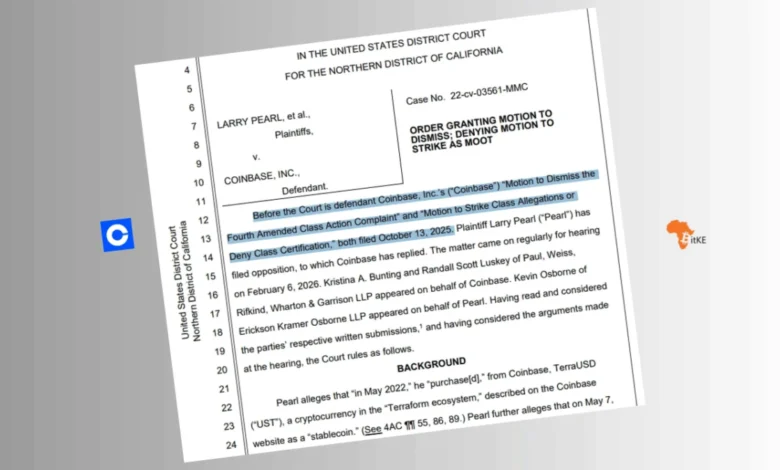
A California federal court has officially dismissed a high-profile class-action lawsuit accusing major cryptocurrency exchange Coinbase of misleading consumers regarding its past offerings of TerraUSD (UST), the algorithmic stablecoin whose catastrophic collapse in May 2022 wiped out billions of dollars in market value and triggered a sweeping industry-wide contagion. The ruling, handed down without leave to amend, provides a crucial legal precedent and a vital case study for centralized and decentralized digital asset platforms navigating the complex intersection of regulatory compliance, consumer protection, and token listing due diligence.
The plaintiff in the lawsuit alleged that Coinbase bore liability for investor losses because the exchange allegedly failed to adequately warn buyers that TerraUSD was not a traditional fiat-backed stablecoin secured by cash reserves in regulated bank accounts. Instead, the legal challenge pointed out that UST relied heavily on an inherently volatile, algorithmic relationship with its sister token, LUNA, to maintain its targeted one-to-one peg with the United States dollar. Furthermore, the complaint argued that UST constituted an unregistered security under United States federal law, asserting that Coinbase either sold the asset directly or actively facilitated its distribution through misleading marketing materials and platform listings.
However, United States District Court judges firmly rejected these arguments. The court found that Coinbase’s publicly available documentation, user agreements, and asset disclosures had sufficiently informed customers about the operational mechanics of TerraUSD. Specifically, the exchange’s literature made it clear that UST was not backed by fiat currency reserves and that its stability mechanism depended on a dynamic burning and minting process involving LUNA. Because the platform had provided adequate disclosures regarding these underlying operational dependencies and associated risks, the court concluded that the plaintiffs could not sustain a claim of fraud or misleading trade practices.
Furthermore, the court swiftly dismissed the securities-related claims brought forward by the plaintiff. The judicial review determined that the legal team failed to establish that TerraUSD qualified as a security under the statutory boundaries of the historic Howey test. Most notably, the plaintiff failed to adequately demonstrate the existence of a common enterprise or a reasonable expectation of profits derived primarily from the entrepreneurial or managerial efforts of others—a foundational threshold required to classify a digital asset as a security under United States federal securities jurisprudence.
Background Context: The Anatomy of the Terra-LUNA Collapse
To fully appreciate the significance of the California court’s ruling, one must revisit the unprecedented market events of May 2022, which fundamentally transformed the regulatory and legal landscape of the digital asset industry. TerraUSD (UST) was designed as a decentralized algorithmic stablecoin developed by Terraform Labs, a South Korean blockchain enterprise founded by Do Kwon. Unlike centralized stablecoins such as Tether (USDT) or USD Coin (USDC), which maintain dedicated reserves of cash, cash equivalents, and short-term US Treasury bills to back every token in circulation, algorithmic stablecoins utilize software code, economic incentives, and companion tokens to defend their price pegs.
In the case of the Terra ecosystem, whenever the price of UST rose above one dollar, arbitrageurs were incentivized to burn LUNA tokens to mint new UST, thereby increasing supply and driving the price back down. Conversely, when market demand dropped and the price of UST fell below its dollar peg, holders could burn UST to mint LUNA, reducing the circulating supply of UST and theoretically restoring its parity. For a prolonged period, this reflexive loop functioned effectively during a roaring bull market, attracting institutional and retail investors seeking attractive yields through decentralized finance (DeFi) protocols like Anchor, which famously promised algorithmic yields of up to 20 percent on deposited UST.
However, the architecture proved catastrophically vulnerable to macroeconomic tightening and coordinated capital flight. In early May 2022, massive withdrawals from the Anchor Protocol triggered a wave of selling pressure on TerraUSD, causing its price to break its crucial dollar peg. As panic intensified, the algorithmic mechanism backfired catastrophically. To defend the peg, the system printed staggering quantities of LUNA—hyper-inflating its supply—while burning billions of dollars worth of UST. Within a matter of days, the market value of both assets effectively evaporated, resulting in a staggering loss of approximately $40 billion to $60 billion in investor wealth, triggering liquidations across global crypto lenders, and precipitating a broader market downturn that ultimately claimed several prominent centralized lending firms, including Celsius Network and Voyager Digital.
The Evolving Legal Burden on Crypto Exchanges

The Coinbase ruling sheds critical light on the evolving legal standards governing cryptocurrency exchanges, brokers, and trading platforms. Historically, platforms operated under a relatively loose framework regarding token listings, often prioritizing asset availability, liquidity, and trading volume to capture lucrative transaction fees. As the digital asset market matured and regulatory agencies such as the U.S. Securities and Exchange Commission (SEC) and the Commodity Futures Trading Commission (CFTC) increased their enforcement footprint, platforms faced mounting pressure to scrutinize the digital assets they permit on their order books.
The judicial decision in the Coinbase case underscores a vital defensive strategy for crypto exchanges: the absolute necessity of transparent, comprehensive, and accessible user disclosures. By demonstrating that it clearly communicated the underlying architecture, collateralization model, and operational risks of TerraUSD to its user base prior to purchase, Coinbase successfully insulated itself from liability. Legal experts note that this establishes a powerful benchmark. While exchanges cannot be expected to predict the catastrophic failure of every protocol they list, they are increasingly expected to ensure that retail investors are not misled regarding the fundamental nature of the financial instruments they trade.
This ruling arrives at a time when the regulatory definition of digital assets remains a subject of intense global debate. While regulatory bodies frequently argue that a vast majority of digital tokens function as unregistered securities, courts continue to evaluate these claims on a strict case-by-case basis, applying established legal doctrines like the Howey test with rigorous scrutiny. The failure of the plaintiff in this case to satisfy the Howey criteria highlights the persistent legal hurdles faced by private litigants attempting to retroactively classify complex algorithmic tokens and stablecoins as securities without demonstrating a clear common enterprise and direct profit expectation tied to a centralized managerial team.
Broader Implications for Token Listings and Digital Asset Compliance
As the cryptocurrency sector expands into increasingly sophisticated financial instruments—ranging from algorithmic stablecoins and real-world asset (RWA) tokenization to complex decentralized finance (DeFi) derivatives and synthetic assets—the implications of the Coinbase court ruling extend far beyond a single closed lawsuit. The case serves as an urgent wake-up call for compliance departments, legal counsels, and listing committees across every major global digital asset exchange.
First, token listing due diligence must evolve beyond traditional anti-money laundering (AML) and know-your-customer (KYC) compliance. Platforms are now compelled to conduct deep architectural audits of prospective listings. Exchanges must evaluate and clearly articulate what backs an asset, how it maintains its peg or valuation, what secondary protocols or companion tokens it depends on, and precisely how it can fail under extreme market stress.
Second, the ruling emphasizes that product marketing and user interfaces must be meticulously aligned with reality. If a digital asset utilizes an experimental, volatile, or unconventional stabilization mechanism, platforms can no longer rely on generic disclaimers buried deep within lengthy terms of service agreements. Instead, proactive, plain-language risk disclosures tailored to specific asset classes may become an industry-standard best practice to protect against future litigation.
Finally, the decision serves as a sobering reminder to the broader investing public. The inclusion of a digital asset on a reputable, regulated, or major global cryptocurrency exchange does not constitute an official endorsement of safety, stability, or long-term financial viability. A token being listed for trading does not inherently make it stable, secure, or equivalent to the traditional financial products suggested by its marketing terminology or market branding.
As regulatory frameworks continue to crystallize across major jurisdictions in the United States, Europe, and Asia, the balance between consumer protection and financial innovation will heavily rely on transparency. The dismissal of the Coinbase lawsuit confirms that while exchanges bear a profound responsibility to inform their users, fully informed consent—backed by transparent disclosures—remains a formidable and legally sound defense in the volatile world of decentralized finance.
Related posts: