When Inflation Breaks the Market: Navigating the Worst-Case Scenario of Stalling Asset Values and Rising Consumer Costs

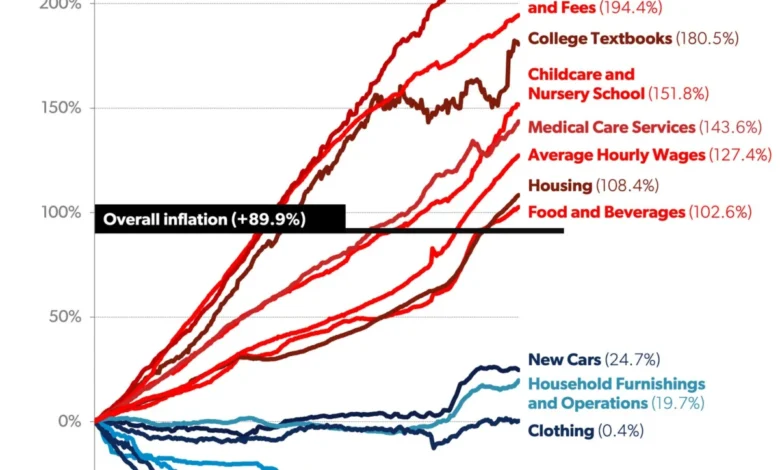
The unwritten economic contract that has governed household finances for much of the post-pandemic era has officially dissolved. For the past several years, consumers and investors maintained a tacit acceptance of persistent inflation, absorbing higher baseline costs for groceries, healthcare, and higher education. This consumer friction was largely offset by surging equity markets, rising real estate valuations, and high-flying private investments. The wealth effect cushioned the blow, allowing households to rationalize escalating living expenses against an expanding portfolio net worth.
That balance has now fractured. In the wake of recent midterm elections, headline inflation remains stubbornly elevated, yet capital markets have entered a synchronized downward correction. Equities, commodities, and digital assets are experiencing aggressive sell-offs, while commercial and residential real estate face delayed downward repricing. For wealth builders, retirees, and everyday earners, this convergence represents a macroeconomic worst-case scenario: contracting asset values occurring simultaneously with unrelenting consumer price pressures.

The Mechanics of the Broken Inflation Bargain
To understand the rapid shift in consumer and investor sentiment, financial analysts point to the math of portfolio erosion against baseline expenditures. Consider a household with a $1,000,000 investment portfolio and an annual cost of living of $120,000. With an inflation rate hovering around 3.7%, the household’s annual cost of living increases by approximately $4,400.
When equity markets routinely posted 20% annual gains, that same household realized a $200,000 portfolio expansion—equivalent to roughly 45 years of inflation-induced cost increases. Under those conditions, a $4,400 rise in living expenses was negligible.
However, as public equities correct downward by 12%, that identical household faces a $120,000 capital loss while its $4,400 annual inflation burden remains entirely intact. The wealth cushion has evaporated, leaving consumers to absorb higher baseline living costs while holding depreciated assets. This dynamic explains the sudden contraction in consumer confidence and the rapid onset of the reverse wealth effect, which historically accelerates much faster during market downturns than gains accumulate on the way up.

Catalysts of the Correction: Market Mechanics and Monetary Policy
The current market retracement was catalyzed by a confluence of political, sectoral, and monetary pressures. Following the midterm elections, which resulted in shifted congressional majorities, institutional investors began aggressively repricing forward expectations. Markets adjusted their outlook on capital-intensive technology investments, specifically scaling back aggressive timelines for artificial intelligence data-center buildouts and infrastructure spending.
This sentiment shift triggered severe drawdowns across the technology sector. Major benchmarks such as the Nasdaq-100 (QQQ) suffered historic weekly declines, marking some of the steepest sell-offs recorded since the onset of the pandemic-era volatility in March 2020. Concurrently, the S&P 500 retreated significantly from its autumn closing highs, bringing major indices to the doorstep of official bear market territory—defined as a 20% drop from recent peaks.
Adding to the complexity, the macroeconomic inflation indicators refuse to align with the Federal Reserve’s preferred trajectory. Recent consumer price index (CPI) reports demonstrated hotter-than-expected month-over-month increases, driven largely by volatile components such as energy and gasoline costs, which remain elevated compared to historical baselines. Despite softening equity valuations, market pricing has increasingly factored in the possibility of further Federal Reserve interest rate hikes. Tightening monetary policy into a decelerating equity market presents a classic policy conflict, amplifying downside volatility across risk assets.

Corporate Earnings Versus Valuation De-Rating
A critical distinguishing factor separates the current market correction from historical systemic shocks like the dot-com bust of 2000 or the global financial crisis of 2008. Despite collapsing share prices, underlying corporate earnings remain remarkably resilient. Major Wall Street institutions, including Goldman Sachs, project continued earnings growth for the S&P 500, with consensus estimates anticipating stable aggregate earnings expansion through the coming years.
Rather than a collapse in corporate profitability, the market is undergoing a valuation de-rating. The forward price-to-earnings (P/E) multiple of the S&P 500 has compressed significantly from its prior peaks above 23x down to approximately 16.5x.
Institutional analysts emphasize that this compression reflects a fundamental reassessment of risk premiums and growth expectations rather than an outright recession in corporate cash flows. Investors are no longer willing to pay premium multiples for speculative growth, demanding a higher margin of safety amidst elevated interest rates and geopolitical uncertainty.

If valuations mean-revert to their historical five- or ten-year averages, indexes retain modest upside potential based purely on earnings projections. Conversely, if earnings estimates are subjected to downward revisions due to corporate cost-cutting or delayed enterprise technology spending, indices face further downside risk before establishing a durable market floor.
Labor Market Implications and Corporate Restructuring
As asset prices decline and profit margins face scrutiny, corporate leadership teams typically pivot toward defensive cost management. The most immediate lever available to chief financial officers is workforce reduction.
Technology and financial sectors have already witnessed elevated layoff announcements over the past year, with artificial intelligence cited as an accelerating factor in workforce optimization. Market corrections of this magnitude historically trigger secondary waves of corporate restructuring. Historical precedents from major financial institutions indicate that initial workforce reductions frequently target redundancies, middle management, and high-cost operational units.

For the labor force, macroeconomic uncertainty necessitates strategic preparation. Career positioning increasingly relies on productivity enhancement, operational visibility, and adaptability. Professionals navigating volatile employment landscapes often utilize structured career transitions or negotiate severance arrangements proactively during periods of corporate realignment, securing financial bridges ahead of broader sector-wide layoffs.
Strategic Framework for Navigating High Inflation and Low Asset Values
Surviving a macroeconomic environment characterized by simultaneous inflation and asset depreciation requires a multi-pronged defensive strategy. Financial planners and market strategists recommend focusing on four core pillars:
1. Prioritizing Income and Job Security
In a bull market, portfolio appreciation can outpace primary salary earnings. In a stagflationary or corrective environment, employment income serves as the primary non-depreciating asset. Securing primary income streams, maximizing workplace value through efficiency tools, and building secondary revenue sources to offset baseline consumer expenses are critical risk-mitigation steps.

2. Defending Purchasing Power and Liquidity
Fixed-rate debt, such as long-term mortgages locked in during low-interest-rate eras, loses real value in high-inflation environments, making aggressive early payoff unnecessary for those maintaining healthy liquidity. Concurrently, higher interest rate environments provide attractive risk-free yields on short-term Treasury bills and money
market instruments, allowing cash reserves to generate meaningful returns while waiting for market stabilization.
3. Disciplined Valuation-Based Deployment
Rather than attempting to time absolute market bottoms, disciplined investors utilize forward P/E valuation thresholds to deploy capital in structured tranches. Risk tolerance quantification—calculating potential downside exposure in terms of months of earned income—ensures that equity allocations remain aligned with psychological and financial capacity, preventing panic selling during periods of maximum volatility.

4. Focusing on Controllable Variables
In periods when public markets fail to reward risk-taking, redirecting capital and energy toward tangible assets, home maintenance, family investments, and personal well-being reinforces an internal locus of control. Diversifying away from public equities into income-generating private assets, such as commercial real estate or data-center infrastructure that benefits structurally from long-term technological buildouts, provides a buffer against public market volatility.
Outlook and Broader Implications
Market corrections historically function as capital transfer mechanisms, reallocating resources from leveraged or impatient market participants toward disciplined, long-term investors. While the dual pressure of sticky inflation and lower asset valuations creates near-term financial friction, historical market cycles demonstrate that economic downturns are inherently cyclical.
The immediate priority for households and investors is not speculative wealth generation, but capital preservation, income security, and risk management. By maintaining liquidity, protecting primary earning power, and adhering to disciplined allocation strategies, market participants can position themselves to weather current volatility and capture the recovery when macroeconomic conditions ultimately stabilize.