Court-Ordered Domain Seizure Strips Radaris of Its Flagship Web Address in Landmark Daniel’s Law Enforcement Action


The opaque and often controversial consumer data broker industry has suffered a severe legal blow following a federal and state court crackdown that stripped the prominent people-search platform Radaris of its primary web domain. In an extraordinary enforcement action, a New Jersey court ordered the transfer of radaris.com—alongside more than a dozen associated properties—to the plaintiffs of a high-stakes privacy lawsuit. The judgment stems from repeated stonewalling, procedural evasion, and alleged willful violations of New Jersey’s stringent Daniel’s Law, a statute designed to protect the personal privacy and physical safety of law enforcement personnel, government officials, and the judiciary.
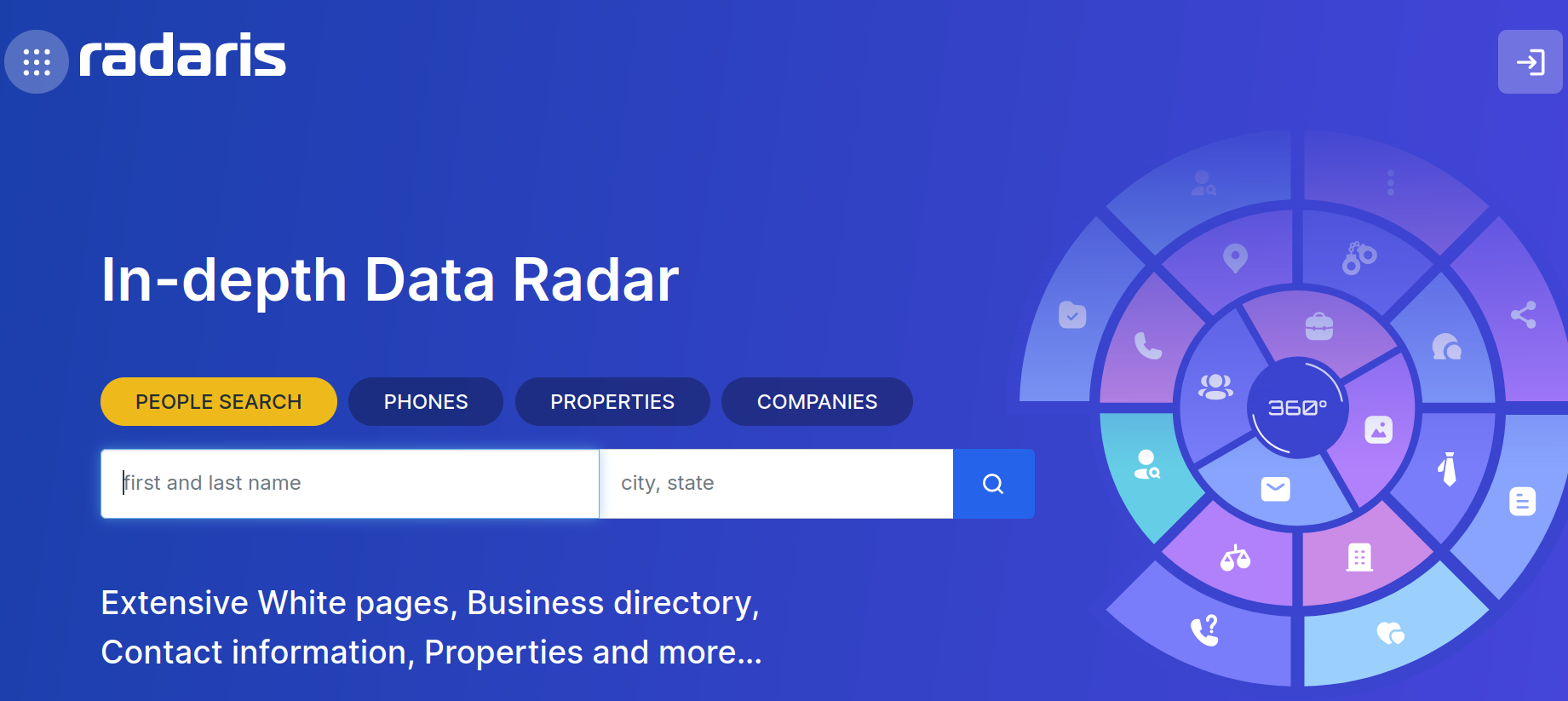
For years, Radaris maintained a reputation for ignoring consumer opt-out requests, allowing detailed personal dossiers of millions of Americans to remain accessible online despite mounting public backlash. That operational strategy unraveled in a New Jersey courtroom, where the presiding judge ordered domain registrar Verisign to hand over radaris.com to Atlas Data Privacy Corp, the firm spearheading the litigation. Today, visiting radaris.com no longer serves up commercial data-broker search results; instead, it redirects visitors to an official notice detailing the court-mandated transfer.
The Genesis and Enforcement of Daniel’s Law
Enacted in the wake of a tragic family shooting involving the son of a federal judge, Daniel’s Law provides robust protections for public servants in New Jersey. The statute explicitly prohibits commercial data brokers and people-search engines from publishing or redistributing personal identifying information—such as home addresses, personal phone numbers, and familial details—pertaining to judges, prosecutors, law enforcement officers, and other designated public personnel. Crucially, the legislation empowers affected individuals and proxy enforcement entities to seek statutory damages of $1,000 per violation against companies that fail to comply with removal demands.
In February 2024, Atlas Data Privacy Corp leveraged this statute to launch a sweeping legal assault against Radaris. Rather than cooperating or contesting the allegations on their merits, the operators of Radaris deployed a series of procedural delays and jurisdictional shell games designed to obfuscate ownership and exhaust the plaintiffs’ resources.
The Chronology of Evasion and Corporate Shell Games
The legal battle against Radaris highlights the complex, international architecture frequently utilized by modern data brokers to shield themselves from domestic accountability. Investigators and court filings reveal a decade-long pattern of structural shifting:
- 2017: Radaris temporarily lost a $7.5 million default judgment in a class-action lawsuit (Huebner v. Radaris, LLC) after failing to respond in court. When plaintiffs attempted to collect, the court ordered the transfer of the domain name. Radaris attorneys successfully appealed, arguing due process violations because the true owner, a Cyprus-based entity called Bitseller Expert Limited, had not been explicitly named.
- Post-2017: Following the successful appeal, operational control shifted from Bitseller to Andtop Company, an entity incorporated in the Marshall Islands in October 2020. Plaintiffs in that specific action chose not to refile, allowing the network to continue operations unabated.
- February 2024: Atlas Data Privacy Corp formally filed suit against Radaris under Daniel’s Law.
- March 2024: Investigative reports published by KrebsOnSecurity unmasked the Russian-born brothers Igor and Dmitry (also known as Dan) Lybarsky—Massachusetts residents—as the actual masterminds behind Radaris and a sprawling web of sister sites. Radaris legal representation initially threatened defamation lawsuits and claimed the company was genuinely owned by Ukrainians living in Ukraine, while simultaneously utilizing a fictitious CEO persona named "Gary Norden" for investor pitches.
- June 2025: Atlas refiled its lawsuit, dramatically expanding the scope of named entities to capture the broader family of interconnected data brokers. According to Atlas President and CEO Matt Adkisson, the defendants repeatedly utilized an "island-hopping" strategy, shifting administrative policies and corporate paper trails through offshore jurisdictions including the Marshall Islands, the British Virgin Islands, and the Seychelles. In one instance, when defense attorneys asserted a Marshall Islands entity managed the platform, local investigators discovered the designated corporation did not legally exist.
- August 2025: A New Jersey judge ruled that the defendants had been afforded ample opportunity to defend themselves but repeatedly defaulted. Consequently, the court ordered the forfeiture and transfer of radaris.com and 13 sister domains to Atlas.
Uncovering the Corporate Web via Document Discovery
During the course of the litigation, Atlas reportedly secured more than 10,000 internal emails, financial records, and operational documents. According to summaries provided by the plaintiffs, this documentary cache—corroborated independently by banks, payment processors, hosting providers, and software vendors—dismantled the illusion of independent corporate entities.
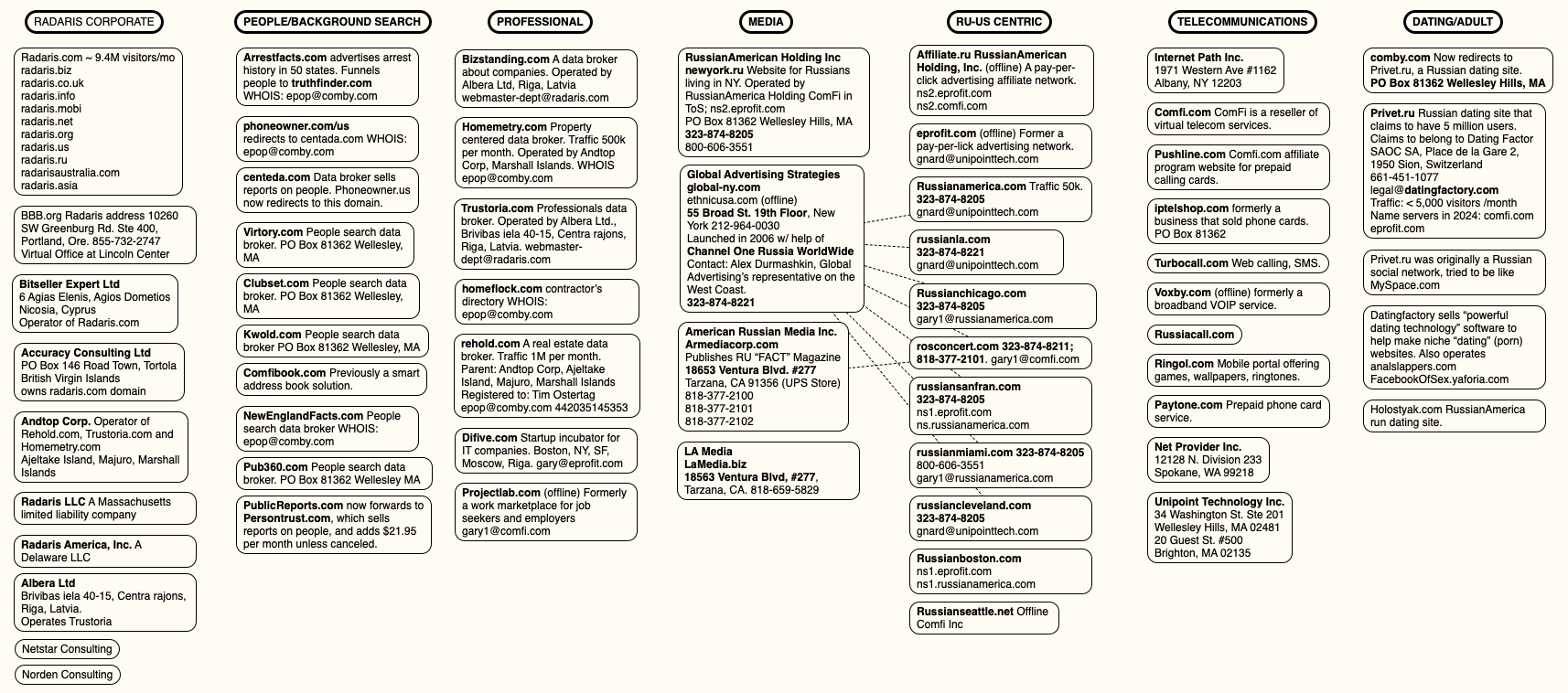
The discovery documents established that nominal corporate vehicles—including Radaris America, Inc., Bitseller Expert Limited, Digital Orbit Corp, Core Solutions Group Inc, Lucky Solutions Inc, Virtura Corp, Veripages Inc., Nuform Solutions Inc., Growth Data Advisors Inc., and Property Experts, Inc.—were administered by the same core group of individuals. These entities shared centralized financial accounts, payment card processing sets, virtual office addresses, and technical infrastructure managed via specific mail domains such as difive.com, centerex.com, and realmo.com.
Financially, the network operated at a high volume. Internal communications indicated that Radaris.com generated approximately $42,000 monthly, while sister site Veripages.com pulled in roughly $45,000 per month through affiliate partnerships with major marketing entities like the Lifetime Value Company (operator of PeopleLooker, PeopleSmart, and Bumper). Furthermore, investigators found evidence of lucrative financial arrangements with prominent privacy-removal services, including Onerep, highlighting a controversial industry loop wherein consumer data brokers profit simultaneously from publishing personal records and assisting users in removing them.

Legal Defense and Constitutional Challenges
Despite the decisive rulings in New Jersey, the legal war is far from over. Victor Worms, legal counsel representing the defense, has mounted an aggressive pushback against the default judgments. Worms argued that the New Jersey court erred fundamentally by executing a domain transfer against "Radaris.com," which he contends is a non-legal entity rather than a registered corporate person.
"We have made a motion to vacate that default judgment on the grounds that it is void since a non-entity has no legal capacity to sue or be sued," Worms stated, adding that the defense intends to pursue all available appellate pathways because the forfeiture violates foundational constitutional principles.
Meanwhile, the broader data broker industry has mobilized collectively against Daniel’s Law. Roughly 150 consumer data broker firms targeted by Atlas lawsuits have coordinated a massive constitutional challenge, successfully moving at least 70 of the cases into federal court. The core argument rests on First Amendment protections, with data brokers asserting that state-level statutes restricting the publication of public records are overly broad and infringe upon commercial speech rights.
The ultimate resolution of this constitutional showdown is widely anticipated to reach the U.S. Supreme Court, particularly given the regional legal friction. While a federal district court in West Virginia ruled that state’s version of Daniel’s Law facially unconstitutional under the First Amendment in August 2025, at least 14 other states have enacted similar statutes, and numerous others are weighing legislation.
Broader Implications for 21st-Century Digital Privacy
The Radaris enforcement action underscores the severe limitations of piecemeal state privacy legislation in an era of ubiquitous data harvesting. Privacy experts point out that while state-level statutes offer vital protections for specific professional classes like law enforcement, they leave the general public entirely exposed due to statutory exemptions for "public" or government records.
Justin Sherman, a privacy researcher and author focusing on the data broker industry, noted that federal legislative efforts continue to face intense lobbying headwinds from powerful technology sectors, social media giants, cryptocurrency enterprises, and artificial intelligence proponents. According to Sherman, arguments claiming that data-scraping limitations will cripple economic competitiveness under international pressure have repeatedly stalled comprehensive federal reform.
Furthermore, the lack of federal data protection standards leaves critical digital infrastructure vulnerable to widespread exploitation. Observers frequently link the unregulated collection of public and identity verification documents—such as driver’s licenses—to massive commercial and dark-web data breaches, highlighting that targeted state laws alone cannot fix systemic vulnerabilities in the digital ecosystem.
As the legal battles surrounding Radaris proceed through appellate courts and the Third Circuit weighs the constitutionality of Daniel’s Law, the case stands as a watershed moment for digital privacy enforcement. It demonstrates that while offshore shell companies and procedural stonewalling can stall accountability for years, determined legal adversaries can pierce corporate veils, disrupt core operational infrastructure, and fundamentally alter the landscape for predatory people-search engines.