Leveraging DeepSeek as a Risk Management Engine for Algorithmic Trading Strategies

The landscape of algorithmic trading has undergone a paradigm shift as developers move away from using Large Language Models (LLMs) as predictive engines for market direction—a task notoriously prone to failure—and toward utilizing them as sophisticated risk management supervisors. Recent research, including analysis from experts like E.P. Chan, underscores that while predicting the next day’s returns for liquid, large-cap equities such as Apple (AAPL) remains statistically elusive, LLMs excel at the nuanced categorization of market regimes. By shifting the objective from "predicting direction" to "assessing risk exposure," traders are finding new ways to calibrate portfolio positioning based on historical state-based performance metrics.
The methodology, pioneered by practitioners like José Carlos Gonzáles Tanaka, involves a multi-layered architecture where the LLM functions as an intelligent decision-maker. This approach effectively decouples the task of forecasting price movement from the vital function of capital allocation.
The Evolution of Regime-Adaptive Trading
Traditional quantitative strategies often rely on rigid, rule-based thresholds that fail to account for the qualitative shifts in market sentiment. For example, a simple volatility threshold might trigger a sell signal during a flash crash, but it may also exit a position prematurely during a healthy bull market correction. By contrast, an LLM-based approach processes a suite of technical indicators—such as rolling mean returns, standard deviations, and Sharpe-like performance scores—and maps them to distinct market states.
In this model, the LLM evaluates the historical "mood" of the market. When provided with a summarized table of data representing different regimes, the model determines whether the current environment warrants a fully invested position or a defensive, risk-off stance. This transition from "next-day prediction" to "risk-management policy" acknowledges the fundamental limitation of current AI models: they cannot see the future, but they can be exceptionally effective at interpreting the present through the lens of history.
Chronology and Methodology of the Walk-Forward Loop
To maintain integrity and prevent the common pitfalls of backtesting, such as lookahead bias or over-optimization, this strategy utilizes a monthly walk-forward loop. Since January 2023, the testing framework has followed a strict, out-of-sample (OOS) protocol:
- Training Window: At the start of every month, the model ingests three years of preceding historical data.
- Policy Generation: The LLM analyzes this data to generate a "policy table," which maps specific market states to exposure levels (e.g., 50%, 80%, or 100% long).
- Guardrail Calibration: Thresholds for volatility and drawdown stops are re-optimized based on the most recent market regime to ensure the safety net remains responsive.
- Execution: The model implements the position for the following month, with no lookahead. This ensures that the equity curve remains a true reflection of how the strategy would have performed in a live environment.
Integrating Hard Guardrails to Prevent Catastrophic Loss
The LLM-based policy is augmented by a secondary layer of "hard guardrails." These automated triggers are designed to protect capital when the market enters territory for which there is no historical precedent—such as sudden liquidity events or macro-economic shocks.
The strategy utilizes two primary triggers:
- Volatility Stop: If realized volatility spikes in tandem with short-term acceleration, the system automatically deleverages.
- Drawdown Stop: If the strategy’s cumulative equity falls beyond a predefined limit, coupled with a breach of the 50-day moving average, the system defaults to a flat position.
A critical innovation in this architecture is the "re-entry mechanism." Many algorithmic strategies suffer from a "deadlock" where a drawdown stop triggers a flat position, causing the equity to freeze and preventing the strategy from ever recovering. By implementing a forced re-entry after a set period—typically 10 to 20 days—the system ensures that the algorithm remains active, allowing it to resume participation in market drift once the immediate period of turbulence has passed.
Performance Analysis: Data-Driven Insights
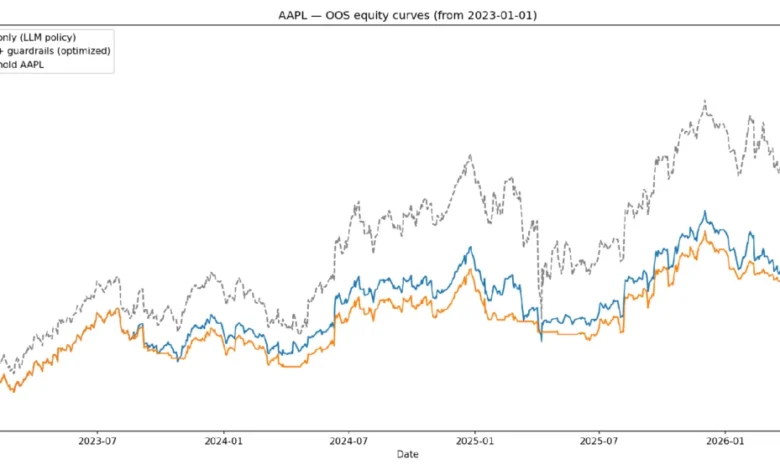
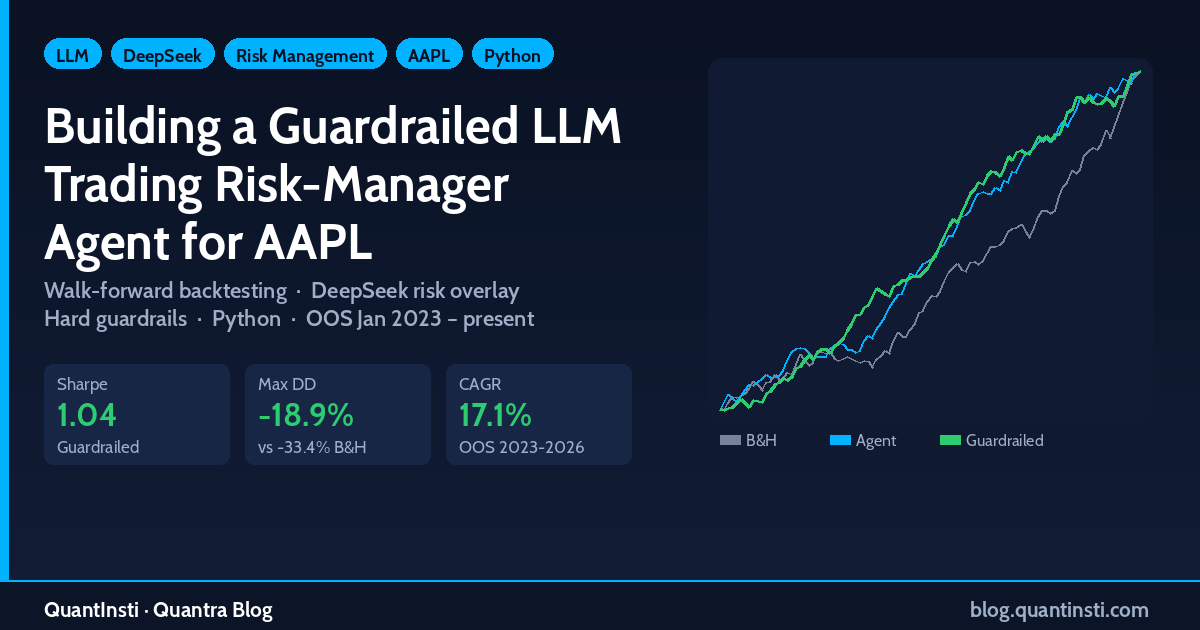
Data from the January 2023 to 2026 period indicates that while the strategy does not consistently outperform a passive "Buy and Hold" approach in terms of raw Compound Annual Growth Rate (CAGR), it offers significant advantages in risk-adjusted performance.
For instance, the strategy often achieves a maximum drawdown reduction of approximately 45% compared to a static buy-and-hold index strategy. During periods of intense market stress, the guardrails successfully trim exposure before losses compound. This suggests that the primary value proposition of LLM-integrated trading is not alpha generation, but rather the preservation of capital and the smoothing of equity curves.
Technical Implications and Implementation Challenges
The successful deployment of such a system requires rigorous data hygiene. For assets like AAPL, which have undergone multiple splits since the 1990s, the use of auto_adjust=True in data acquisition is mandatory to prevent artificial return spikes from poisoning the volatility calculations.
Furthermore, the choice of the LLM prompt is decisive. By explicitly instructing the model to "default to a long position" and "refrain from predicting direction," developers can effectively mitigate the tendency of the model to become overly conservative. The cost of running these inferences via modern APIs, such as DeepSeek, is relatively low—often under $0.10 for a full backtest run—making the framework accessible to independent researchers and institutional analysts alike.
Future Research Directions
The current implementation serves as a foundational prototype, with several avenues for improvement currently being explored by the quant community:
- Macro-Regime Filtering: Incorporating S&P 500 index movement as a global context filter for single-stock trading.
- Earnings Blackout Windows: Automatically forcing flat positions around known corporate earnings dates to avoid gap risk.
- Comparative Multi-Model Analysis: Running the same policy prompt through multiple models (e.g., GPT-4o, Claude, and DeepSeek) to determine if consensus between AI models produces more robust risk decisions.
- Continuous Sizing: Shifting from discrete 50/80/100% exposure levels to a continuous [0, 1] output to allow for more granular capital allocation.
Institutional Context and Ethical Considerations
As AI-driven trading models become more prevalent, the financial industry faces a growing need for transparency in how these models reach their conclusions. The use of strict JSON output formats for policy tables is a step toward "explainable AI" (XAI) in trading. By auditing the LLM’s decision logs, developers can verify that the strategy’s actions were based on defined logic—such as a high-volatility state—rather than arbitrary noise.
However, industry experts continue to caution that these tools remain, at their core, probabilistic engines. The reliance on LLMs should be balanced by human oversight and, more importantly, by hard-coded financial guardrails that operate independently of any generative model.
Conclusion
The synthesis of LLMs and traditional quantitative backtesting represents a move toward more "human-aware" algorithms. By reframing the LLM’s role from a forecaster to a risk manager, traders can harness the analytical power of large models to navigate complex market regimes. While the strategy currently functions as a supplementary tool for risk modulation, the trajectory of this technology suggests that as signal quality improves through better feature engineering and more sophisticated prompt architecture, the potential for AI-managed portfolios will continue to expand. For now, the framework provides a robust, transparent, and honest methodology for any participant looking to integrate LLMs into a disciplined, data-backed investment process.