Fiduciary Grade AI and the Transformation of Regulated Professional Workflows in Financial Services

The integration of artificial intelligence into highly regulated sectors is proceeding under a set of conditions that differ fundamentally from the broader consumer technology market: a mandate for zero tolerance regarding error. In the realms of financial services, legal counsel, tax preparation, and corporate auditing, partial accuracy is not merely a technical limitation; it represents a catastrophic compliance failure. For these industries, the stakes of AI adoption involve not only operational efficiency but also the preservation of regulatory standing, financial stability, and institutional reputation.
The economic pressure driving this transition is substantial. According to research published by the National Bureau of Economic Research (NBER), the average firm in the United States allocates between 1.3 and 3.3 percent of its total wage bill specifically to regulatory compliance. This burden is not static; it has grown significantly over the past decade and varies sharply based on industry complexity and firm size. As the volume of global regulation increases, the manual labor required to maintain compliance has become a primary bottleneck for growth, leading many institutions to view AI as an existential necessity rather than an optional upgrade.
However, the path to implementation is fraught with technical hurdles. Researchers at Stanford University recently conducted rigorous testing of general-purpose large language models (LLMs) against verifiable legal queries. The study uncovered hallucination rates ranging from 58 to 88 percent. These findings highlight why off-the-shelf AI solutions remain fundamentally unfit for high-stakes professional work without the implementation of purpose-built safeguards and domain-specific training.
The Emergence of Fiduciary-Grade Standards
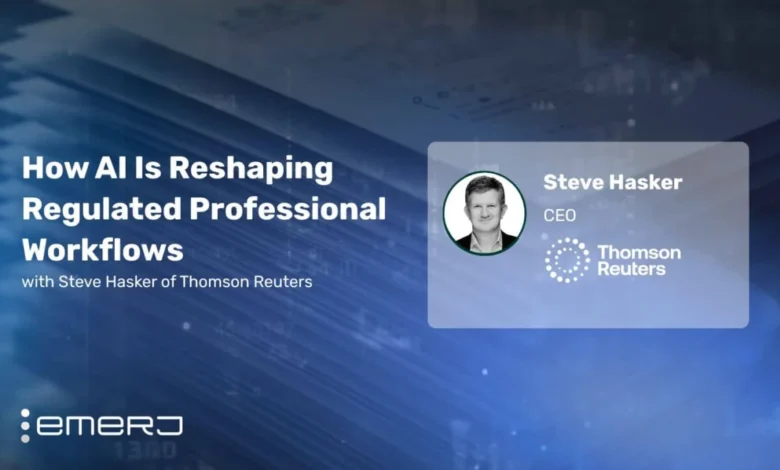
In a recent episode of the AI in Financial Services Podcast, Daniel Faggella, CEO and Head of Research at Emerj, hosted Steve Hasker, the CEO of Thomson Reuters, to discuss the evolution of "fiduciary-grade" AI. Hasker, who oversees one of the world’s most significant providers of professional information and technology, argues that regulated functions operate under accuracy standards that probabilistic, general-purpose AI systems were never designed to meet.
Fiduciary-grade AI refers to systems that provide precision, verifiability, and consistency—qualities that traditional LLMs often lack. In the legal and financial sectors, an incorrect output is more than an operational nuisance; it is a breach of the duty of care owed to clients and regulators. Consequently, the threshold for AI entry into core workflows is defined by whether machine-generated work can match the expectations placed on licensed human professionals.
Hasker emphasizes that while AI can significantly accelerate the drafting and analysis of complex documents, the output must be grounded in authoritative, verified content. For financial institutions, this means moving away from "black box" models toward systems that can cite their sources and provide a clear audit trail for every assertion made.
Chronology of AI Integration in Regulated Sectors
The journey toward fiduciary-grade AI has moved through several distinct phases:
- The Rule-Based Era (Pre-2010): Compliance relied on rigid, "if-then" logic systems and manual oversight. These systems were effective for simple screening but struggled with the nuance of legal language.
- The Machine Learning Wave (2010–2020): Institutions began using predictive analytics for fraud detection and risk scoring. While powerful, these models remained specialized and required massive, structured datasets.
- The Generative AI Breakthrough (2022–Present): The arrival of LLMs promised to handle unstructured text, which comprises the bulk of legal and regulatory work. However, the initial "hype" phase has been followed by a "realism" phase, where the focus has shifted to mitigating hallucinations and ensuring data privacy.
- The Fiduciary-Grade Pivot (Current): Industry leaders are now focusing on "Retrieval-Augmented Generation" (RAG) and specialized fine-tuning, ensuring that AI models operate only within the boundaries of verified professional datasets.
Automating the Investigative Burden in Regulatory Filings
One of the most immediate applications for AI in financial services is the preparation of regulatory filings. Large financial institutions routinely manage millions of pages of disclosures, audit inputs, and supporting documentation. This process is historically labor-intensive, repetitive, and carries significant legal risk.
Hasker notes that expert-driven AI applications are now capable of automating the "investigative burden" of these filings. By scanning vast repositories of corporate data and cross-referencing them with current regulatory requirements, AI can produce initial drafts and identify potential discrepancies in a fraction of the time required by human teams.
However, the accountability structure remains unchanged. Even as AI handles the document preparation, the final sign-off remains the responsibility of the Chief Financial Officer (CFO), General Counsel, or other senior executives. The AI does not replace the professional; it reduces the manual load that precedes expert judgment, allowing highly paid professionals to focus on high-value analysis rather than document sorting.
Addressing the Data Leakage and Privacy Mandate
A secondary but equally critical barrier to AI adoption is the "data handling" problem. The National Institute of Standards and Technology (NIST) AI Risk Management Framework identifies privacy concerns tied to training data as a core risk category. For a bank or a law firm, the prospect of client data being ingested into a public model’s training corpus is an existential threat.
For financial institutions, there is a hard requirement: vendors must provide ironclad guarantees that sensitive filings, tax records, and proprietary client data never become part of a model’s future training set. Most commercial, consumer-facing AI systems are not built to make such guarantees.
Hasker highlights that regulated institutions require "data isolation" protocols. This ensures that while a model may be used to analyze a sensitive document, the insights and data from that document are never "leaked" to other users or used to improve the general model. This "single-tenant" or "private instance" approach to AI deployment is becoming the standard for the professional services industry.
Explicit Accountability and Human-in-the-Loop Decision Making
The final pillar of fiduciary-grade AI is the preservation of accountability. In the conversation with Emerj, Hasker emphasizes that AI adoption ultimately comes down to who is responsible when something goes wrong. In regulated environments, responsibility for a legal opinion or a financial submission cannot be delegated to an algorithm.
This necessitates a "human-in-the-loop" architecture. Every machine-assisted decision must have an explicit sign-off requirement. Institutions are currently formalizing the boundaries between machine-supported preparation and human-led decision-making. This involves:
- Verifiable Citations: AI must point to the specific clause or regulation used to generate a recommendation.
- Audit Trails: Every interaction with the AI must be logged to show how a final document was reached.
- Liability Frameworks: Clear internal policies must define that the human professional remains the "ultimate authority," ensuring that the use of AI does not dilute the institution’s fiduciary duties.
Broader Implications and Industry Impact
The move toward fiduciary-grade AI is expected to reshape the competitive landscape of professional services. By reducing the cost of compliance and the time required for document-heavy tasks, AI may allow mid-sized firms to compete more effectively with global giants. Conversely, firms that fail to adopt these tools may find themselves priced out of the market as the "compliance tax" on their operations remains high.
Furthermore, the demand for "authoritative content" gives a significant advantage to companies that own vast, proprietary datasets. In the legal and tax world, the value is no longer just in the software, but in the verified data that prevents the software from hallucinating.
As regulators like the SEC and the European Banking Authority begin to issue their own guidelines on AI usage, the focus will likely remain on transparency and risk management. The consensus among industry leaders like Hasker is that AI will not replace the professional class, but it will fundamentally change the "workflow of the professional," shifting the emphasis from the collection of facts to the application of wisdom.
In conclusion, the adoption of AI in regulated industries is not a race to see who can implement the technology fastest, but rather who can implement it with the highest degree of integrity. By focusing on fiduciary-grade accuracy, robust data protection, and clear accountability, financial and legal institutions are setting a new standard for the responsible use of artificial intelligence in the modern economy.