Stocks vs Bonds: Evaluating Asset Class Performance Over the Next Decade

The fundamental question of whether equities or fixed-income securities will provide superior returns over the coming ten years has moved to the forefront of financial discourse, particularly as investors grapple with the aftermath of an extended period of aggressive market growth. During the recent Bogleheads conference held in Las Vegas, this inquiry highlighted a growing investor anxiety: after nearly two decades of a historic bull market, many market participants are questioning the sustainability of current equity valuations and the potential for a long-awaited mean reversion.
Historical Performance and Market Baselines
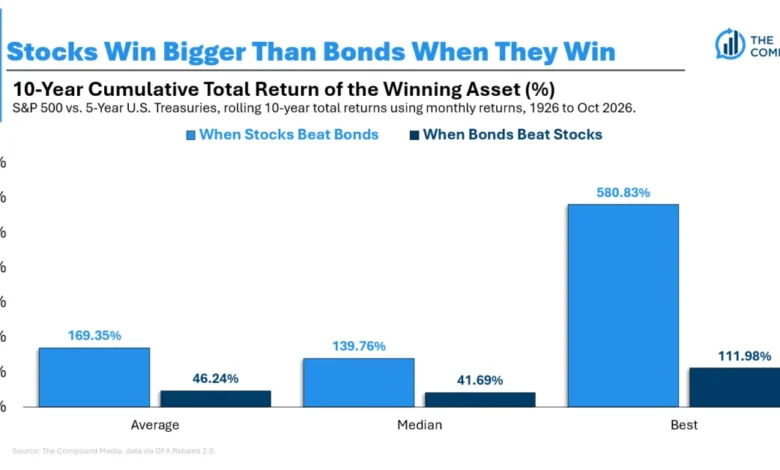
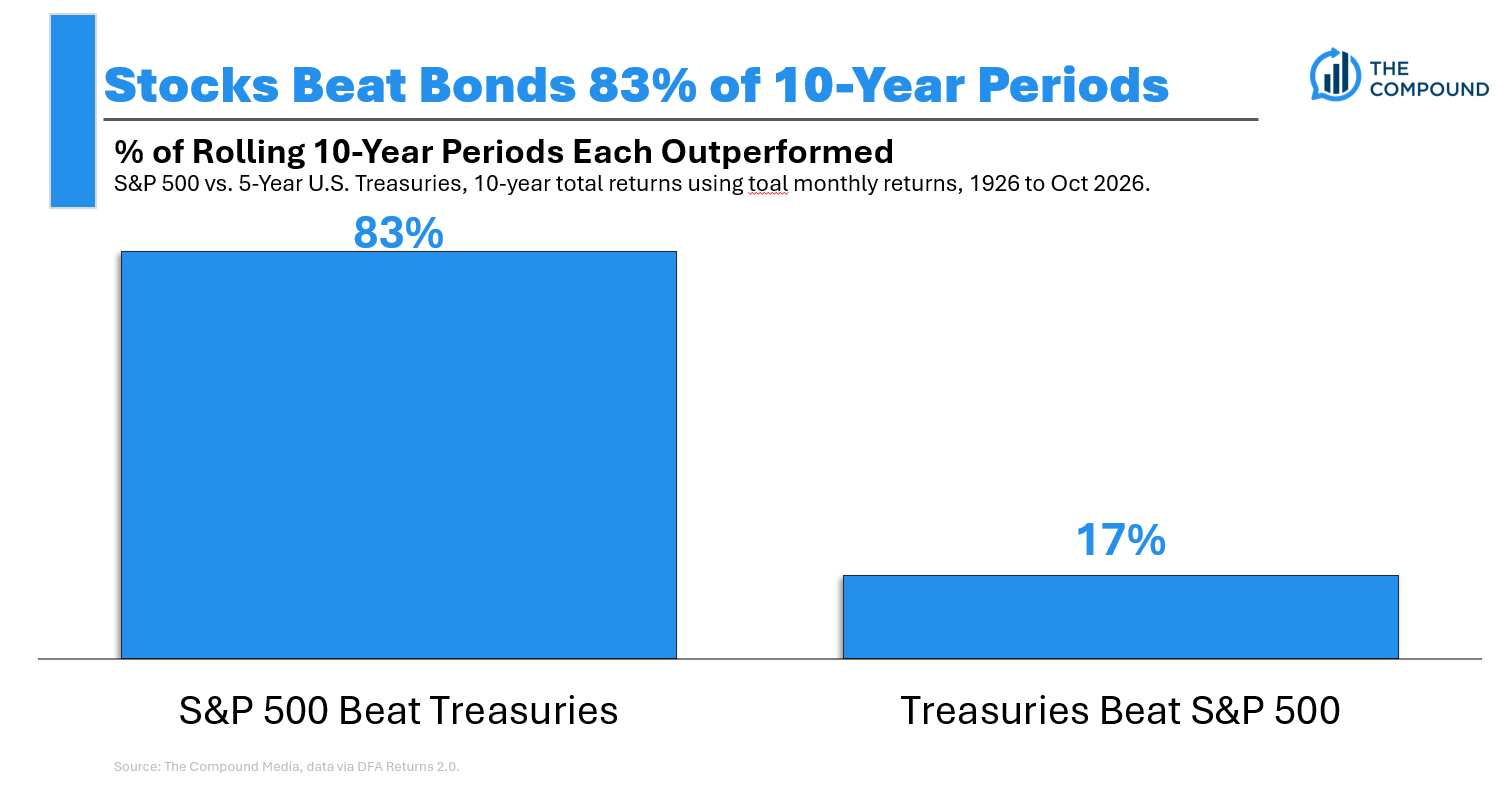
To understand the potential trajectories of these asset classes, analysts frequently look to historical data spanning back to 1926. This long-term view provides a necessary baseline for assessing risk and reward across different economic cycles. Historical analysis of rolling 10-year returns indicates that while stocks have consistently outperformed five-year Treasury bonds, this outcome is far from guaranteed.
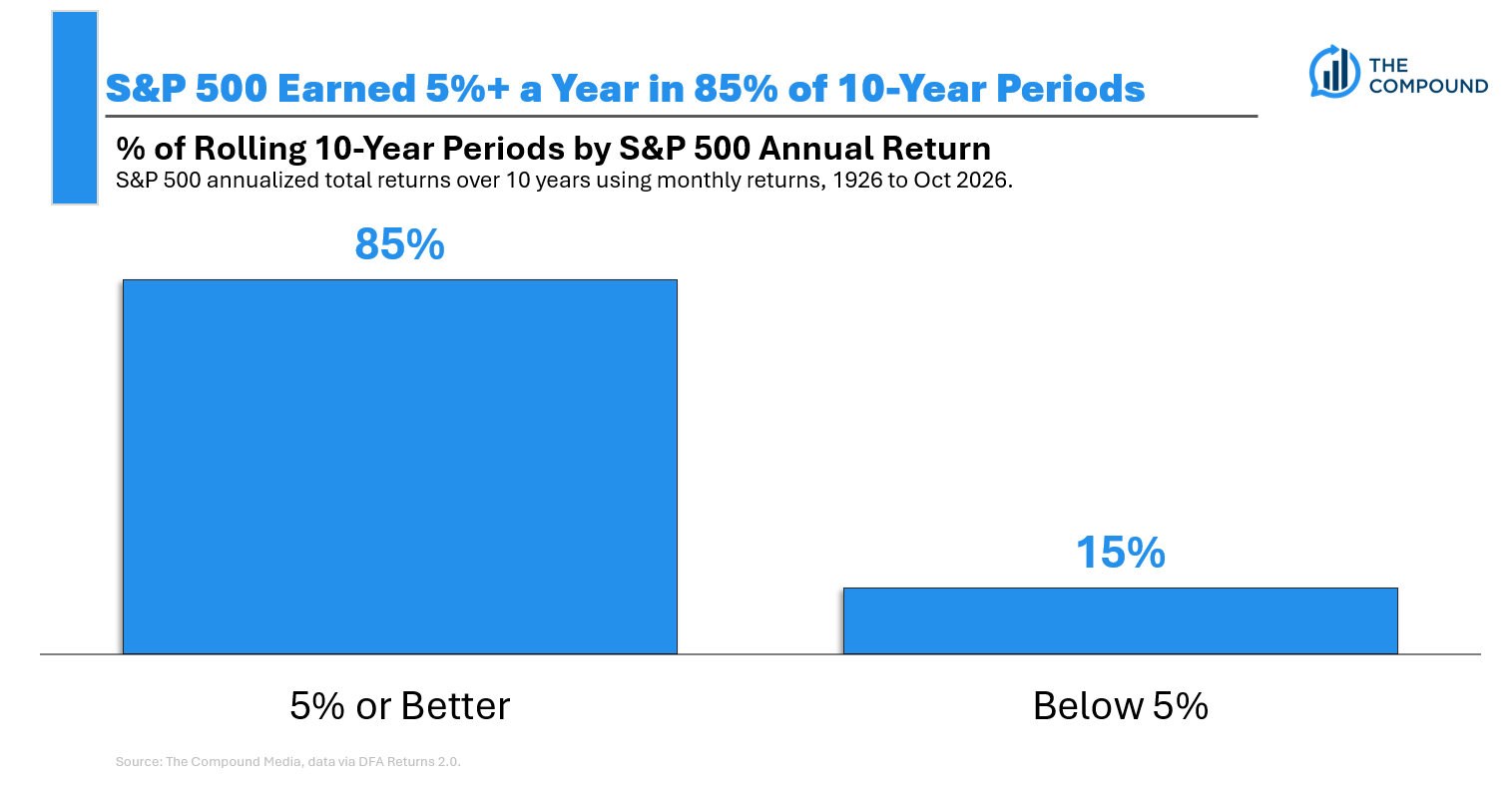
Data reflecting these 10-year windows demonstrates that there have been notable, albeit less frequent, periods where bonds have delivered higher returns than equities. However, the frequency of equity outperformance remains significant. When examining the probability of stocks exceeding a 5% annual return—a figure that roughly mirrors current government bond yields—equities have achieved this threshold in approximately 85% of all 10-year periods since 1926. While this suggests a high probability of success for long-term equity holders, the 15% of periods where returns failed to reach this benchmark represent years of stagnant or negative growth that pose significant challenges to portfolio stability.
Quantifying the Magnitude of Outperformance
The disparity between the two asset classes is most apparent when analyzing the magnitude of their respective victories. When stocks outperform bonds, the degree of that outperformance is typically much greater than the margin by which bonds occasionally beat stocks. This asymmetry underscores the inherent nature of equity investing: while the potential for loss exists, the ceiling for gains is significantly higher.
Conversely, bonds act as a volatility buffer. While their "wins" are rarely as dramatic as those of the stock market, they serve a critical function in capital preservation during periods of economic contraction. As interest rates have normalized, the "margin of safety" for fixed-income investors has improved, making bonds a more viable component of a diversified portfolio compared to the low-yield environment that characterized much of the previous decade.
The Context of a Generational Bull Market
The current apprehension regarding U.S. equities is grounded in recent performance data. As of late 2026, the S&P 500 has posted annual returns exceeding 15% over the trailing 10-year period. This trend extends to the 15-year window, and when measured from the cyclical lows of the 2009 financial crisis, the index has appreciated at nearly 17% per year for almost 18 years.
This prolonged period of expansion is widely categorized by economists as a "generational bull market." Such periods are characterized by their ability to defy conventional valuation metrics for longer than traditional models predict. However, historical precedent suggests that the eventual end of such extended bull runs often involves significant market corrections. The challenge for modern investors is to balance the optimism fueled by recent gains against the statistical reality that markets rarely move in a single direction indefinitely.
Expert Perspectives on Market Probability
At the Bogleheads conference, industry experts, including renowned financial author Bill Bernstein, emphasized the distinction between gambling and disciplined long-term investing. Bernstein’s assertion that long-term market participants essentially "become the house" highlights the advantage of patience. By capturing the equity risk premium over multiple decades, investors utilize the power of compounding and market growth, effectively putting the statistical odds in their favor.
However, even the "house" encounters losing hands. The consensus among financial professionals is that while stocks are statistically more likely to outperform bonds over the next decade, this is a statement of probability rather than a guarantee. For investors, the takeaway is not necessarily to choose one asset class over the other, but to determine the appropriate allocation that aligns with their specific risk tolerance and financial goals.
The Role of Diversification and Hedging
Given the uncertainty surrounding future market cycles, diversification remains the primary strategy for risk management. For those concerned about mean reversion in the equity markets, financial advisors increasingly point toward a broader array of investment vehicles. While bonds have their own set of risks—including duration risk and inflation sensitivity—they provide a necessary counterbalance to equity-heavy portfolios.
The integration of fixed income allows investors to navigate periods of volatility without the necessity of liquidating equity positions during a downturn. In the current interest rate environment, where yields are more attractive than they have been in years, fixed income has regained its status as a cornerstone of balanced investing.
Broader Financial Implications
The dialogue surrounding stocks and bonds also extends to the evolution of retail investment products. Discussions at the recent Bogleheads conference and in broader industry forums have touched upon the growing complexity of modern portfolios. Topics such as the rise of leveraged ETFs, the proliferation of options-income products, and the changing landscape of sector dominance—where technology has largely displaced the financial sector as the primary driver of market sentiment—are now critical components of the investor’s lexicon.
Furthermore, the shift in how families approach long-term financial planning, such as the utilization of specialized accounts for children’s futures, reflects a broader trend of increased financial literacy and strategic long-term thinking among retail investors.
Conclusion
As the market moves into the final years of the 2020s, the debate between equity-driven growth and fixed-income stability remains as relevant as ever. While historical data strongly suggests that the S&P 500 will likely continue to outperform bonds over a 10-year horizon, the reality of market cycles dictates that investors must remain prepared for periods of underperformance.
The most prudent approach appears to be one that acknowledges the high probability of equity success while maintaining a robust enough allocation to fixed income to mitigate the impact of inevitable market reversals. By focusing on long-term time horizons and maintaining a disciplined approach to asset allocation, investors can position themselves to weather the fluctuations of the next decade, regardless of which asset class ultimately claims the title of top performer. The primary lesson for the modern investor is that success is rarely defined by betting on the "winning" asset class, but by constructing a portfolio that can endure the volatility inherent in both.
Related posts: