The Unseen Foundation: How Financial Data APIs Power Modern Algorithmic Trading

In the intricate world of algorithmic trading, the spotlight often shines on sophisticated models, predictive signals, and execution logic. However, beneath this complex veneer lies a more fundamental, yet often overlooked, prerequisite: the reliable and consistent access to financial data. This bedrock of quantitative research is not merely a preliminary step but a critical gating function. Any instability or inconsistency at the data layer inevitably propagates downstream, compromising the integrity of every subsequent model and analysis. This article delves into the foundational layer of systematic trading, exploring how financial data APIs, such as those offered by Financial Modeling Prep (FMP), facilitate automated data ingestion, integrate seamlessly into quantitative research pipelines, and empower developers to construct scalable research workflows using Python.
Why Data Infrastructure Matters in Algorithmic Trading
The efficacy and scalability of any quantitative trading workflow are directly determined by its underlying data infrastructure. Before even the most elegant models can be evaluated or signals rigorously tested, researchers must guarantee that financial data is available in a structured, consistent, and scalable format. Without this robust foundation, even theoretically sound strategies can become exceptionally difficult to validate, reproduce, or deploy effectively.
Systematic Trading Requires Reliable Data Inputs
The subtle inconsistencies that can plague financial data inputs—such as missing values, misaligned timestamps, or disparate formatting—may not be immediately apparent. However, these seemingly minor discrepancies can propagate through an entire analytical pipeline, distorting feature calculations, compromising model outputs, and ultimately rendering backtest results unreliable. In systematic trading, where precision and reproducibility are paramount, even small data errors can lead to significant financial misjudgments.
Data Requirements in Quantitative Research
Quantitative workflows are inherently reliant on the seamless integration of multiple, diverse datasets. These typically include historical price data, detailed financial statements, and crucial event-driven information. As research expands in scope—encompassing larger investment universes and longer historical timeframes—the complexity of managing these integrated datasets escalates dramatically. This complexity underscores the necessity of a well-defined and efficient data infrastructure.
Challenges with Manual Data Collection
In the absence of automation, the process of collecting and preparing financial data quickly devolves into an inefficient and error-prone endeavor. Manual workflows, which often involve downloading spreadsheets from various sources or painstakingly copying data from disparate platforms, introduce significant limitations. While such methods might suffice for rudimentary analyses, they are fundamentally incapable of scaling to meet the demands of professional research environments.
Common issues arising from manual data collection include:
- Time Inefficiency: Manual downloading, cleaning, and reformatting consume valuable researcher time that could be better allocated to analysis and strategy development.
- Human Error: The repetitive nature of manual data handling increases the likelihood of transcription errors, data entry mistakes, and formatting inconsistencies.
- Lack of Standardization: Data from different sources may be presented in varying formats, requiring extensive and often inconsistent preprocessing for each new dataset.
- Version Control Difficulties: Tracking which version of a dataset was used for a particular analysis can become challenging, hindering reproducibility.
- Scalability Limitations: Manual processes are inherently difficult to scale, making it impractical to cover a broad universe of securities or extended historical periods.
These challenges collectively contribute to data inconsistencies, making it exceedingly difficult to validate research outcomes reliably over time or to compare findings across different research iterations.
Financial Data APIs as the Foundation
Financial data APIs (Application Programming Interfaces) offer a structured and automated solution to these challenges. They enable the direct programmatic retrieval of datasets into a research environment, effectively replacing manual workflows with efficient, code-driven access. Within quantitative research pipelines, APIs are primarily responsible for powering the crucial data ingestion layer. They allow for the automated retrieval and integration of essential datasets such as market prices, financial statements, and analyst estimates directly into the research workflow. This programmatic approach ensures repeatable data access, facilitates seamless integration with Python-based pipelines, and ultimately leads to more scalable and robust research processes.
What Is a Financial Data API?
A financial data API serves as a programmatic interface that allows developers to access and retrieve financial datasets directly within their code, eliminating the need for manual data collection. It acts as a bridge between a data provider’s extensive database and a researcher’s analytical environment. This interface enables data to be requested and consumed directly within code, typically through structured requests and responses. Developers evaluate APIs not only on the breadth and depth of data offered but also on critical operational aspects such as latency (the time it takes to receive a response), rate limits (restrictions on the number of requests allowed within a given timeframe), schema consistency (the predictable structure of returned data), and the reliability of API endpoints when handling large-scale requests.
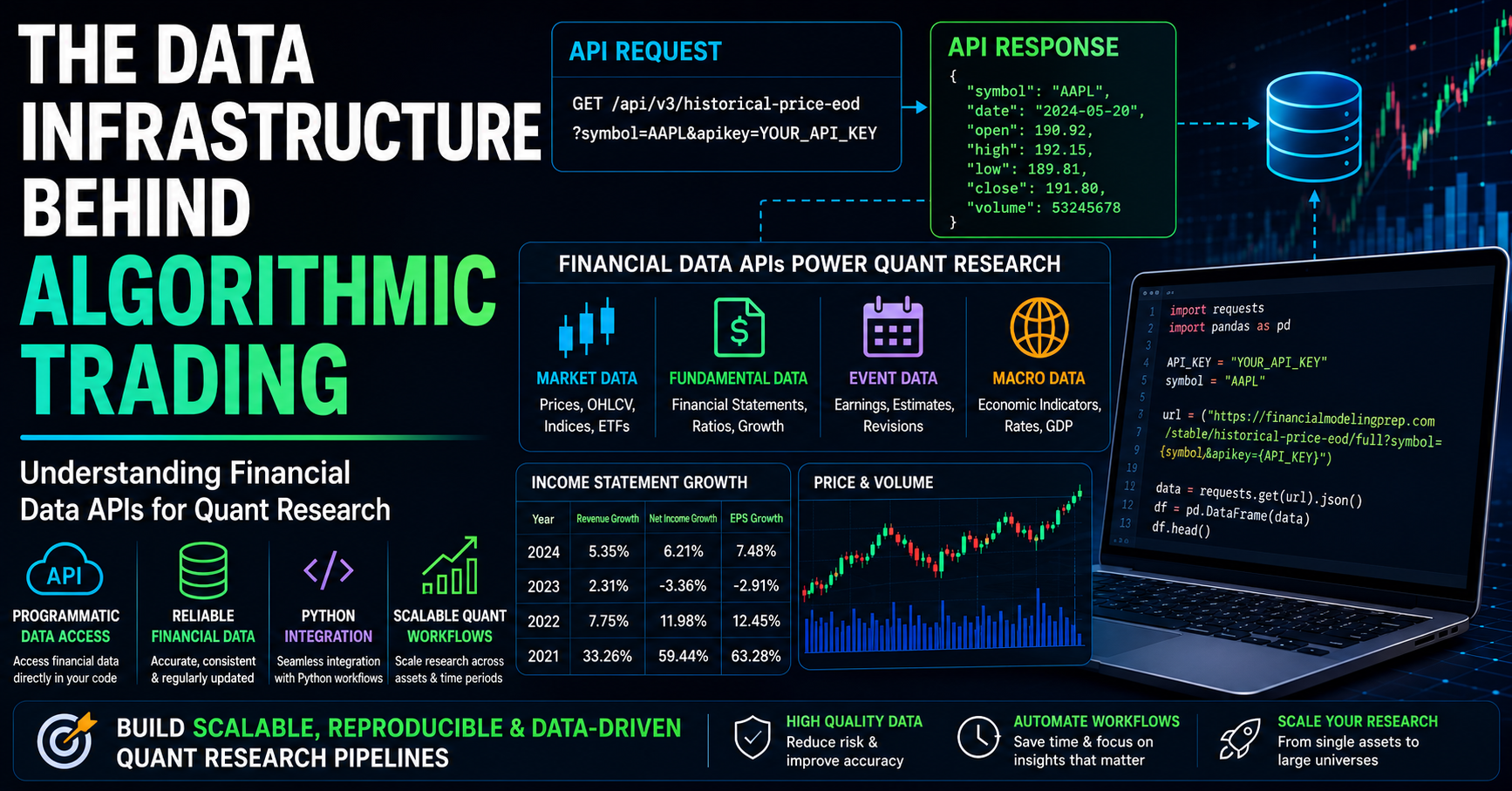
For quantitative researchers using Python, this translates into the ability to write scripts or notebooks that can fetch historical price data, detailed financial statements, or analyst consensus estimates without any manual intervention, such as downloading files from a website.
How an API Works in Practice
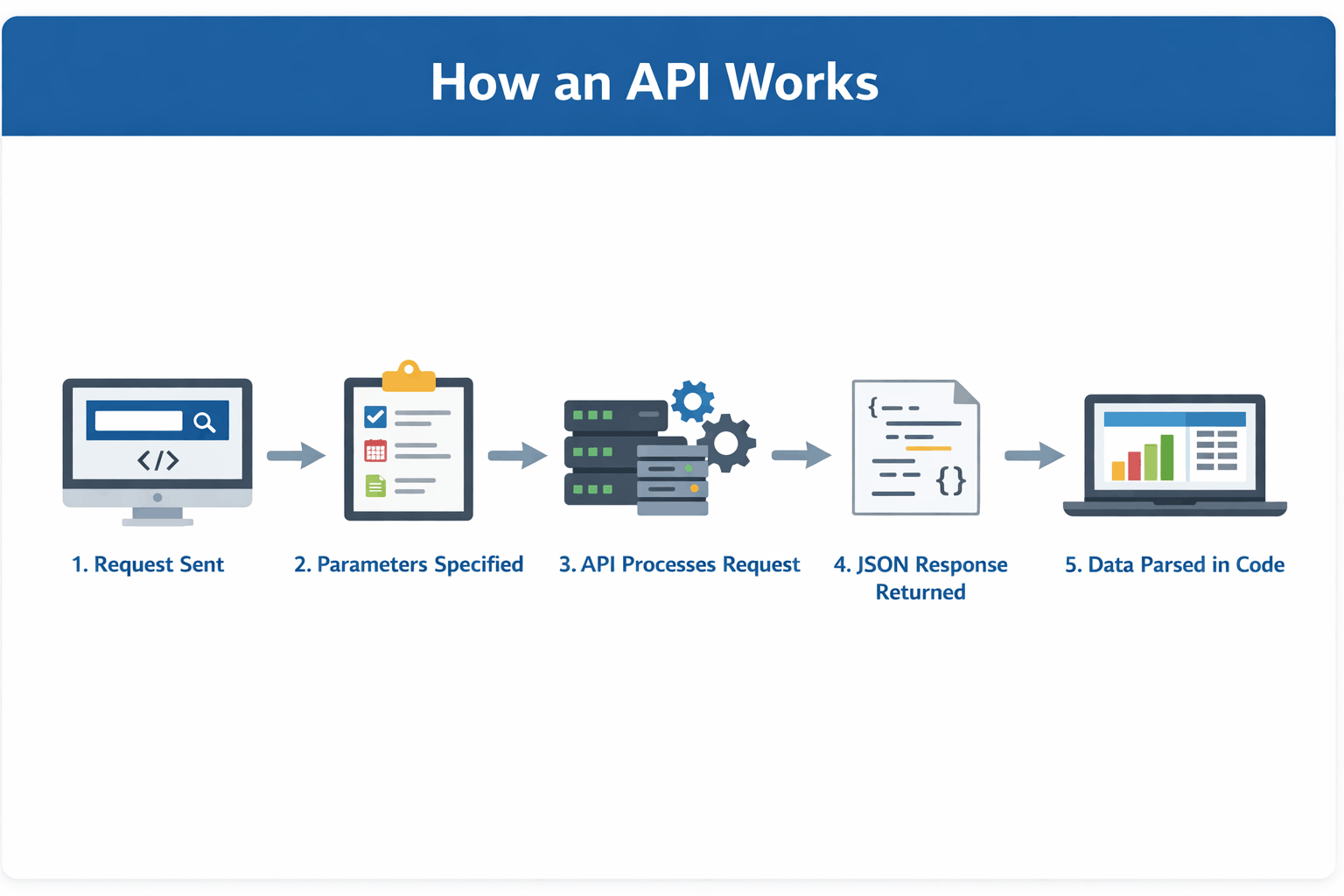
The interaction between a user’s application and a financial data API follows a well-defined pattern. A request is formulated by the application, specifying the desired data and any necessary parameters. This request is then sent to the API endpoint. The API server processes the request, retrieves the relevant data from its database, and formats it into a structured response. This response, typically in a format like JSON or XML, is then sent back to the application, where it can be parsed and utilized.
[User Application] --> [API Request] --> [API Server] --> [Data Retrieval] --> [API Response] --> [User Application]Financial data platforms expose specific endpoints for various datasets, such as company profiles, historical price movements, and detailed financial statements. Each of these endpoints adheres to this request-response paradigm, ensuring a predictable and structured data retrieval process.
Manual vs. Programmatic Data Retrieval
The contrast between manual and API-based data retrieval becomes starkly evident when examining the effort, scalability, and consistency involved.
| Aspect | Manual Data Retrieval | Programmatic Data Retrieval |
|---|---|---|
| Effort | High (repeated manual steps) | Low (automated through code) |
| Scalability | Limited to small datasets | Scales across large datasets |
| Consistency | Prone to formatting inconsistencies | Standardized and structured |
| Update Process | Requires manual updates | Automatically refreshable |
| Reproducibility | Difficult to replicate | Fully reproducible workflows |
For quantitative research, the advantages of programmatic access are clear: it significantly reduces human intervention, thereby minimizing errors and ensuring a higher degree of consistency across datasets and research iterations.
Authentication Using API Keys
To ensure secure access and manage usage, most financial data APIs employ an authentication mechanism, typically through API keys. An API key is a unique token that is included with each request. It serves to verify the identity of the user or application and allows the data provider to track usage, enforce rate limits, and manage access permissions. Obtaining and correctly using an API key is a fundamental step in integrating with any financial data API.
Why APIs Are Central to Quant Workflows
Financial data APIs fundamentally transform data access from a manual, often cumbersome task into a programmable, integrated component of the research pipeline. Instead of spending significant time on data preparation, researchers can now embed data retrieval directly into their code. This integration fosters consistent data inputs, accelerates the iteration cycle for strategy development and testing, and enables the creation of truly scalable research workflows. Consequently, APIs have become an indispensable cornerstone of modern quantitative research environments, empowering researchers to focus on analysis and strategy rather than data wrangling.
Types of Financial Data Used in Algorithmic Trading
Once programmatic access to data is established, understanding the types of datasets commonly employed in quantitative research becomes the next critical step. These datasets form the input layer of most research pipelines and are typically retrieved via financial data APIs.
| Type of Data | Examples |
|---|---|
| Market Data | Historical price data (open, high, low, close, volume), intraday price series, index and ETF prices |
| Fundamental Data | Income statements (revenue, net income), balance sheets (assets, liabilities), cash flow statements, financial ratios |
| Event & Macro Data | Earnings calendars, analyst estimates and revisions, economic indicators (inflation, interest rates, GDP) |
These diverse datasets, when accessed programmatically, provide the raw material for sophisticated quantitative analysis.
Scenario: Evaluating Fundamental Performance as a Cross-Sectional Signal
To illustrate how financial data APIs support real-world workflows, consider a simplified research scenario. The objective is not to construct a complete trading strategy, but to demonstrate the flow of data through a structured pipeline using reliable and repeatable data sources.
A researcher aims to evaluate whether improving company fundamentals can serve as a consistent cross-sectional signal across a broad universe of equities. This requires combining multiple datasets to analyze how financial performance trends correlate with observed price behavior across different companies. Such workflows are commonly taught in structured quantitative finance programs and reflect how research pipelines are built in both academic and professional quant settings.
APIs Used in This Workflow
Before constructing the pipeline, the necessary datasets and corresponding APIs are defined:
- Historical Price Data: To perform time-series analysis and understand price behavior, end-of-day price data is essential.
- Income Statement Growth Data: To assess fundamental performance, growth metrics such as revenue growth and earnings growth are required.
How to Get Your API Key
Accessing most financial data APIs necessitates user registration to obtain an API key. This key is crucial for authentication and usage tracking. For instance, registering at Financial Modeling Prep provides access to their API. After registration, the API key is typically found within the user’s dashboard. This key must then be substituted for placeholders like "YOUR_API_KEY" in code examples to authenticate requests.
Step 1: Data Ingestion
The initial phase of the pipeline involves retrieving structured datasets using financial data APIs. Rather than manual collection, both market and fundamental data are fetched programmatically.
Fetching Historical Price Data
The process begins by retrieving end-of-day price data for a specific symbol, such as Apple (AAPL), which will be used to analyze price dynamics over time.
import requests
import pandas as pd

API_KEY = "YOUR_API_KEY"  # Replace with your actual API key
symbol = "AAPL"
url = f"https://financialmodelingprep.com/stable/historical-price-eod/full?symbol=symbol&apikey=API_KEY"
response = requests.get(url)
data = response.json()
prices = pd.DataFrame(data)
print(prices.head())
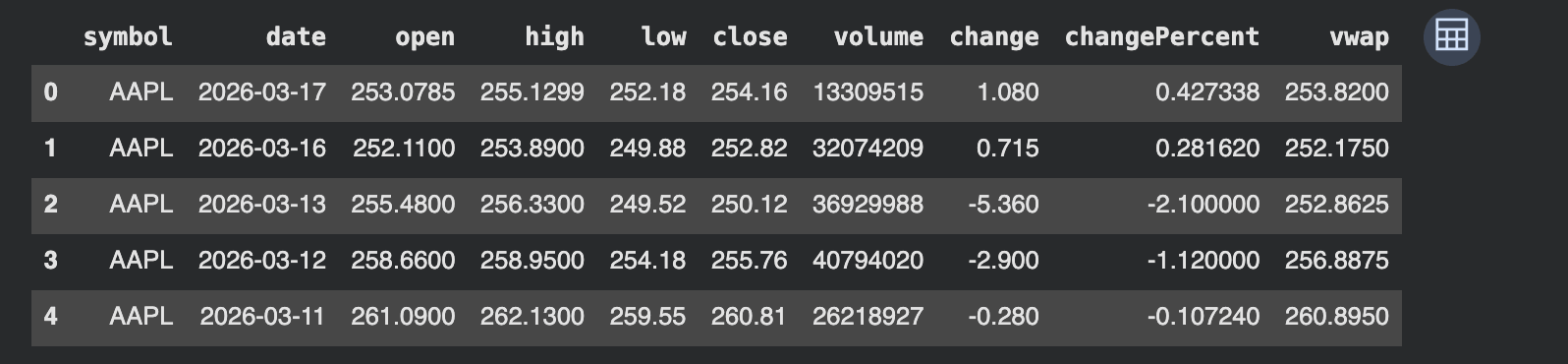
The output typically shows structured end-of-day price data for Apple in a clean tabular format. Each row represents a trading day, and columns include key market fields like open, high, low, close, volume, daily price change, percentage change, and VWAP (Volume Weighted Average Price).
This structured output is immediately usable within a research environment, eliminating the need for manual formatting. Researchers can efficiently sort by date, filter specific periods, calculate rolling statistics, align prices with fundamental events, or merge this table with other datasets.
Fetching Fundamental Growth Data
To support the research objective, fundamental growth metrics are also retrieved. These datasets provide insights into how a company’s financial performance is evolving.
growth_url = f"https://financialmodelingprep.com/stable/income-statement-growth?symbol=symbol&apikey=API_KEY"
growth_response = requests.get(growth_url)
growth_data = growth_response.json()
growth_df = pd.DataFrame(growth_data)
print(growth_df.head())
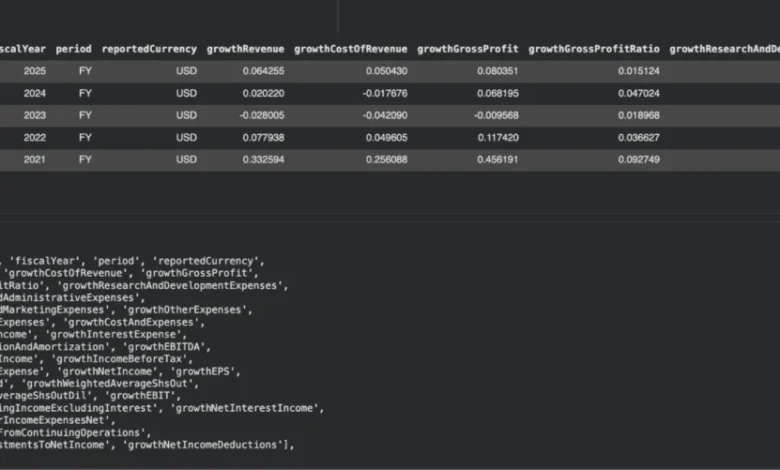
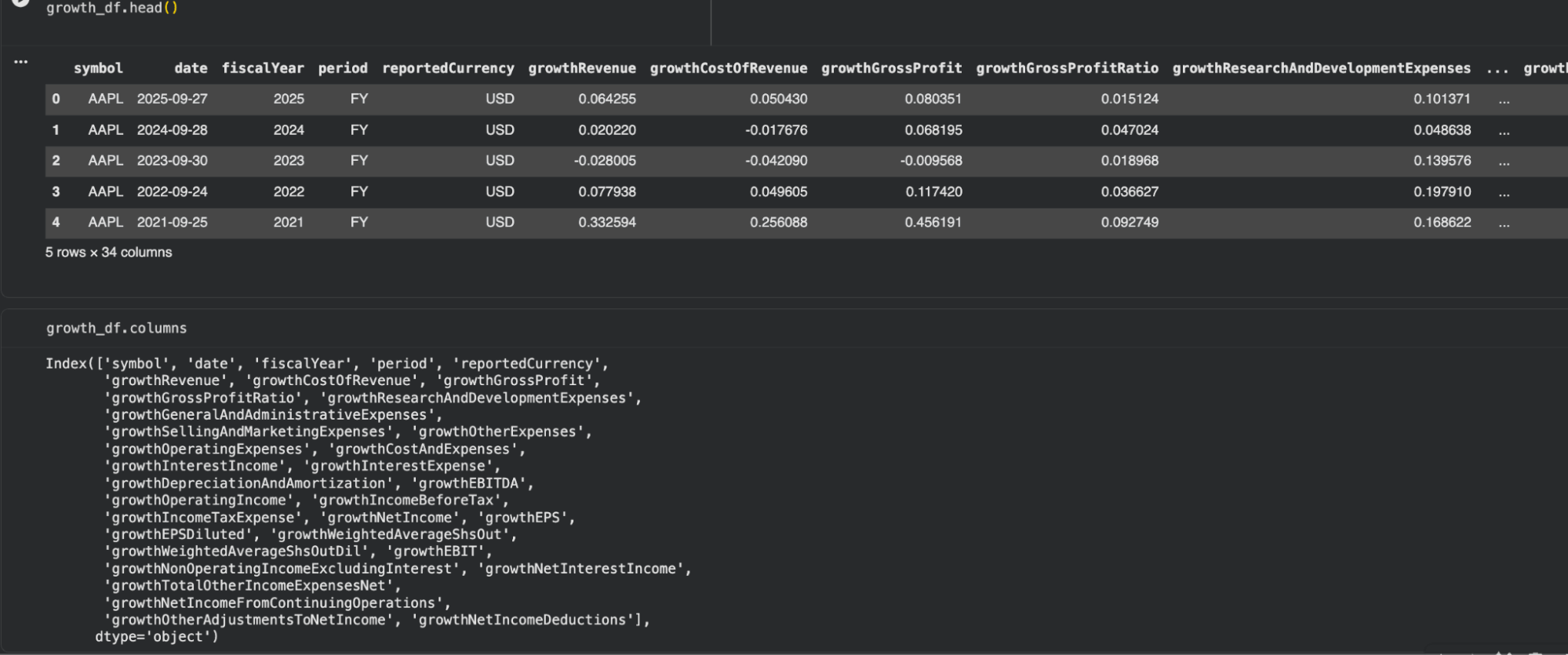
The retrieved data typically presents structured fundamental growth metrics for Apple across multiple fiscal years. Each row corresponds to a reporting period, and columns detail growth across various income statement components.
Interpretation:
Key observations from this dataset include:
- Directly Usable Growth Metrics: The API often provides pre-calculated growth rates (e.g., revenue growth, net income growth) for different periods (year-over-year, quarter-over-quarter). This saves researchers the effort of manual calculation and ensures consistency.
- Time Granularity: Unlike daily price data, fundamental data is typically reported at a financial period level (e.g., annual, quarterly). This difference in granularity is a crucial consideration when integrating datasets later in the pipeline.
Overall, this dataset complements the price-based data by capturing the evolution of a company’s fundamentals over time.
Step 2: Feature Engineering
With both market and fundamental data acquired, the subsequent step involves transforming these raw datasets into structured variables suitable for analysis.
Engineering Price-Based Features
Features are derived from the historical price data to capture different aspects of market behavior.
prices = prices.sort_values("date").reset_index(drop=True)
prices["daily_return"] = prices["close"].pct_change()
prices["price_range"] = prices["high"] - prices["low"]
prices["rolling_5d_avg_close"] = prices["close"].rolling(5).mean()
prices["rolling_5d_volatility"] = prices["daily_return"].rolling(5).std()
print(prices[["date", "close", "daily_return", "price_range", "rolling_5d_avg_close", "rolling_5d_volatility"]].head(10))
The engineered dataset demonstrates how raw price data is converted into structured features that facilitate deeper analysis.
daily_return: Measures the percentage change in closing price from one day to the next.price_range: Indicates the trading range for a given day (high minus low).rolling_5d_avg_close: Represents the average closing price over the preceding five trading days.rolling_5d_volatility: Calculates the standard deviation of daily returns over the past five trading days, serving as a measure of short-term price volatility.
Initial NaN values are expected due to the nature of rolling calculations, which require a minimum number of prior observations. This step effectively transforms raw market data into features that can be compared across time and integrated with other datasets.
Working with Fundamental Growth Features
The fundamental dataset, having been retrieved from an API, often already includes engineered growth variables. These can be used directly, requiring minimal additional transformation. Examples of readily available features include:
- Revenue Growth (YoY, QoQ)
- Net Income Growth (YoY, QoQ)
- Earnings Per Share (EPS) Growth
- Gross Profit Margin, Operating Margin, Net Profit Margin
These variables are central to many research workflows as they describe the trajectory of a company’s financial performance.
Aligning Price and Fundamental Data
A critical step in feature engineering is aligning datasets that operate at different frequencies. Incorrect alignment between reporting periods (for fundamental data) and daily price data is a common source of bias in quantitative research, particularly if fundamental data is forward-filled improperly.
To combine these datasets effectively, fundamental values are typically mapped to corresponding price periods. Techniques for this alignment include:
- Forward Filling: Assigning the fundamental data point from the most recent reporting period to all subsequent daily price observations until a new fundamental data point becomes available.
- Backward Filling: Less common for fundamentals, but used in specific contexts.
- Interpolation: Estimating values between known data points, though this can introduce artificial smoothness.
A simplified example of aligning these datasets:
# Convert date columns to datetime objects
prices["date"] = pd.to_datetime(prices["date"])
growth_df["date"] = pd.to_datetime(growth_df["date"])

# Merge datasets on date and symbol
merged_df = prices.merge(growth_df, on=["symbol", "date"], how="left")

# Forward fill fundamental values across daily data
merged_df = merged_df.sort_values("date").ffill()
print(merged_df.head())
This alignment process ensures that both market behavior and underlying business performance can be analyzed within a unified dataset, providing a more holistic view.
Key Outcome of Feature Engineering:
At this stage, the dataset comprises:
- Daily Market Features: Including raw prices, returns, volatility, and moving averages.
- Fundamental Growth Features: Reflecting year-over-year or quarter-over-quarter changes in key financial metrics.
- Aligned Data: Ensuring that price and fundamental data points correspond appropriately in time.
This combination enables more meaningful analysis, allowing researchers to evaluate price behavior in conjunction with changes in company fundamentals.
Step 3: Hypothesis Testing
With both price-based features and fundamental growth data integrated, the researcher can now systematically evaluate relationships within the data. The focus remains on testing for observable patterns between market behavior and underlying business performance.
Defining the Research Question
A pertinent hypothesis might be: "Do periods of stable price behavior systematically align with improving company fundamentals?" This question connects two key dimensions:
- Market Behavior: Measured by price volatility and trading range.
- Business Performance: Indicated by growth in revenue, profits, and other fundamental metrics.
Structuring the Analysis
To evaluate this hypothesis, the researcher can perform several analytical steps:
- Identify periods of stable price behavior: This could involve filtering for days or weeks with low volatility or narrow price ranges.
- Examine fundamental performance during these periods: Analyze the trend of fundamental growth metrics leading into and during these low-volatility periods.
- Compare with periods of high volatility: Assess if improving fundamentals are less prevalent or absent during periods of high price volatility.
Example Workflow: Identifying Low Volatility Periods
A simplified analytical approach could involve identifying and isolating periods of low volatility:
# Example: Identify low volatility periods based on rolling 5-day volatility
low_volatility_threshold = prices["rolling_5d_volatility"].quantile(0.3) # Top 30% lowest volatility
low_volatility_periods = prices[prices["rolling_5d_volatility"] < low_volatility_threshold]
print(low_volatility_periods.head())
The filtered dataset highlights periods where short-term volatility is relatively low, based on the lower quantile of the rolling 5-day volatility. Analyzing the fundamental data corresponding to these dates would then allow the researcher to test the hypothesis. For instance, if the average revenue growth in the quarter preceding or during these low-volatility periods is significantly higher than in other periods, it would lend support to the hypothesis.
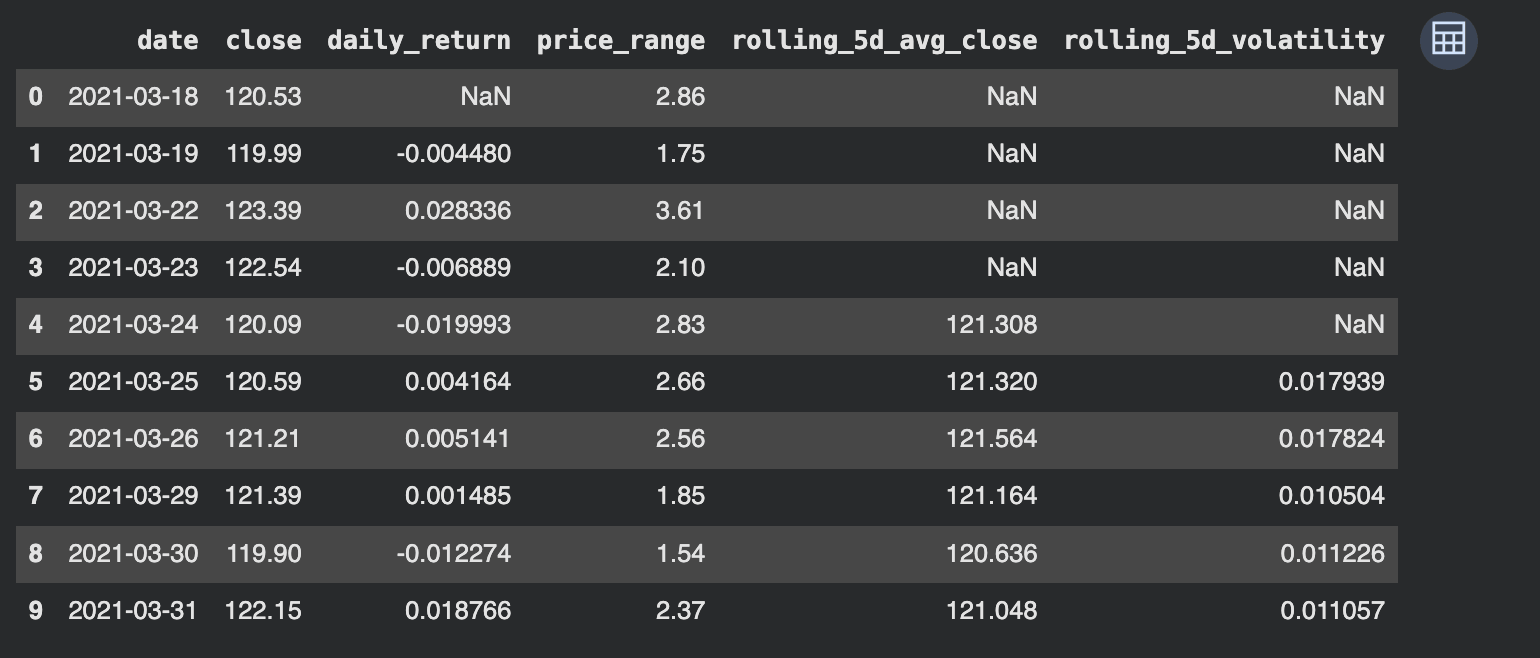
This output demonstrates how raw market data can be transformed into features that enable a structured evaluation of market behavior, moving from descriptive patterns to testable relationships.
Step 4: Scaling the Research
In professional quantitative environments, research pipelines are designed to operate across hundreds or thousands of securities. Therefore, scalability is a core requirement, not merely an optimization. Once a workflow is validated for a single company, the same pipeline can be extended across a larger universe of securities with minimal modifications, thanks to the programmatic implementation of data ingestion and feature engineering.
Scaling may involve:
- Iterating through a Universe of Stocks: Applying the same Python scripts to a list of ticker symbols.
- Batch Processing: Running the pipeline on multiple securities concurrently.
- Cloud Infrastructure: Utilizing cloud platforms for parallel processing and storage.
The ability to apply identical feature engineering logic to hundreds of stocks using a simple loop or batch process underscores the power of API-driven workflows. Financial data APIs are instrumental in enabling researchers to transition from isolated examples to scalable research systems where data retrieval, transformation, and analysis can be executed consistently across vast datasets.
Why Data Quality Matters in Systematic Trading
With a structured and repeatable research pipeline in place, the reliability of any analysis ultimately hinges on the quality of the underlying data. Even the most sophisticated workflows can yield misleading results if the input data is incomplete, inconsistent, or incorrectly adjusted. Data quality is not solely a technical concern; it directly impacts the accuracy with which researchers can evaluate patterns, compare entities, and validate hypotheses.
Common Data Issues in Quantitative Research
Financial datasets are often replete with subtle issues that can significantly skew analysis. These include:
- Survivorship Bias: Including only companies that currently exist or have survived, thus excluding those that have gone bankrupt or been delisted, leading to an overly optimistic view of historical performance.
- Lookahead Bias: Incorporating information that would not have been available at the time of the decision-making, often stemming from incorrectly timestamped data or data released after its effective date.
- Missing Historical Records: Gaps in historical data for certain securities or time periods.
- Improper Handling of Corporate Actions: Failure to correctly adjust price and volume data for events like stock splits, dividends, mergers, or spin-offs.
These issues become more pronounced and problematic when scaling analysis across numerous securities or extended historical periods.
Impact on Research Outcomes
Data quality directly influences every stage of the research pipeline. Inconsistent or incomplete data can lead to:
- Distorted Signals: Features derived from flawed data may not accurately reflect underlying market or company dynamics.
- Unreliable Comparisons: Differences in data quality across securities can make cross-sectional comparisons invalid.
- Misleading Conclusions: Backtests and analyses based on poor-quality data can lead to flawed investment decisions.
Role of Financial Data APIs
Reliable financial data APIs play a crucial role in mitigating many of these challenges. By providing standardized and structured datasets, APIs offer a more consistent source of information. Features such as consistent schemas, pre-processed metrics, and regular data updates simplify the integration of diverse datasets into a unified research pipeline, thereby enhancing data quality.
Why Data Quality Is Foundational
Data quality is the bedrock upon which the credibility of quantitative research is built.

If the input data is reliable:
- Research is Reproducible: Findings can be consistently replicated.
- Analysis is Accurate: Insights reflect true market and company dynamics.
- Decisions are Sound: Investment strategies are based on valid patterns.
If the input data is flawed:
- Research is Unreliable: Results are inconsistent and untrustworthy.
- Analysis is Biased: Conclusions are skewed by errors.
- Decisions are Risky: Strategies are based on faulty premises.
This underscores why data quality is considered a foundational layer in systematic trading. Before any hypothesis can be meaningfully evaluated, researchers must ensure that the data being utilized is accurate, consistent, and complete.
Key Takeaways
- Data Infrastructure is Paramount: Reliable access to clean, structured financial data is the essential prerequisite for any successful quantitative research or algorithmic trading endeavor.
- APIs Enable Automation and Scalability: Financial data APIs provide a programmatic interface that automates data ingestion, integrates seamlessly into research workflows, and enables scalable analysis across large datasets.
- Data Quality is Non-Negotiable: The accuracy, consistency, and completeness of financial data directly impact the validity of research findings and the soundness of investment decisions.
- Python Integration: APIs facilitate the integration of financial data into popular Python-based quantitative research environments, empowering developers with powerful tools.
About the Contributor:
Financial Modeling Prep (FMP) is a provider of structured financial data APIs, serving quantitative researchers, investment analysts, and developers. Its platform is engineered to offer scalable access to a wide array of datasets, including market data, financial statements, and analyst estimates, all critical for systematic research environments.
Disclaimer: All data and information provided in this article are for informational purposes only. QuantInsti® makes no representations as to accuracy, completeness, currentness, suitability, or validity of any information in this article and will not be liable for any errors, omissions, or delays in this information or any losses, injuries, or damages arising from its display or use. All information is provided on an as-is basis.