The Myth of the Passive Stock Picker and the Reality of Market Concentration in 2026

The long-standing investment adage suggesting that a dart-throwing monkey could outperform a professional portfolio manager has been increasingly challenged by the current market environment. While the S&P 500 index has demonstrated resilience with a year-to-date gain exceeding 13% through late September 2026, the underlying performance of individual equities reveals a starkly different narrative. Beneath the surface of these headline-grabbing index returns lies a landscape defined by extreme dispersion, where the vast majority of individual companies are failing to keep pace with the broader market.
The Anatomy of a Bifurcated Market
Market data as of September 2026 indicates that only 35% of all S&P 500 constituents are currently outperforming the index. This performance gap is not merely a statistical anomaly but a reflection of a concentrated market structure that has persisted for several years. Four out of every ten stocks in the S&P 500 have recorded negative returns for the year, and a full quarter of the index’s components have suffered losses of 10% or greater.
This downturn has impacted even well-established, blue-chip corporations. Notable market laggards include Lululemon, which has seen its share price contract by 51%, and Nike, which has experienced a 42% decline. Other major household names such as Domino’s, FedEx, and Netflix have posted double-digit losses, down 28%, 26%, and 24% respectively. Conversely, a narrow cohort of high-performing assets has driven the index’s growth. Nineteen stocks have achieved triple-digit returns year-to-date, with standout performers including SanDisk at +665%, Dell at +341%, Intel at +232%, and CrowdStrike at +124%.
The Erosion of Buy-and-Hold Efficacy
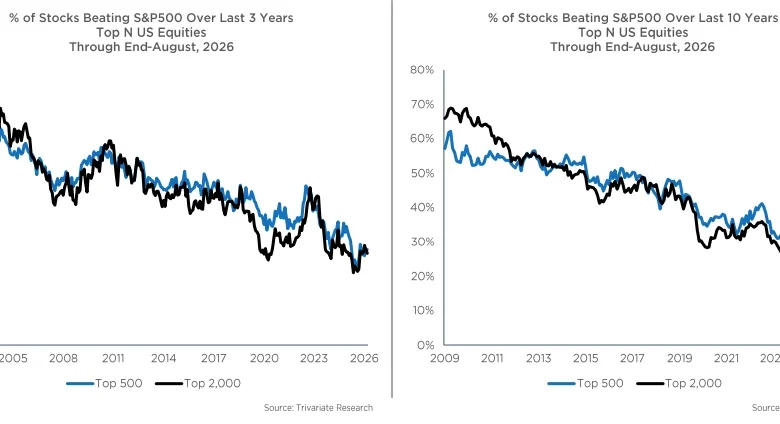
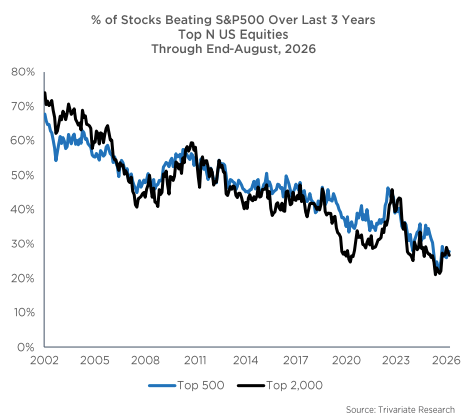
A recent report by Adam Parker of Trivariate Research, titled "Buy-and-Hold Doesn’t Work," provides a sobering assessment of long-term investment strategies. Parker’s analysis of the S&P 500 and the top 2,000 U.S. stocks reveals that the probability of an individual stock outperforming the market index has declined precipitously over the last decade.
According to the data, a mere 23% of stocks have managed to beat the S&P 500 over a 10-year horizon. The results over a three-year period show similarly muted success rates. This trend marks a significant departure from the post-dot-com bubble era, where the percentage of stocks outperforming the index frequently hovered between 60% and 70%.
The implications for individual investors are profound. The gulf between winners and losers is at a historical zenith. Over the last three years, losing stocks have underperformed the index by an average of 62%, while winning stocks have outperformed by an average of more than 100%. Looking at the 10-year window, the divergence is even more extreme: underperformers trailed the index by an average of 205%, while winners outpaced it by an average of 600%.
Chronology of Market Concentration
To understand the current state of the equity markets, one must examine the progression of market concentration over the last several decades. Following the 2008 financial crisis, the market experienced a period of relatively broad-based recovery. However, the subsequent years, particularly following the 2020 pandemic-induced volatility, saw a massive acceleration in the "winner-take-all" dynamic.
- 2000–2010: Following the collapse of the tech bubble, investors saw a higher correlation between individual company success and market performance. During this decade, active management often found success by identifying mid-cap growth opportunities that were not captured by major indices.
- 2011–2020: The rise of mega-cap technology firms—often referred to as the "Magnificent Seven" or similar iterations—began to skew index returns. The widespread adoption of index-tracking exchange-traded funds (ETFs) created a self-reinforcing cycle where capital flows into the largest companies, further inflating their market capitalization and influence over index returns.
- 2021–2026: We are currently in a cycle characterized by extreme divergence. The market is now defined by "first-level thinking," where investors gravitate toward recognizable tech giants, assuming these companies will maintain their dominance indefinitely. This has resulted in a market that rewards passive index ownership while punishing those who attempt to deviate from the index through active security selection.
Analysis of Institutional and Retail Implications
The current environment presents a unique challenge for institutional asset managers. For those who rely on active stock picking, being "meaningfully different" from the market-cap-weighted index has been a significant liability. When a small handful of companies accounts for the vast majority of index gains, any portfolio that is underweight in those specific names is almost guaranteed to trail the benchmark.
However, paradoxically, the current landscape offers a potential advantage to individual investors who adopt a disciplined, long-term approach. By utilizing passive index funds, investors are automatically exposed to the winners that drive the market, while the losses of the underperforming 65% of the index are mitigated by the outsized gains of the top tier.
Howard Marks, co-founder of Oaktree Capital Management, has frequently warned of the dangers of "first-level thinking," which involves identifying a good company and purchasing the stock without regard for its valuation. In the current market, however, first-level thinking has been remarkably profitable. Investors who simply bought into major technology platforms—Apple, Google, Microsoft, Meta, and others—have enjoyed significant returns because these companies have consistently defied traditional valuation concerns.
Looking Toward the Future
While the current market structure favors mega-cap dominance, history suggests that such concentrations are rarely permanent. The history of the S&P 500 is littered with companies that were once considered untouchable market leaders but eventually succumbed to competitive pressures, regulatory intervention, or cyclical shifts.
Experts suggest that at some point, this concentration will inevitably wane. When market leadership rotates, the "winner-take-all" dynamic will likely subside, creating a environment where a broader array of stocks can contribute to index gains. Until then, the data suggests that for the average investor, the most statistically sound path remains either a robust passive index strategy or a highly active, disciplined approach that acknowledges the extreme volatility of individual stock picking.
The difficulty of beating the market is not a new phenomenon, but the current disparity between the top tier and the rest of the market makes the act of "stock picking" a low-probability exercise. As of late 2026, the market serves as a reminder that in an era of extreme concentration, the ability to recognize when to be passive is as vital as the ability to identify growth. Whether this trend continues through the remainder of the decade remains the central question for portfolio managers and retail investors alike. For now, the "slugging percentage" of the market—the ability to produce massive winners—continues to mask the "batting average" of the majority of its participants.