The Rise of the Vibe Quant: Why Relying on Artificial Intelligence for Trading Strategies Could Cost Retail Investors Dearly


The rapid integration of generative artificial intelligence into financial markets has given birth to a distinct online subculture known colloquially as the "vibe quant" movement. Driven by the accessibility of advanced Large Language Models (LLMs), a growing cohort of retail traders are now employing AI to autonomously source academic literature, formulate trading hypotheses, backtest quantitative strategies, and deploy automated systems into live production environments. While the promise of leveraging artificial intelligence to democratize algorithmic trading is undeniably seductive, industry veterans and quantitative researchers are sounding the alarm. According to experienced market practitioners, this hands-off approach to strategy development not only risks significant financial capital but also deprives novice traders of the foundational learning curve necessary to survive in modern financial markets.
Background and Context of the AI Trading Phenomenon
Algorithmic trading—the use of computer algorithms to execute trading decisions at speeds and frequencies impossible for human traders—was once the exclusive domain of institutional heavyweights, hedge funds, and proprietary trading firms with multi-million-dollar technology budgets. Over the past decade, however, the democratization of financial data, open-source programming languages like Python, and cloud computing infrastructure have lowered the barriers to entry, enabling retail participants to build sophisticated trading setups from home.
The advent of generative AI models in late 2022 drastically accelerated this trend. Platforms powered by sophisticated LLMs allow users to converse with code, synthesize complex academic papers on market anomalies in seconds, and generate executable Python scripts for backtesting without requiring a formal degree in financial mathematics or computer science. The "vibe quant" phenomenon emerged organically across online forums and developer communities as traders discovered they could delegate the technical burden of coding and data analysis entirely to machines. In this workflow, the human participant transitions from a researcher to a passive supervisor, greenlighting algorithmic strategies produced by an AI black box.
The Mechanics of Quantitative Research Versus AI Automation
To understand the core critique leveled against the vibe quant methodology, financial analysts point to the traditional quantitative research lifecycle: hypothesizing, testing, learning, and iterating. In a conventional setting, every cycle of research forces the practitioner to grapple with market mechanics, transaction costs, liquidity constraints, and counterparty behaviors. Each failure provides granular insight into why a particular market inefficiency exists and how other participants operate within the ecosystem. This experiential knowledge compounds over time, building a trader’s intuition and analytical judgment.
Conversely, relying on an LLM to execute these steps compresses the workflow into a superficial loop. Because the AI performs the heavy lifting of generating ideas and writing validation code, the human operator’s comprehension remains static. Critics argue that a trader utilizing this method on their thousandth day of operation possesses the same shallow understanding of market structure as they did on day one. Rather than accelerating expertise, the workflow functions as a technical treadmill, creating the illusion of rigorous research while bypassing the critical cognitive friction required to acquire genuine market edge.
The Core Problem: Ignoring Market Mechanics and Counterparty Risk
At the heart of professional quantitative finance lies a fundamental question: Who is on the other side of the trade, and why are they consistently losing money? Sustainable financial edge—or alpha—rarely stems from finding a novel mathematical pattern in historical price data. Instead, true edge is typically derived from structural constraints, regulatory mandates, capacity limits, or behavioral biases that force certain market participants to trade at disadvantageous prices.
Market veterans note that the vast majority of publicly available trading literature, online tutorials, and even academic research papers largely ignore this foundational question. Publicly accessible corpora are frequently saturated with surface-level technical indicators, curve-fitted backtests, and superficial pattern recognition designed more to satisfy academic publication metrics or commercial content creation than to explain actual market microstructure.
Because LLMs are trained predominantly on this publicly available corpus, their output inherently reflects these limitations. When tasked with finding an alpha-generating strategy, an LLM defaults to what it knows best: identifying statistical correlations, writing backtesting scripts, and producing plausible-sounding rationales that lack genuine grounding in institutional realities. Consequently, traders who rely on these models often build strategies on statistical artifacts rather than structural economic realities, leaving them dangerously vulnerable when market regimes shift.
Case Study: The LLM Self-Diagnosis Paradox
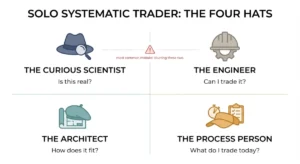
Recent analyses within quantitative developer circles have highlighted the paradox of using AI to diagnose its own methodological shortcomings. In a widely discussed case study, a solo trader fed an analytical framework concerning the division of labor in retail trading into an advanced LLM. The AI produced a remarkably astute self-diagnosis, correctly identifying that automated tools encourage traders to skip fundamental edge research ("Hat 1") in favor of rapid engineering and backtesting ("Hat 2").
The AI explicitly noted that systems could ingest financial literature and deploy multi-quarter earnings screens in minutes, while entirely failing to verify whether a genuine economic edge existed within the trader’s specific asset universe or holding period. However, when instructed to rectify this flaw, the LLM’s default behavioral pattern reasserted itself: it immediately generated new internal Python validation scripts and engineering frameworks to accelerate the very pipeline it had just critiqued.
This behavior underscores a systemic characteristic of current generative AI models. When presented with strategic dilemmas, LLMs respond by generating more of the mechanics they were trained to execute—namely, code, data processing, and technical validation—rather than cultivating the skeptical, qualitative reasoning required to evaluate counterparty motivations.
Data Integrity, Drawdowns, and the Loss of Adaptability
From a risk management perspective, the reliance on AI-generated strategies introduces severe vulnerabilities during periods of market stress. Professional trading systems inevitably experience drawdowns—periods of sustained financial loss. When an institutional quant experiences a drawdown, their deep understanding of the strategy’s underlying mechanism allows them to diagnose whether the core structural constraint has dissolved, whether counterparties have adapted, or whether the drawdown falls within normal statistical expectations.
A trader whose entire methodology rests on an LLM-discovered pattern lacking a mechanical rationale possesses no diagnostic framework. Lacking insight into why a strategy worked in the first place, the trader cannot determine whether to maintain discipline, modify parameters, or abandon the position. The only recourse is to prompt the AI for a new pattern, locking the practitioner into an endless cycle of anxiety, parameter tinkering, and capital attrition.
Industry Implications and the Proper Role of AI
Financial technologists and established quantitative researchers emphasize that their critique is not directed against artificial intelligence as a tool, but rather against its uncritical substitution for human judgment. Within professional prop shops and hedge funds, LLMs and machine learning models are deployed extensively—not to discover magical trading strategies out of thin air, but to automate operational grunt work.
In a balanced trading workflow, AI excels at data cleaning, code refactoring, infrastructure automation, and the rapid visualization of experimental results. These tasks correspond to the supportive layers of quantitative development where computational speed provides a legitimate advantage. However, the formulation of trading hypotheses, the rigorous questioning of counterparty behavior, and the synthesis of market intuition remain uniquely human domains forged through iterative experience and mentorship.
As the vibe quant movement continues to gain traction across social media and retail trading communities, financial analysts predict a clear divergence. While some participants may achieve temporary, luck-driven success during favorable market regimes, those who bypass the arduous process of developing fundamental market literacy are expected to incur substantial financial losses. Ultimately, industry experts warn that while artificial intelligence can construct a sophisticated fishing rod, it cannot teach a trader where the fish actually swim—leaving inexperienced participants uniquely unequipped for the unpredictable realities of global financial markets.