Trade.xyz Review: S&P 500 Perps On Hyperliquid Examined for Market Dominance, Operational Mechanics, and Regulatory Landscape

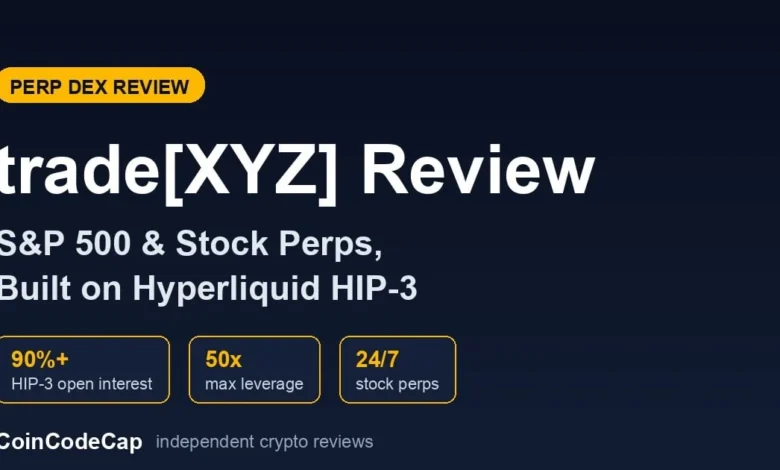
In a rapidly evolving landscape of decentralized finance (DeFi), trade.xyz has emerged as a formidable player, commanding over 90% of the open interest across Hyperliquid’s HIP-3 markets. This unprecedented dominance in onchain derivatives allows traders to engage in sophisticated financial maneuvers, such as longing Tesla or shorting the S&P 500, directly from a crypto wallet, circumventing traditional brokerage accounts. This comprehensive review delves into the intricacies of trade.xyz, dissecting its operational framework, fee structures, leverage offerings, market footprint, and the critical risks inherent in its synthetic perpetual futures products.
Understanding trade.xyz: A Decentralized Derivatives Innovator
At its core, trade.xyz is not a standalone exchange but rather a specialized deployer operating within the Hyperliquid Improvement Proposal 3 (HIP-3) framework. This innovative architecture enables independent teams to launch their own perpetual futures markets atop Hyperliquid’s robust infrastructure. In this symbiotic relationship, trade.xyz assumes responsibility for curating asset selection, establishing reliable oracle feeds, and configuring leverage limits. Meanwhile, Hyperliquid’s HyperCore engine provides the foundational services: high-speed order matching, efficient funding mechanisms, automated liquidations, precise margining, and immutable onchain settlement.
This division of labor is crucial for understanding the platform’s risk profile. Trade.xyz’s primary directive is to identify viable assets and integrate robust, multi-sourced price feeds, ensuring market integrity. HyperCore, on the other hand, guarantees the technical execution, promising rapid trade processing and accurate onchain settlement. For those seeking a broader understanding of the ecosystem, Hyperliquid itself supports a diverse array of alternatives and competitors, some of which are covered in guides comparing decentralized exchanges.
Since the introduction of HIP-3 in late 2025, builder-deployed markets have witnessed explosive growth, now accounting for approximately half of all perpetual trading volume on Hyperliquid. Trade.xyz has been the primary catalyst for this expansion, single-handedly driving the vast majority of this growth. The platform distinguished itself by launching the inaugural HIP-3 market, the XYZ100 index, and has since maintained an aggressive pace in adding a wide spectrum of equities, commodities, and foreign exchange (FX) pairs, outpacing other developers leveraging the same infrastructure.
Market Offerings and the Significance of the S&P 500 License
Trade.xyz’s market lineup extends significantly beyond traditional crypto assets, offering a gateway to a diverse array of global financial instruments. Traders can access leveraged positions on individual stocks from major global exchanges, widely recognized indices, essential commodities, and popular currency pairs. A key distinguishing feature is the 24/7 trading availability, with all positions settled in USDC, even when the underlying traditional markets are closed.
A landmark achievement for trade.xyz occurred in March 2026 when it secured an official licensing agreement with S&P Dow Jones Indices for a perpetual contract tracking the S&P 500. This milestone cemented its position as the first platform to offer a 24/7 product of its kind built on a legitimately licensed version of the benchmark index, moving beyond unauthorized synthetic reproductions. This official endorsement not only enhances the platform’s credibility but also provides a level of legitimacy rarely seen in the nascent synthetic asset space, addressing concerns about data integrity and intellectual property rights that often plague unlicensed derivatives.
Beyond indices and equities like Tesla, Nvidia, and Apple, the platform also offers exposure to commodities such as natural gas and various FX pairs. The pricing mechanism relies on an oracle-based system, where the mark price is derived from a median of three independent components, mitigating reliance on any single data feed and enhancing price stability. Furthermore, trade.xyz has integrated with TradingView, a widely used charting platform, allowing traders to utilize familiar analytical tools for market assessment.
Operational Mechanics: Fees, Leverage, and Non-Custodial Trading
Trade.xyz employs a tiered fee schedule designed to reward higher trading volumes. At the entry-level tier, takers incur a fee of 0.090%, while makers benefit from a reduced fee of 0.030%. As trading volume increases, taker fees progressively decrease, reaching as low as 0.048% at the top tier, with maker fees potentially falling to zero. This competitive fee structure is particularly attractive to active traders and market makers, aiming to foster deep liquidity within its markets. Additionally, for eligible real-world-asset markets, a "Growth Mode" can further reduce fees by 90% or more, bringing taker fees down to approximately 0.0048%, showcasing an aggressive strategy to attract volume in these novel asset classes.
Leverage caps are dynamic and vary significantly across asset classes, reflecting the inherent volatility and risk profiles of different markets. For instance, the S&P 500 perpetual contract offers leverage of up to 50x, allowing for significant capital efficiency. In contrast, less volatile commodities, such as natural gas, typically feature more conservative caps, closer to 10x. It is imperative for traders to verify the specific leverage limits for each market before committing capital to a position, as these limits directly impact potential gains and, crucially, liquidation thresholds.
A cornerstone of trade.xyz’s appeal, and a defining characteristic of decentralized finance, is its non-custodial architecture. Users retain full control over their private keys throughout the entire trading process. This fundamental difference from centralized futures exchanges means that trade.xyz, or any affiliated entity, cannot unilaterally freeze accounts or jeopardize user funds through hot wallet compromises. The absence of an intermediary holding user assets fundamentally alters the risk landscape, shifting custody risks from the platform to the individual user. This self-custody model resonates strongly with traders prioritizing security and autonomy, making it a compelling alternative to platforms requiring extensive identity verification. Onboarding is streamlined and wallet-based, supporting MetaMask, Phantom, Rabby, or the creation of a Privy wallet via email, completely bypassing traditional Know Your Customer (KYC) procedures. However, users remain solely responsible for adhering to regulatory requirements in their respective jurisdictions.
Market Performance and Ecosystem Impact
By mid-2026, trade.xyz had facilitated approximately $53 billion in 30-day trading volume, as reported by DefiLlama, alongside managing about $1.5 billion in open interest. These figures are indicative of substantial real-world trading activity, far removed from mere testnet simulations. This robust performance underscores the platform’s ability to attract significant liquidity and user engagement, positioning it as a critical component of the Hyperliquid ecosystem. Its rapid growth and dominant market share within HIP-3 markets highlight a successful strategy in identifying and fulfilling a market demand for onchain synthetic TradFi derivatives. This level of activity also contributes to the overall health and decentralization goals of the broader Hyperliquid network, demonstrating the viability of its underlying infrastructure for complex financial instruments.
Competitive Landscape and Broader DeFi Trends
Trade.xyz operates within an increasingly competitive segment of the DeFi market, vying with other innovative platforms aiming to bridge traditional finance (TradFi) assets with blockchain technology. A direct comparison can be drawn with Arcus, a 24/7 stock-perp DEX developed by the dYdX team. While Arcus shares trade.xyz’s ambitious goal of offering perpetuals on traditional stocks, it operates on a different infrastructural stack than Hyperliquid’s HIP-3 framework. Other projects within the Hyperliquid orbit, such as Aster and Pacifica, primarily focus on crypto-native perpetuals, making them less direct substitutes for traders specifically seeking exposure to synthetic equities.
The broader landscape of decentralized exchanges (DEXs) and crypto futures platforms encompasses a wide spectrum of options, from established centralized giants like Binance to other decentralized venues like GMX. Each platform presents a unique trade-off between features, fees, asset variety, and the degree of decentralization. For traders prioritizing anonymity, a growing number of no-KYC futures exchanges offer alternatives, though often with heightened regulatory risks. The emergence of platforms like trade.xyz reflects a wider trend in DeFi to replicate and innovate upon traditional financial products, offering them with the added benefits of transparency, censorship resistance, and 24/7 accessibility inherent to blockchain technology.
Navigating Risks and Regulatory Uncertainties
Despite its innovative approach and market success, trade.xyz operates in a challenging regulatory environment. Synthetic stock and index perpetuals currently occupy a significant regulatory gray zone. Unlike traditional exchange-traded products, these instruments lack a clear, comprehensive regulatory framework from major global financial authorities specifically tailored to HIP-3-style synthetic equities. This ambiguity introduces a layer of systemic risk for both the platform and its users.
A notable regulatory caution comes from the UK’s Financial Conduct Authority (FCA), which has publicly identified Hyperliquid’s core websites as unauthorized to provide financial services to UK consumers. This warning, while specifically naming Hyperliquid, carries significant implications for trade.xyz, given that all its trades are settled through the same HyperCore infrastructure. Consequently, UK users engaging with trade.xyz would not benefit from Financial Ombudsman recourse or Financial Services Compensation Scheme (FSCS) protection if issues arise. Furthermore, trade.xyz explicitly states it is not intended for US persons or residents of jurisdictions where derivatives trading of this nature is restricted. Users are strongly advised to meticulously review local regulations before funding an account.

Trade.xyz’s immense dominance as the largest HIP-3 deployer also concentrates risk. Any significant operational misstep, oracle failure, or adverse regulatory action against trade.xyz could have disproportionate ripple effects across a substantial portion of Hyperliquid’s builder-deployed volume. The platform’s reliance on external oracles for pricing, while designed with redundancy, remains a critical vulnerability. An oracle malfunction could lead to incorrect liquidations or price manipulation, despite the multi-component median pricing strategy.
The inherent leverage offered by these perpetual contracts compounds these risks. A 50x leveraged position on the S&P 500 perp, for instance, dramatically narrows the margin for error, bringing the liquidation price much closer than a 5x position. While the appeal of leveraged exposure without KYC is undeniable, traders must exercise extreme caution. For those seeking leveraged exposure with defined risk rules and external capital, crypto prop firms specializing in perpetual futures offer an alternative pathway.
Before initiating any trade, particularly for new or less liquid markets, it is prudent to independently verify market depth and recent price action using independent DEX analytics tools or aggregators. This practice ensures that quoted liquidity and prices reflect genuine market conditions, rather than solely relying on the platform’s interface.
Future Outlook: Tokens, Points, and Ecosystem Evolution
As of mid-2026, trade.xyz has not officially confirmed plans for a native token or a points program. However, given the aggressive use of points systems by other projects within the Hyperliquid ecosystem and the broader DeFi space to incentivize early adoption and trading volume, such an initiative would not be surprising. Traders actively farming the Hyperliquid ecosystem for potential future distributions should monitor trade.xyz closely for any announcements. The broader trend of perp DEX airdrop farming highlights the strategic importance of early engagement in nascent protocols.
The landscape of decentralized trading is diverse, with significant activity across various blockchain networks. For traders operating on Solana, a distinct set of DEX platforms caters to that ecosystem. The choice between a centralized exchange (CEX) and a decentralized perpetual venue often boils down to a fundamental trade-off between convenience, regulatory oversight, and self-custody. Comprehensive comparisons, such as those between Binance and GMX, help illustrate these complex considerations.
An expert tip for traders on trade.xyz, particularly when dealing with stock or index perpetuals outside traditional market hours, is to diligently check the oracle spread. Off-hours pricing for synthetic equities can exhibit wider divergences from the eventual market-open price compared to typical crypto oracles. This potential for increased basis risk can lead to unexpected liquidations, underscoring the need for heightened vigilance.
Conclusion
Trade.xyz has undeniably carved out a significant niche within the Hyperliquid ecosystem, building impressive HIP-3 liquidity and bolstering its credibility with an official S&P 500 license. This positions it favorably against many synthetic-equity competitors that lack such formal endorsements. The platform offers a compelling proposition for experienced traders seeking 24/7, non-custodial access to a diverse range of leveraged TradFi and crypto perpetuals.
However, it is not a direct replacement for a regulated brokerage, and the regulatory landscape for products of this nature remains in flux globally. The inherent risks associated with high leverage, potential oracle failures, and the uncertain regulatory environment demand a high degree of user sophistication and risk management. For individuals who possess a thorough understanding of leveraged trading, prudently size their positions, and reside in jurisdictions where such derivatives trading is permissible, trade.xyz presents an innovative and powerful tool. Conversely, for those who find these complexities or regulatory ambiguities daunting, caution is strongly advised, and alternative, more regulated avenues may be more suitable.
This review is current as of July 2026, reflecting trade.xyz’s published fee schedule, market lineup, and licensing status at the time of writing. Given the dynamic nature of crypto platforms, including frequent changes to fees, leverage limits, and supported markets, users are strongly encouraged to confirm the most current terms directly on the official trade.xyz application before engaging in any trading activity.