Venture Capital’s Blind Faith: How Paper Fortunes Are Reshaping the Modern Wealth Equation

The dichotomy between liquid public equities and illiquid private assets has long defined the architecture of wealth management. Historically, traditional financial philosophy dismissed corporate stock as speculative "funny money"—abstract digital entries that hold no intrinsic utility until liquidated into tangible, revenue-generating real assets such as commercial or residential real estate. Real estate has traditionally offered a psychological and physical security blanket: investors can occupy, modify, and physically interact with property while remaining insulated from the visceral, second-by-second volatility characteristic of public exchanges.
However, the unprecedented velocity of private company capitalization and value creation in recent years, particularly within the artificial intelligence sector, is challenging this long-held paradigm. While venture capital paper gains cannot be immediately spent at retail, the staggering ascent of early-stage private enterprises is redefining how investors calculate net worth, psychological stability, and market exposure.
The Mechanics of Modern Venture Capital: MOIC, TVPI, and DPI
For limited partners (LPs) allocating capital to venture funds, evaluating returns requires navigating a specific lexicon that separates illusion from realization. The primary metric governing paper gains is the Multiple on Invested Capital (MOIC), which measures the current estimated value of an investment relative to its initial cost, calculated prior to management fees and carried interest.
At the fund level, Total Value to Paid-In Capital (TVPI) serves as a broader scorecard. TVPI aggregates total distributions returned to investors plus the remaining net asset value (NAV), divided strictly by the capital that has been called and paid in by the LP. Because venture funds typically call capital incrementally over several years, TVPI offers a comprehensive look at portfolio health, though valuations are frequently subject to a reporting lag.
Conversely, Distributions to Paid-In Capital (DPI) represents the actual cash returned to investors divided by paid-in capital. In early-stage venture portfolios, DPI often sits at zero for years. While high MOIC and TVPI figures generate significant psychological wealth effects—alleviating financial anxiety and shifting personal outlooks—industry veterans frequently emphasize that only DPI satisfies external financial liabilities such as tax obligations, real estate acquisitions, or consumer purchases.
The Meteoric Rise of Instinct: A Case Study in AI Valuation Velocity
Nowhere is the compounding effect of private market valuation more pronounced than in San Francisco’s artificial intelligence ecosystem. Following a prolonged economic contraction in the wake of the COVID-19 pandemic, the regional venture capital market has rebounded aggressively, propelled by generative AI innovation that consistently outpaces traditional borrowing costs and macroeconomic headwinds.

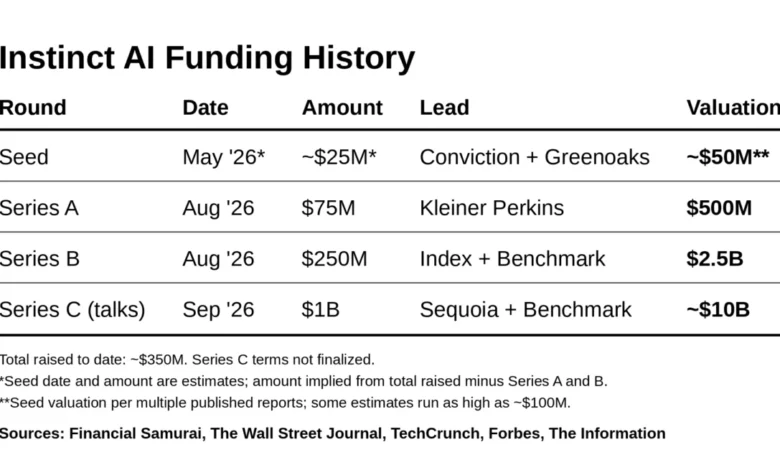
A prime illustration of this unprecedented funding velocity is Instinct, an AI assistant accessible primarily through native text messaging interfaces without requiring standalone application downloads. Founded in April 2026 by Noah Shinn, a 23-year-old former research scientist at Sierra, the company has traversed multiple institutional funding rounds at a pace previously unseen in Silicon Valley history.
The chronological expansion of Instinct’s capital structure highlights the aggressive nature of contemporary AI investing:
- April 2026: Company officially registered by Noah Shinn.
- Spring 2026: Seed funding round secured with backing from Conviction and Greenoaks at an initial valuation of $50 million.
- Early August 2026: Series A financing led by Kleiner Perkins, injecting $75 million at a $500 million valuation.
- Late August 2026: Series B financing co-led by Index Ventures and Benchmark, totaling $250 million at a $2.5 billion valuation.
- September 2026: Advanced negotiations reported for a $1 billion capital raise targeting a $10 billion valuation, with venture firms Sequoia Capital and Benchmark reportedly in talks to lead the syndicate.
Should the rumored $10 billion capitalization close, early seed investors would realize an unprecedented gross return approaching a 200x multiple within a five-month operational window. This trajectory compresses traditional venture scaling timelines from a decade into mere quarters, testing the predictive models of institutional allocators and general partners alike.
Psychological and Market Implications of Illiquid Wealth
The expansion of private company valuations generates a complex psychological phenomenon among capital allocators and startup employees. Even in the absence of immediate liquidity, substantial paper gains alter risk tolerance, professional confidence, and consumer behavior. Investors holding positions in high-performing funds report a distinct reduction in market-related anxiety, often referred to as the "fear of missing out" (FOMO), which is particularly acute among participants in localized technology hubs.
From a portfolio management perspective, holding hyper-growth private assets alongside entrenched public equities—such as major technology conglomerates with established revenue moats—creates a balanced approach to modern wealth preservation. However, financial analysts caution that paper valuations remain highly vulnerable to market corrections, regulatory shifts, and technological displacement. If competing platforms successfully deploy rival natural language models or consumer interfaces, high-flying private valuations can contract just as rapidly as they expanded.
Diversification into Real Assets and Infrastructure
The tension between illiquid paper wealth and tangible utility has driven many high-net-worth investors to hedge their technology allocations with physical infrastructure. Because artificial intelligence operations depend heavily on computational power, and compute infrastructure is fundamentally bound by physical real estate, power grids, and regulatory permitting, capital allocators increasingly target physical assets to balance their portfolios.
Investments in specialized data centers, energy grid modernizations, and industrial real estate platforms provide a bridge between the high-risk, high-reward nature of venture capital and the steady income generation of tangible property. This dual approach acknowledges that while software and artificial intelligence may dictate the future of valuation growth, physical infrastructure remains the bedrock upon which the digital economy operates.