The Economics of Climate and Real Estate: Why Weather Has Become the Ultimate Luxury Good in American Housing Markets

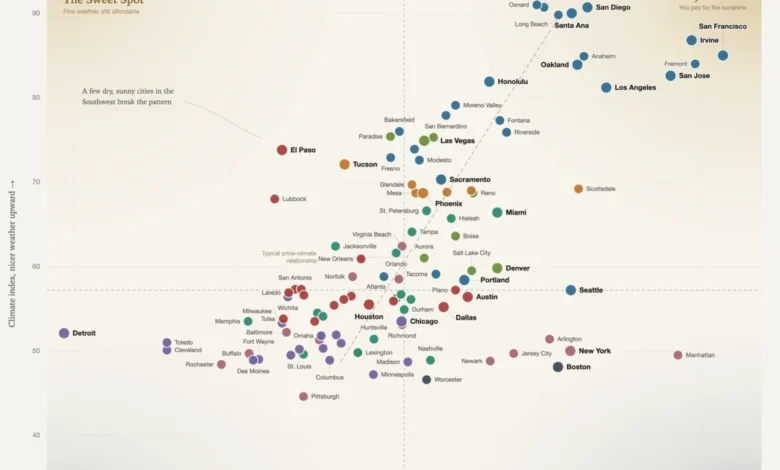
The intersection of geographic climate and residential real estate valuation has increasingly defined urban economics across the United States. Recent spatial analyses plotting more than 100 metropolitan areas against National Oceanic and Atmospheric Administration (NOAA) climate normal indexes and Redfin median home sale prices reveal a profound economic correlation: predictable, temperate weather functions as a premier, appreciating asset class. For decades, traditional macroeconomic theory dictated that residential property values were bound primarily by local employment density, median household incomes, and municipal tax structures. However, contemporary data indicates that year-round environmental comfort operates as an independent, non-depreciating driver of housing costs, fundamentally reshaping migration patterns and household balance sheets.
The Historical Evolution of Regional Migration and Economic Density
To understand the modern geographic premium, one must examine the twentieth-century shift in American demographics. Throughout the industrial era, population density concentrated heavily in the Northeastern and Midwestern rustbelts. Cities such as New York, Chicago, Detroit, and Pittsburgh served as the epicenter of manufacturing, finance, and corporate headquarters. Residents endured harsh winters—typified by heavy snowfall and sub-freezing temperatures—in exchange for proximity to high-paying labor markets and industrial capital.
By the late twentieth and early twenty-first centuries, however, technological advancements, the rise of the service and information economies, and the decentralization of traditional corporate offices altered this calculus. Professionals gained geographic flexibility, allowing lifestyle considerations to heavily influence relocation decisions. Cities in the Sunbelt, Northern California, and the Pacific Northwest experienced unprecedented net migration. This demographic shift did not merely redistribute the population; it concentrated high-net-worth individuals in regions possessing optimal climate indices, driving up housing demand in markets with fixed geographical boundaries.
Analyzing the Metropolitan Quadrants: Climate Indices Versus Housing Valuations
A comprehensive review of 110 U.S. metropolitan statistical areas categorized by weather favorability and housing costs yields four distinct quadrants that challenge traditional real estate valuation models.
The Upper-Right Quadrant: The High-Cost, High-Climate Premium
Dominated almost exclusively by California coastal markets—including San Francisco, San Diego, Los Angeles, San Jose, and Santa Barbara—alongside select Pacific and Atlantic enclaves like Honolulu and Miami, this quadrant commands the nation’s highest real estate valuations. Critics frequently characterize these markets as overvalued bubbles driven by speculative tech and foreign capital. Yet, urban economists argue these valuations are fundamentally rational.

In these regions, residential real estate substitutes for multiple consumer expenditures. A temperate, year-round outdoor climate functions implicitly as an aggregate wellness center, a natural mood stabilizer, and an open-air recreational venue. Families in these areas do not face extended winter lock-ins, eliminating seasonal displacement costs. Furthermore, these markets coincide with the highest density of venture capital, corporate headquarters, and high-income employment opportunities in the nation. Combined with strict geographical constraints—bounded by oceans, mountain ranges, and rigorous zoning regulations—housing supply remains inelastic, sustaining long-term asset appreciation.
The Upper-Left Quadrant: The Value-Hunter’s Climate Haven
Encompassing cities such as El Paso, Tucson, Phoenix, Las Vegas, and Bakersfield, the upper-left quadrant offers favorable climate metrics paired with median home sale prices at or below the national average. These metropolitan areas provide abundant sunshine and manageable winter conditions. However, the economic trade-off lies in extreme summer temperatures, which necessitate high energy consumption for cooling and seasonal lifestyle adjustments.
Despite these climatic hurdles, regions like Clark County, Nevada, and Maricopa County, Arizona, have experienced explosive population growth. The appeal is straightforward: expanding families can acquire significantly larger square footage and modern amenities for a fraction of the capital required in coastal California or the Northeast. Furthermore, jurisdictions like Nevada offer zero state income taxes, attracting remote workers, retirees, and enterprises seeking fiscal optimization.
The Lower-Left Quadrant: Affordable Essentials and Yield Optimization
The industrial Midwest and Rust Belt—featuring Detroit, Cleveland, Buffalo, St. Louis, Pittsburgh, and Minneapolis—comprise the lower-left quadrant. Characterized by affordable housing stock and challenging winter climates, these cities present a unique value proposition for real estate investors and pragmatic homeowners.
Real estate yields in this sector significantly outperform those in coastal markets. While a prime property in San Francisco or Manhattan may generate a gross rental yield of 3 percent, properties in Midwestern urban cores frequently achieve gross yields between 7 and 8 percent. Housing affordability remains high, allowing middle-income earners—such as educators, civil servants, and healthcare workers—to achieve outright homeownership early in their adult lives. While property appreciation rates historically lag behind coastal counterparts, the cash-flow generation and stability of these markets offer a reliable hedge against broader economic volatility.
The Lower-Right Quadrant: Career Density and Institutional Prestige
Home to financial and cultural capitals like New York City, Boston, Chicago, and Seattle, the lower-right quadrant commands exceptional real estate valuations despite arduous winter weather conditions and high municipal tax burdens. Residents in these urban centers are not purchasing environmental comfort; rather, they are paying for proximity to institutional power, cultural density, educational excellence, and elite professional networks.
In these environments, career optionality and serendipitous networking drive economic mobility. The ability to access decision-makers across finance, law, technology, and the arts within a compact geographic radius offsets the financial drag of high housing costs and severe seasonal weather. For many households, these economic network effects outweigh the tangible benefits of climate comfort.
Macroeconomic Implications: The Separation of Living and Investing
As the price gap between climate-favored regions and traditional industrial hubs widens, household financial strategies are evolving. Real estate strategists increasingly advocate for a bifurcated approach to asset allocation: decoupling the geography of primary residence from the geography of real estate investment.
This methodology, often termed the "Buy Utility, Rent Luxury" framework applied geographically, encourages professionals to reside in high-opportunity, high-climate-index metropolitan areas if their career trajectory demands it, while deploying investment capital into higher-yielding, lower-cost markets across the Sunbelt and the Heartland. By renting residential space in high-cost-of-living metropolitan centers—thereby avoiding massive capital lock-up in inflated markets—investors can channel funds into cash-flowing rental properties in regions with superior capitalization rates.
Institutional reactions to these demographic shifts reflect a growing recognition of climate as a quantifiable economic variable. Institutional real estate funds, real estate investment trusts (REITs), and private equity firms have systematically reallocated capital toward Sunbelt logistics, multifamily housing, and single-family rental portfolios. This institutional backing further solidifies price floors in moderate-climate markets, reducing historical volatility.
Future Outlook for Urban Centers
The premium placed on favorable weather is unlikely to recede. As remote work permanence solidifies and demographic aging alters labor force participation, lifestyle preferences will continue to exert upward pressure on housing demand in temperate regions. Metropolitan areas that fail to adapt their zoning laws to increase housing density in high-demand climate zones risk compounding affordability crises. Conversely, interior markets offering a balance of mild weather, business-friendly tax policies, and affordable housing are poised to capture continued net domestic migration. Ultimately, American residential real estate reflects a clear consumer mandate: households are increasingly willing to pay a definitive financial premium for the one commodity that monetary policy cannot manufacture—predictable, life-affirming weather.