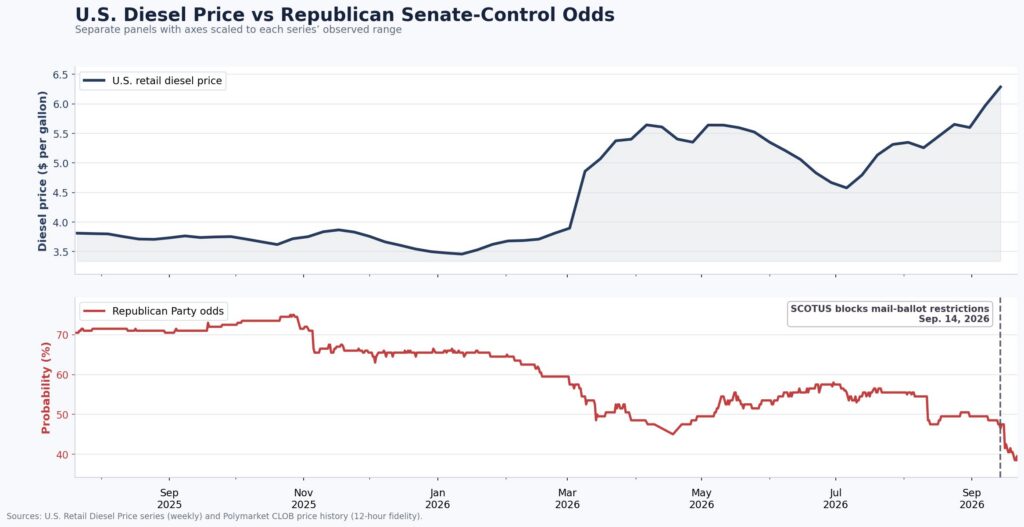
The debate surrounding the geopolitical friction between the United States and Iran has increasingly centered on Washington’s internal political pressures and Tehran’s escalating domestic instability. While much of the mainstream media commentary frequently highlights President Donald Trump’s direct incentives to negotiate a swift conclusion to hostilities—driven largely by soaring gasoline and diesel prices that threaten political standing ahead of upcoming midterm elections—this analytical framing remains incomplete. A comprehensive examination of the macroeconomic indicators suggests that Iran possesses far more urgent incentives to come to terms with the United States, propelled by a compounding domestic economic crisis that threatens the stability of the regime itself.
The Iranian Economy Under Sanctions and Conflict

Economic projections from the International Monetary Fund (IMF) paint a dire picture for Iran, estimating a gross domestic product (GDP) contraction of 6.1% alongside persistent inflation exceeding 70%. Official reports published by Iran’s Statistics Organization indicate even steeper annual inflation figures, with basic sustenance becoming increasingly out of reach for the average citizen. Essential goods have experienced staggering price surges, highlighted by fruit prices climbing roughly 75% and staples such as bread and grains nearly doubling in cost over a comparable period.
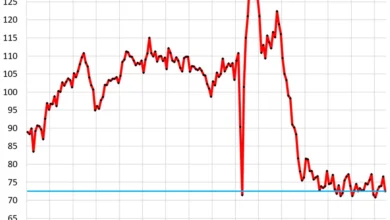
Currency depreciation has simultaneously undermined the purchasing power of the population. The Iranian rial has plummeted on unofficial markets, trading at approximately 2.3 million per U.S. dollar, a stark divergence from the state-administered benchmark rate of roughly 1.675 million. For historical context, the rial traded near 600,000 to the dollar just a year prior. This widening spread between street rates and official exchange mechanisms underscores the central bank’s waning capacity to stabilize the currency or manage external capital flows.
Although Iran’s population has demonstrated a historical resilience to external coercion—having absorbed decades of comprehensive economic sanctions and high inflation over the past half-century—the cumulative burden of the current conflict differs significantly in magnitude. While consumers in Western economies express frustration over elevated fuel prices and general inflation, overall economic foundations remain structurally sound. Conversely, the citizenry of Iran bears an exponentially heavier toll, one that financial analysts predict will eventually compel regime leadership to seek a diplomatic off-ramp or face widespread domestic insurrection.
The Bond Market, Equity Risk Premiums, and S&P 500 Valuations
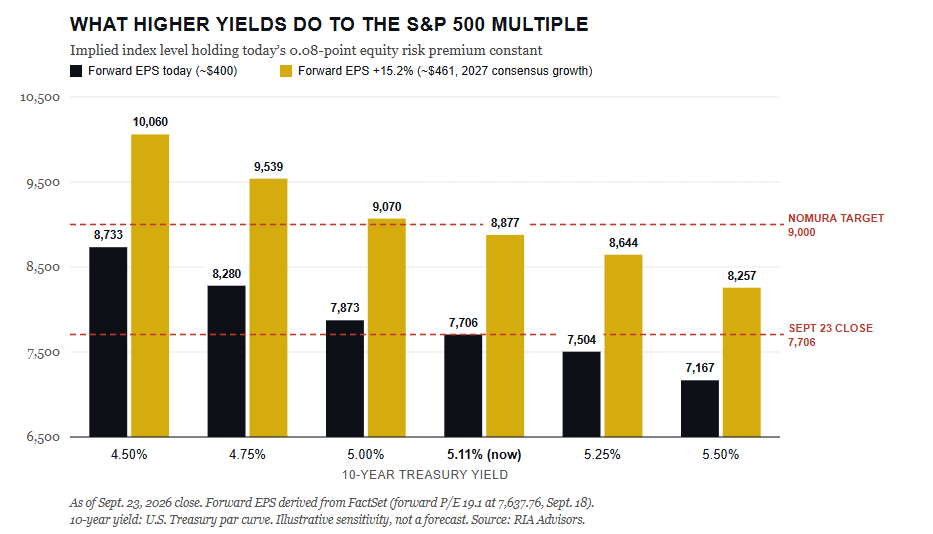
Parallel to geopolitical considerations, global financial markets face a critical inflection point dictated by rising sovereign debt yields and narrow equity risk premiums. Market strategists reviewing the economic landscape note that while corporate earnings estimates remain exceptionally optimistic—with Nomura famously outlining a speculative target of 9,000 for the S&P 500—the primary risk to equities stems from the discount rate rather than operational earnings shortfalls.
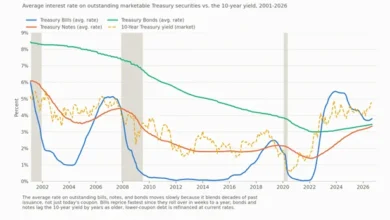
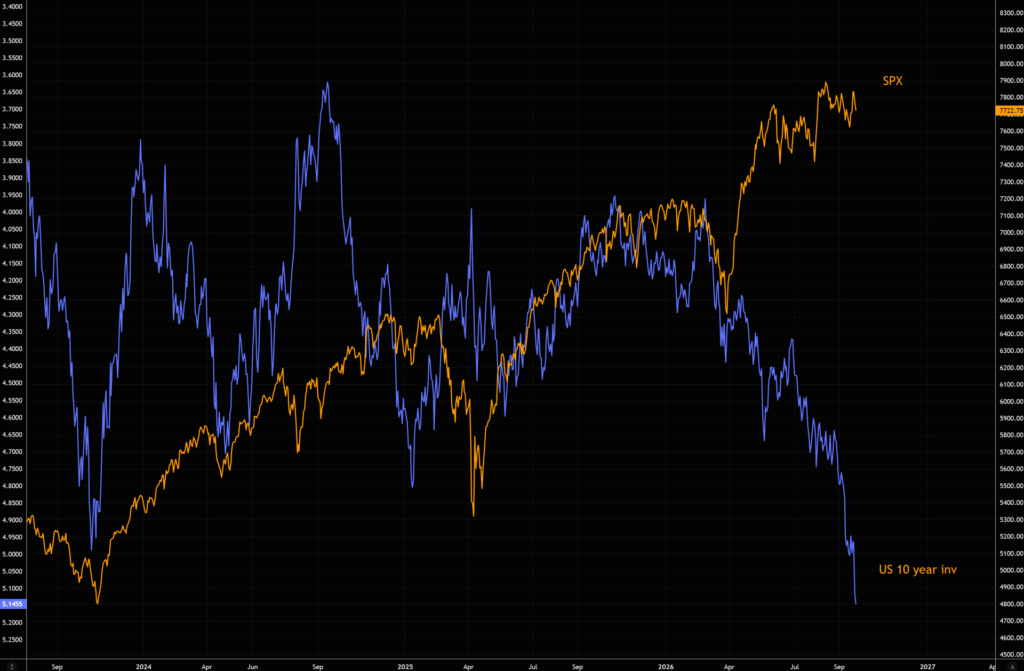
On Wednesday, the benchmark 10-year U.S. Treasury yield closed at 5.11%, marking its highest level since 2007. Despite this restrictive monetary environment, major equity indexes have exhibited remarkable resilience; the S&P 500 slipped a modest 0.8% to close at 7,706. However, a closer inspection of market mechanics reveals a compressed margin of safety. FactSet data places the forward price-to-earnings (P/E) ratio of the S&P 500 at 19.1, implying forward earnings of approximately $400 per share. This establishes an aggregate earnings yield of roughly 5.2%, which stands in stark contrast to the risk-free return of 5.11% offered by the 10-year Treasury.

Consequently, equity investors are currently compensated by a mere 8 basis points to assume the inherent volatility of stocks over guaranteed government debt. This razor-thin buffer reflects prevailing investor certainty regarding artificial intelligence-driven productivity gains and corporate earnings growth.
While proponents of a continued bull market argue that corporate profits will naturally expand to justify elevated valuations—with consensus estimates forecasting 15.2% earnings growth by 2027—such expansion assumes stable or declining discount rates. Consensus projections suggest forward earnings could approach $461, yet at current yields, this level only supports an index valuation near 8,877. Achieving a milestone of 9,000 necessitates a retracement of the 10-year Treasury yield toward the 5.0% threshold. Conversely, if yields advance to 5.5%, fair value models indicate that the S&P 500 could face downward pressure toward 7,170, representing a potential correction of approximately 7% from recent closing levels.
Velocity of Yields and Historical Market Precedents
Market historians frequently reference Robert Farrell’s ninth market rule, which posits that when all forecasters and experts reach a universal consensus, alternative outcomes frequently materialize. While Wall Street consensus remains anchored to robust earnings forecasts, few analysts are adequately stress-testing portfolios against rapid fluctuations in discount rates.
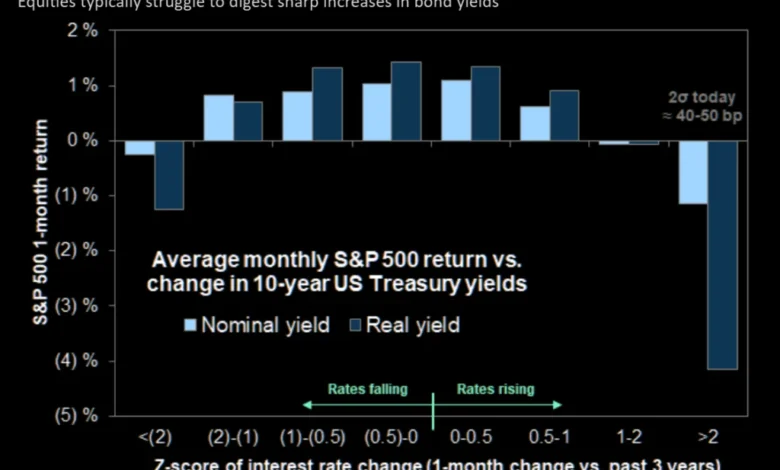
Financial institutions emphasize that the velocity of yield adjustments carries as much significance as the absolute level. Historical observations from Goldman Sachs indicate that equity markets characteristically encounter significant resistance once the 10-year Treasury yield completes a two-standard-deviation move, defined as a 30-basis-point increase within a two-week window or a 50-basis-point increase over a month. Market dynamics have approached these thresholds, with the 10-year yield climbing 28 basis points since early September and 37 basis points since late August.
The immediate impact of this monetary tightening has manifested prominently in rate-sensitive sectors. The Russell 2000 index of small-capitalization companies tumbled 1.8% in a single session, absorbing losses more than double those sustained by the broader S&P 500. Portfolio managers recommend prudent risk management strategies, advising investors to rebalance equity allocations toward target weights, trim long-duration growth assets vulnerable to elevated interest rates, and maintain adequate cash reserves.
Meta’s Muse Launch and Sector Disruption
Away from macroeconomic and geopolitical headwinds, the technology sector experienced a significant structural shock following Meta Platforms’ launch of its personal artificial intelligence agent, designated "Muse." Shares of Meta surged more than 10% following the announcement, propelling the application to the number one position on Apple’s U.S. App Store within days and extending the company’s stock gains past 20% over a two-week period.
Financial institutions have quickly revised growth trajectories for the tech giant. Projections compiled by Truist Bank suggest that the Muse platform could generate up to $28.5 billion in incremental revenue by the year 2030, prompting analysts to observe a fundamental shift in market sentiment surrounding Meta’s long-term monetization capabilities.
The commercial ramifications of the rollout quickly rippled across traditional financial services. On the day of the announcement, Charles Schwab shares dropped 6.1%, while JPMorgan Chase, Bank of America, and American Express declined 3.4%, 3%, and 2.6%, respectively. Market analysts attribute this synchronized sell-off among brokerages, wealth managers, and banking institutions to mounting anxieties that sophisticated AI agents will disintermediate traditional financial advisory and consumer banking services.
Despite the initial market enthusiasm and consumer adoption—evidenced by over 2.5 million downloads within a fortnight—the regulatory and operational landscape for AI agents remains contentious. Retail giant Amazon notably blocked the application from executing automated purchases on its e-commerce platform due to unauthorized data access protocols. Furthermore, consumer trust studies published by Oppenheimer indicate that only 8% of surveyed consumers express willingness to entrust Meta with sensitive credentials, compared to 30% for competitors such as Google.
Industry analysts anticipate that rival technology conglomerates, including Alphabet (Google) and OpenAI, will introduce competing agentic frameworks in the near term. Nevertheless, the rapid deployment of Muse signals a crucial transition wherein artificial intelligence revenue generation is expanding beyond foundational data center infrastructure and model usage fees, fundamentally altering valuations across adjacent consumer and financial sectors.