The Deceptive Simplicity of Data Mining and Vibe Quanting in Financial Markets

The allure of quick profits and sophisticated trading strategies has led many to explore the realms of data mining and what is colloquially termed "vibe quanting." However, a closer examination reveals a fundamental sameness in their approach, both at a core operational level and in their underlying philosophical assumptions about market engagement. This article delves into the methodologies, critiques, and alternative frameworks for achieving sustainable success in financial markets, moving beyond the superficial appeal of pattern recognition to a deeper understanding of market mechanics and the creation of genuine trading edges.
The Illusion of Automated Discovery
At their heart, both data mining and vibe quanting operate on a principle of exhaustive exploration. Data mining, in its traditional application, can be understood as a process of systematically testing a vast number of rules and parameters against historical market data until a set of conditions appears to yield profitable results. The underlying assumption is that within the historical record lies a discoverable pattern that, when replicated, will continue to generate alpha.
Vibe quanting, often amplified by the capabilities of artificial intelligence and machine learning, essentially automates this process. Instead of a human meticulously crafting and testing each rule, AI algorithms are employed to iterate through an even larger, more complex array of potential patterns and correlations. The statement, "I’ll try enough rules until something sticks," is the common denominator. Whether the engine is human intuition or an advanced algorithm, the fundamental methodology remains the same: brute-force pattern identification.
A Philosophical Critique: Seeking Reward Without Understanding
The philosophical underpinnings of these approaches reveal a shared ambition to extract value from markets without necessarily grasping the causal mechanisms driving that value. Both can be seen as attempts to "skip the hard part" – the rigorous intellectual labor of understanding why certain market movements occur and who is facilitating them. This is akin to trying to win a chess game by memorizing opening moves without understanding strategic principles, or building a complex machine without understanding the laws of physics that govern its operation.
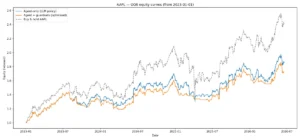
The author’s personal journey, as described, mirrors that of many who have been drawn into this pursuit. The experience of "building increasingly elaborate systems, torturing parameters until the equity curve looked right, confusing a good backtest with a good idea," is a common narrative. This phase often feels like progress, a testament to intellectual prowess and technical skill. Yet, as the author contends, it is neither. It represents a sophisticated form of overfitting, where historical data is bent to fit a preconceived outcome, rather than deriving an outcome from a fundamental understanding of market dynamics.
The discomfort or feeling that "something was off" for those who have engaged in these practices is a valid intuition. It signals a disconnect between the perceived sophistication of the method and the elusive nature of sustainable trading success. This article aims to illuminate a more robust and intellectually honest path forward.
The Cornerstone of Edge: Understanding Counterparties
The core of any sustainable trading strategy lies in identifying and exploiting a genuine "edge." An edge is not merely a profitable pattern; it is a predictable advantage derived from a structural inefficiency or a consistent market dynamic. Crucially, every dollar of trading profit originates from another market participant who, by definition, is losing money on that specific trade. Therefore, the foundational question for any aspiring trader must be: "Who is paying me, and why are they willing to continue doing so?"
This question transcends mere curiosity; it is the bedrock upon which profitable trading is built. It requires a deeper inquiry: "Why do I, an individual trader operating with potentially limited resources and visibility, have access to this profitable exchange?" The answers to these questions provide the vital context that data mining and vibe quanting often overlook.
Case Studies of Sustainable Edges
Consider the example of a wealth manager rebalancing a portfolio. These institutions operate under strict mandates to maintain specific asset allocations. If a particular asset class, such as stocks, experiences a significant rally, the wealth manager is compelled to sell those appreciated assets and reinvest in others, like bonds, to adhere to their target percentages. This rebalancing is not driven by market timing or a view on the assets themselves, but by the obligation to maintain the portfolio’s structure.
The timing of these rebalancing flows, especially around month-end, can become semi-predictable. The sheer volume of these trades, irrespective of price, can influence market direction. A trader who understands this dynamic can position themselves to profit from these mandated flows. The wealth manager is not intentionally losing money; their primary objective is asset allocation, and the cost of rebalancing is secondary. This creates an opportunity for a trader who can reliably take the other side of these trades.
The edge here is clear: the trader knows who is paying (the wealth manager), why they are paying (mandated rebalancing), and why they will continue to pay (the ongoing need to maintain allocations). Furthermore, the trader understands why they are allowed to participate: the edge is often too small, too infrequent, or too noisy for larger, more resource-intensive players to focus on, making it accessible to nimble individuals.
Another compelling example is "crypto carry." In cryptocurrency markets, leveraged speculators on perpetual futures contracts pay funding fees to the holders of the opposite position. This funding rate is essentially the cost of leverage. These speculators are willing to bear this cost because the potential for amplified gains outweighs their concern for the expense. The trader who acts as the counterparty collects these funding fees. They know who pays (leveraged speculators), why they pay (the desire for amplified leverage), and why they will continue to pay (the persistent demand for leveraged trading). The edge is derived from providing liquidity and bearing a risk that others are willing to pay to offload.
Contrast this with a generic statement like, "My backtest of a 14-day RSI crossover with a 50-day moving average filter returned 23% annually from 2019-2025." While such a backtest might appear impressive, it fails to address the critical questions. Who is paying you? Why? Will they continue to pay? Without this understanding, the backtest result is merely a pattern identified in historical data, with no inherent guarantee of future performance. It could be a statistical artifact, a result of data mining, or a fleeting anomaly.
The Limitations of Backtesting as a Research Tool
A significant hurdle in the pursuit of genuine trading edges is the overreliance on backtesting as a primary research tool. Backtesting, by its nature, simulates the performance of a defined set of rules on historical data. While it can indicate whether a strategy could have been profitable in the past, it is a poor instrument for uncovering the underlying edge itself.
The process of creating and optimizing trading rules for a backtest involves numerous degrees of freedom. When applied to noisy market data, the probability of finding spurious patterns that appear profitable purely by chance is exceedingly high. This is a core problem, regardless of whether the optimization is performed manually or delegated to AI. As the author points out, "The AI is faster at finding patterns that don’t mean anything."
Even sophisticated statistical techniques designed to mitigate the issues of multiple testing, such as walk-forward optimization or Monte Carlo simulations, do not address the fundamental problem. While these methods can establish that a pattern is statistically unlikely to be random noise, they cannot prove that the pattern has a reason to persist in the future. The distinction between "unlikely to be noise" and "driven by a structural mechanism that will keep generating returns" is profound. Statistical rigor alone cannot bridge this gap.
The analogy of fishing in an unstudied river is apt. A fisherman with the best equipment and meticulous record-keeping of every cast might catch nothing if they lack an understanding of the river’s ecosystem: where fish reside, their feeding habits, and how water conditions affect their behavior. In contrast, a local angler with rudimentary gear but deep knowledge of the river can consistently catch fish because they understand its underlying dynamics. Similarly, in trading, true success comes not from sophisticated tools and statistical hygiene, but from understanding the "river" of market participants and their motivations.
The Critical Deficiency: The Absence of Compound Learning
Beyond the methodological flaws, a more profound issue with data mining and vibe quanting is their failure to foster genuine learning. The process of diligently identifying an edge involves a cycle of observation, hypothesis formation, data analysis, and refinement. Each iteration of this cycle deepens the trader’s understanding of market mechanics, participant behavior, and the nuances of different market structures. This leads to the development of intuition and a more sophisticated ability to anticipate where profitable opportunities might lie. This is the essence of "compound learning."
In stark contrast, the data miner or vibe quant engages in a process where each backtest, regardless of its outcome, contributes little to their fundamental understanding of markets. If a strategy fails, the only recourse is to mine again, repeating the same flawed process. Three years of this can result in thousands of backtests, yet the trader remains no wiser about the underlying market forces. As the author states, "Zero compounds to zero, no matter how many cycles you do." This path is a treadmill, offering the illusion of progress without actual advancement.
Curiosity as a Catalyst for True Edge Discovery
The path to uncovering genuine trading edges requires a different mindset – one driven by curiosity and a willingness to engage in slow, deliberate thinking. This process is less about "building a trading strategy" in the conventional sense and more akin to scientific exploration. It involves understanding market structure, the motivations and constraints of various participants, and sketching out the causal links that might lead to predictable market distortions.
This type of research can feel tedious and less immediately rewarding than the dopamine rush of seeing a profitable equity curve emerge from a backtest. The "building the system" phase, with its coding and parameter tuning, often holds more appeal. However, it is precisely this deeper, more analytical work that separates consistently profitable traders from those who chase fleeting patterns.
The Transformative Power of Genuine Interest
The "Trade Like a Quant Bootcamp" serves as a practical illustration of this principle. Over the years, a significant portion of participants discover that they are genuinely fascinated by the intellectual challenge of understanding market puzzles. They are motivated not solely by profit, but by the intrinsic interest in market mechanics – why wealth managers create specific flows, or how funding rates differ across exchanges. This inherent curiosity is a powerful advantage. It drives them to perform the rigorous research that others find unappealing, fostering the compound learning that translates into real trading acumen. For these individuals, financial success becomes a natural byproduct of their intellectual engagement.
Another segment of participants realizes that while active research isn’t their primary inclination, they are interested in harvesting risk premia in a more passive manner, requiring less intensive daily involvement. This self-awareness is also a valuable outcome, allowing them to set realistic expectations and pursue strategies that align with their preferences.
The third group, upon experiencing the nature of the work involved, concludes that it is not for them, opting for a refund. This outcome, while seemingly a loss for the course provider, is considered a significant win from the perspective of individual development. It prevents these individuals from investing years in a path that is neither enjoyable nor effective, saving them from the profound frustration of pursuing a trading career without genuine interest or understanding.
The Imperative of Intrinsic Motivation in Trading
The ultimate pitfall is not choosing the wrong strategy, but spending years on a path that is unenjoyable and unproductive due to a lack of self-awareness regarding one’s intrinsic interest in the actual work of trading. Active trading demands intellectual rigor, continuous research, and the navigation of uncertainty. These elements must be found engaging in their own right, not merely as means to an end.
While money is an undeniable objective in trading, it cannot be the sole driver for sustainable success in active strategies. The path to profitability is paved with the very work that one must find intrinsically worthwhile. The research, the analysis, the deep thinking about market participants and their incentives – these are the components that, when pursued with genuine interest, lead to the development of a robust trading edge and, consequently, to financial rewards.
The "Trade Like a Quant Bootcamp" is designed to guide individuals through this understanding, focusing on how to conceptualize edge, identify paying counterparties and their motivations, and conduct research that cultivates compound learning rather than frustration. For those who resonate with this approach and recognize their inherent curiosity for market dynamics, the path may lead further into specialized programs like "RW Pro," where a community of dedicated traders continues to build upon this foundation of deep market understanding.