AUD/USD Climbs Toward 0.7100 as Broad Dollar Weakness and Hawkish RBA Expectations Collide


The AUD/USD currency pair extended its robust winning streak into a third consecutive session during Asian trading hours, hovering near the 0.7080 mark and threatening a breakout toward the psychological 0.7100 threshold. This upward trajectory is primarily being driven by a combination of persistent US dollar weakness across global foreign exchange markets and rapidly shifting monetary policy expectations on the domestic front, where market participants are increasingly pricing in aggressive interest rate hikes by the Reserve Bank of Australia (RBA). While the macroeconomic fundamentals for the Australian dollar remain remarkably resilient, traders are actively weighing the risks of overbought technical indicators against macroeconomic headwinds stemming from Washington’s official policy stance.
Macroeconomic Background and the Anatomy of US Dollar Weakness
The current downside bias plaguing the US dollar index (DXY)—which remains firmly anchored around the 96.00 handle, marking its weakest valuation environment since February 2022—has provided the foundational catalyst for the broader rally in risk-correlated assets, most notably the Australian dollar. This downward pressure on the greenback persists despite the Federal Reserve opting to keep benchmark borrowing costs unchanged during its recent policy meeting. Federal Reserve Chair Jerome Powell reiterated during his post-meeting address that domestic inflation prints remain stubbornly above the central bank’s target threshold, a reality that under normal market dynamics would typically lend support to the American currency.
However, currency markets are currently discounting traditional interest rate differentials in favor of broader structural, political, and institutional anxieties. Growing institutional scrutiny surrounding the independence of the Federal Reserve, combined with escalating geopolitical discussions regarding global de-dollarization and diversified reserve management by foreign central banks, has eroded confidence in greenback-denominated assets. Furthermore, statements from senior fiscal officials, including US Treasury Secretary Scott Bessent, have attempted to reaffirm Washington’s formal commitment to a traditional "strong dollar" policy. Despite these verbal interventions from the executive branch, foreign exchange markets remain skeptical, maintaining heavy short positions on the DXY as ongoing institutional risks overshadow official rhetoric.
Domestic Momentum: Australian Inflation Surprises and RBA Policy Pricing
In stark contrast to the structural headwinds facing the United States currency, the macroeconomic landscape within Australia has undergone a hawkish transformation. Recent domestic data releases indicate that inflationary pressures within the Australian economy are not only proving sticky but are accelerating faster than consensus estimates had previously projected.
According to data released by the Australian Bureau of Statistics, the headline Consumer Price Index (CPI) climbed to 3.8% on a year-over-year basis in December, accelerating past the previous month’s print of 3.4% and easily outpacing market expectations of 3.6%. Furthermore, underlying measures of core inflation also demonstrated persistent momentum, with the trimmed mean inflation gauge ticking higher to 3.3% year-over-year while registering a 0.2% monthly increase.
These hotter-than-expected inflation metrics have fundamentally altered the pricing models of interest rate swaps and futures markets. Market participants are now pricing in a probability exceeding 70% that the Reserve Bank of Australia will implement a 25-basis-point rate hike from its current cash rate of 3.6%. Looking further ahead along the monetary policy horizon, pricing models indicate that the cash rate is now fully expected to reach 3.85% by May, with terminal rate expectations clustered close to 4.10% by September.
External Trade Dynamics and Sector Strength
Beyond consumer prices, Australia’s external economic sectors have delivered robust performances, further cementing the fundamental case for a stronger domestic currency. Official trade balance metrics highlighted a notable resurgence in export performance, with export prices surging 3.2% quarter-over-quarter during the fourth quarter. This expansion follows a protracted period of sluggish external demand characterized by three consecutive quarters of weak export price growth.

Simultaneously, an increase in import prices underscores healthy domestic demand, reinforcing the narrative that Australia’s macroeconomic foundations remain sufficiently robust to absorb tighter monetary policy without risking an immediate economic contraction. This convergence of rising export revenues and persistent domestic inflation has given the RBA considerable policy leeway to prioritize price stability over growth support, directly contrasting with the cautious, data-dependent stance currently adopted by major global peers.
Policy Signals and Competing Washington Dynamics
Despite the pervasive bearish sentiment currently dictating the trajectory of the greenback, market analysts emphasize that the upside momentum in the AUD/USD pair is unlikely to proceed entirely unchecked. The currency pair faces immediate headwinds stemming from intermittent policy signals originating from Washington and the Federal Reserve’s ongoing commitment to a meeting-by-meeting, data-dependent strategy.
While Treasury Secretary Scott Bessent’s renewed commitment to a strong dollar policy serves as a verbal ceiling for aggressive greenback liquidation, the Federal Reserve’s acknowledgment of still-elevated inflation and solid underlying economic growth leaves ample room for a rapid market repricing. Should incoming United States macroeconomic indicators—starting prominently with weekly initial jobless claims and subsequent employment data—surprise consensus forecasts on the upside, the narrative of aggressive Fed easing could be swiftly challenged, offering a temporary lifeline to beleaguered dollar bulls.
Technical Analysis and Price Action Overview
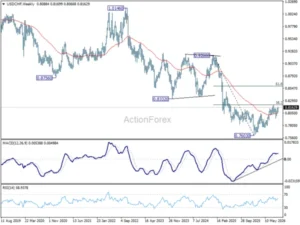
From a technical perspective, the price action on the AUD/USD 4-hour chart illustrates sustained bullish control, with buyers consistently stepping in to defend intermediate moving averages and driving spot prices toward the 0.7100 handle. The broader uptrend remains well-supported above the crucial 20-period moving average, which is currently sloping upward near the 0.6970 region.
Despite the decisive bullish momentum, momentum oscillators such as the Relative Strength Index (RSI) are flashing extreme overbought conditions. This technical divergence suggests that while the overarching trend favors buyers, the pair may be susceptible to near-term technical corrections or periods of consolidation before a legitimate assault on higher resistance levels can be sustained.
In the event of a corrective pullback, initial downside support is anticipated near the psychological 0.7000 handle. A sustained break below this round number would expose the more robust structural support zone anchored at the 20-period moving average near 0.6970, with deeper corrective floors located near 0.6950. Conversely, if buyers manage to absorb immediate selling pressure and establish firm price acceptance above the 0.7100 resistance barrier, the currency pair would clear the path for an extended technical advance toward primary upside objectives at 0.7150, with secondary targets resting near the 0.7200 threshold.
Broader Market Implications and Investor Outlook
The ongoing appreciation of the AUD/USD pair serves as a clear microcosm of the broader shifts taking place across global financial markets at the outset of 2026. As divergence widens between a Federal Reserve grappling with institutional credibility issues and persistent inflation on one hand, and a hawkish Reserve Bank of Australia responding to accelerating domestic price pressures on the other, currency traders are increasingly forced to reallocate capital away from the greenback in favor of high-beta, commodity-linked currencies.
For institutional investors, corporate treasuries, and retail market participants alike, navigating this dynamic environment requires close attention to high-frequency economic data releases, particularly upcoming labor market prints from the United States and global commodity price indices. While the path of least resistance for the Australian dollar remains skewed to the upside in the near term, the delicate interplay between aggressive domestic rate expectations and unpredictable policy interventions from Washington ensures that volatility will remain a defining characteristic of foreign exchange markets in the weeks ahead.
Related posts: