USD/CHF Technical Outlook: Near-Term Rebound Eyes 0.8205/13 Resistance Amid Broader Multi-Decade Downtrend

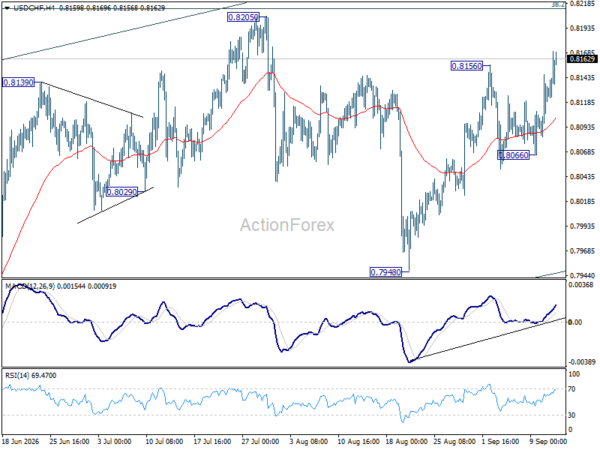
The US Dollar to Swiss Franc (USD/CHF) currency pair has captured the attention of foreign exchange traders and institutional analysts alike following a notable shift in momentum late last week. After carving out a low at 0.7948, the pair initiated a technical rebound that gained substantial traction when it cleanly breached the critical 0.8156 resistance barrier. As markets open for the new trading week, the immediate technical bias points mildly to the upside, with market participants setting their sights on the formidable 0.8205 to 0.8213 resistance zone. A decisive, volume-backed break through this threshold could signal deeper bullish implications for the pair, altering short-term market dynamics while testing the structural resilience of the prevailing long-term trend.
Near-Term Price Action and Immediate Technical Levels
Analyzing the immediate intraday and weekly charts, the current bullish momentum remains structurally intact provided that the crucial downside support level at 0.8066 holds firm. Should profit-taking or minor macroeconomic pullbacks occur, currency strategists note that any retreat should ideally find a floor near this support level to keep the path of least resistance pointed higher toward the 0.8205/13 resistance cluster.
The breakout above 0.8156 at the close of last week has invalidated several short-term bearish setups, forcing tactical traders to adjust their risk parameters. However, foreign exchange desks emphasize that moving past the 0.8205/13 zone is not merely a psychological victory for dollar bulls; it represents a major structural hurdle. Until a confirmed, decisive daily and weekly close occurs above this target area, the broader medium-term framework suggests that the recent recovery may ultimately struggle to establish a sustained trend reversal.
Medium-Term Outlook and Retracement Analysis
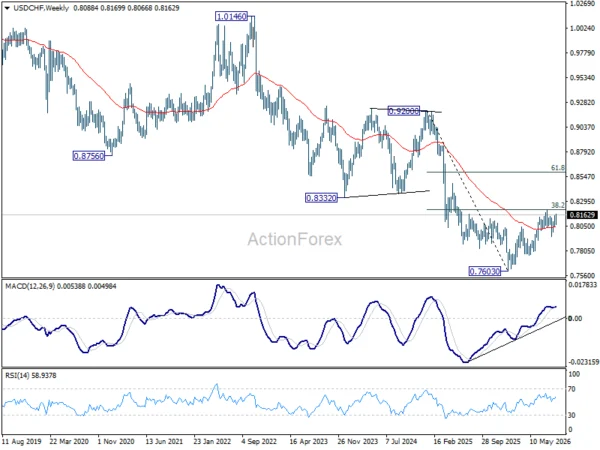
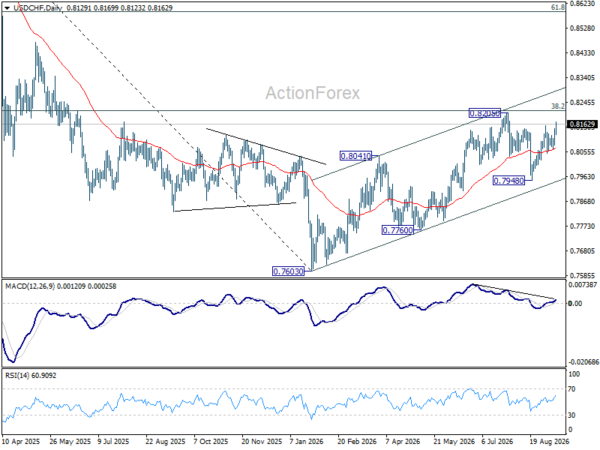
Stepping back to evaluate the medium-term market structure, market focus has zeroed in on the 38.2% Fibonacci retracement level of the major downleg spanning from the 2025 high of 0.9200 down to the recent cycle low of 0.7603, which converges precisely at 0.8213.
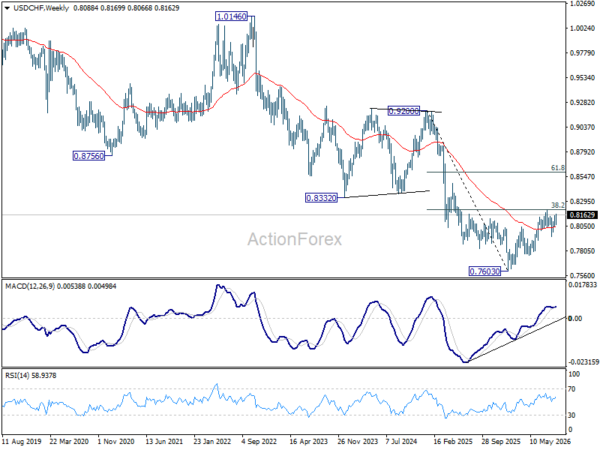
This technical convergence is vital for portfolio managers and hedge funds monitoring the Swiss franc. A decisive and validated break above 0.8213 would offer the first concrete technical evidence that the USD/CHF pair is actively reversing its medium-term bearish trend. Such a breakthrough would immediately redirect analytical attention toward the 0.8332 handle—a historic support level from 2023 that has since inverted into a formidable overhead resistance zone. A successful retest and acceptance above 0.8332 would serve as confirmation of a broader trend shift, potentially sparking systemic short-covering among institutional accounts holding heavy short USD positions.
Conversely, a strong rejection of prices by the 0.8213 barrier would carry vastly different implications. It would suggest that the substantial rebound observed from the 0.7603 cyclical low is nothing more than a temporary, corrective retracement within a larger, unbroken secular downtrend. Under that scenario, disappointment among dollar bulls could trigger renewed selling pressure, driving the pair back down toward established support structures and keeping the long-term structural downtrend entirely intact.
Historical Context and Long-Term Macroeconomic Perspective
To fully understand the weight of the current technical crossroads, analysts must examine the multi-decade trajectory of the USD/CHF currency pair. The macro picture reveals that price action originating from the 2011 historic low of 0.7065 is widely interpreted by technical strategists as an extensive, highly complex corrective pattern within a multi-decade structural decline that commenced at the turn of the millennium—specifically from the monumental 2000 peak of 1.8305.
The structural integrity of this century-long depreciation reflects profound macroeconomic shifts, including persistent interest rate differentials between the United States Federal Reserve and the Swiss National Bank (SNB), structural safe-haven flows favoring the Swiss franc during global economic turbulence, and long-term structural changes in global trade and reserve currency allocations.
Within this historical context, a key analytical debate persists among veteran currency strategists: whether the aggressive downward impulsive wave originating from the 1.0342 high represents the second leg of a complex corrective pattern or the definitive resumption of the secular multi-decade downtrend. Regardless of which wave count proves accurate, the overarching macro outlook remains decisively bearish as long as the critical ceiling at 0.8756—which marks the 2021 low turned major resistance—holds firm against any bullish advances. Should the long-term bearish momentum reassert itself following the current corrective phase, a comprehensive retest of the foundational 2011 low at 0.7065 remains a plausible long-term target for institutional macro models.
Macroeconomic Drivers and Central Bank Policy Divergence
Underpinning these technical price configurations are fundamental shifts in monetary policy between Washington and Bern. The US Federal Reserve continues to navigate a complex economic landscape characterized by sticky domestic inflation prints, resilient labor market data, and fluctuating growth expectations. These economic indicators continually force traders to recalibrate their expectations regarding the trajectory of US interest rates, directly influencing the yield attractiveness of greenback-denominated assets.
On the other side of the Atlantic, the Swiss National Bank maintains its own unique set of monetary policy challenges. Switzerland’s persistent struggle with imported inflation, driven historically by the strength of the Swiss franc, has frequently prompted verbal interventions and active monetary management from SNB officials. The Swiss franc’s status as a premier global safe-haven asset means that geopolitical tensions, fiscal uncertainties in major economies, and shifting risk sentiment across global equity markets routinely trigger sudden, sharp inflows into the CHF, exerting persistent downward gravity on the USD/CHF exchange rate.
Institutional market makers note that while technical indicators like Fibonacci retracements and moving average clusters provide clear roadmaps for execution, the fundamental interplay between US macroeconomic data releases and SNB policy communications will ultimately dictate whether the pair can break through overhead resistance or succumb to the weight of the multi-decade downtrend.
Market Implications and Trading Strategies
As global trading desks position themselves for the upcoming sessions, risk management remains paramount. Short-term momentum traders are currently favoring long exposures while the spot price remains comfortably above the 0.8066 support threshold, targeting a systematic test of the 0.8205/13 resistance band. However, strict stop-loss protocols are being enforced just beneath immediate support levels to mitigate the risk of a sudden bearish reversal.
For longer-term investors and macro hedge funds, the current price action near 0.8213 represents a high-stakes decision point. A failure at this juncture would validate the persistence of the secular downtrend, offering lucrative opportunities for medium-term short positioning targeting deeper historical supports. Conversely, a confirmed structural breakout above 0.8332 would necessitate a comprehensive strategic reassessment, potentially leading to a massive reallocation of capital into US dollar assets against the Swiss currency. As the week unfolds, market participants will closely monitor incoming economic catalysts, order flow dynamics, and volume profiles around these pivotal price zones to gauge the ultimate trajectory of the USD/CHF pairing.