Debunking the U.S. Debt Trap: Why Perpetual Fiscal Warnings Fail to Match Economic Reality

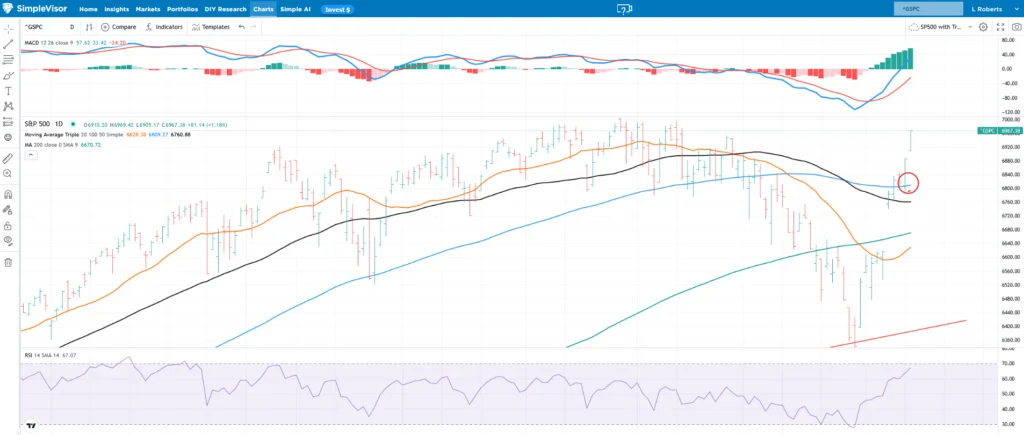
Every few quarters, a prominent financial publication releases a compelling thesis warning that the United States is standing on the precipice of a fiscal catastrophe. The latest iteration of this narrative—frequently highlighted by outlets like The Economist and echoed by macro analysts—contends that Washington’s relentless borrowing has cornered the Federal Reserve. According to this school of thought, the central bank is trapped, unable to raise interest rates without detonating explosive federal financing costs and triggering widespread insolvency. This storyline has become a fixture of modern financial media, resurfacing periodically in the wake of every major legislative spending package or credit rating downgrade.

However, a critical examination of macroeconomic data reveals a stark disconnect between these perpetual doomsday forecasts and market reality. While the long-term trajectory of federal debt presents legitimate structural challenges, the immediate threat of a "U.S. debt trap" collapses under empirical scrutiny. Chief among the flaws in these forecasts is a persistent refusal to attach a timeline or date to the predicted crisis. Without falsifiable parameters, financial forecasting risks devolving from rigorous economic analysis into generalized pessimism—a mood rather than a quantifiable prediction.
The History of Dateless Prophecies in Macroeconomics
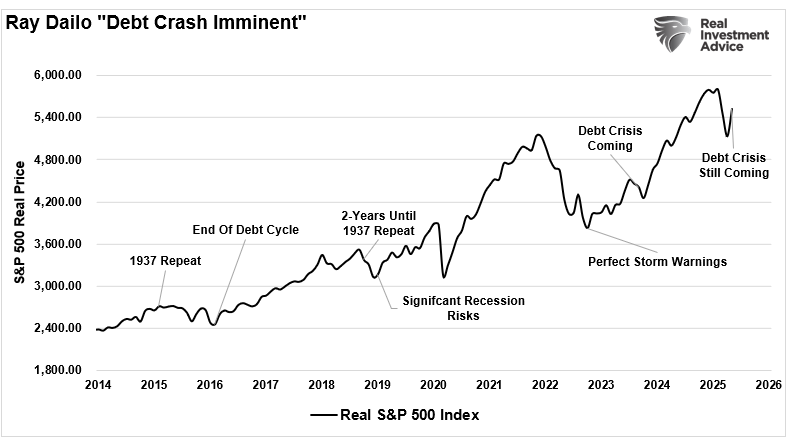
The genre of the dateless fiscal crisis has a long and storied pedigree in financial commentary. Legendary investors and economists have occasionally fallen into the trap of projecting structural imbalances into imminent operational crises. Ray Dalio, founder of Bridgewater Associates and one of the most successful macro investors in history, has openly acknowledged past forecasting errors stemming from this exact bias. In retrospectives detailing his career, Dalio noted that during the 1981–1982 period, he became utterly convinced that the U.S. economy was sliding into an unprecedented depression driven by tight monetary policy and mounting public debt.

Convinced of his thesis, Dalio publicized his warnings across television, print columns, and congressional testimony. Yet, the anticipated systemic collapse failed to materialize in the manner or timeframe predicted, and investors who positioned their portfolios defensively missed one of the most powerful secular bull markets in modern financial history. Despite recognizing these historical miscalculations, variations of the imminent-crisis thesis continue to dominate financial media cycles.
Commentators frequently rely on Rudi Dornbusch’s famous maxim: "A crisis takes far longer to arrive than you think possible, and then arrives faster than you ever imagined." While economically profound, this observation often functions as an analytical alibi. When a predicted fiscal reckoning fails to occur, proponents can argue simply that the trigger has not yet been pulled. Because these forecasts refuse to specify a year or structural breaking point, they are unfalsifiable by design, shielding erroneous models from accountability while potentially misleading long-term investors.
Dissecting the Monetary Assumptions Behind the Debt Trap
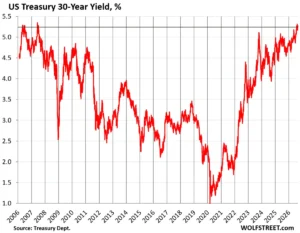
The theoretical foundation of the U.S. debt trap hypothesis rests on a specific monetary assumption: that persistently sticky inflation will force the Federal Reserve into an aggressive, sustained hiking cycle, which will subsequently bankrupt the Treasury as maturing debt is rolled over at prohibitively high yields.
An objective review of monetary policy indicators challenges this foundational premise. Rather than signaling a loss of control, the Federal Reserve has maintained its benchmark policy rate within a steady range of 3.50% to 3.75%, opting for stability through successive policy meetings. International financial bodies, including the International Monetary Fund (IMF), have classified the current federal funds rate as "close to neutral"—the optimal threshold where monetary policy neither aggressively stimulates nor unduly restricts economic activity. This positioning does not reflect a central bank caught in a structural trap; rather, it indicates a monetary authority maintaining equilibrium.

Furthermore, recent inflationary pressures have not emerged from a classic wage-price spiral driven by an overheating domestic labor market. Instead, core inflation has been influenced primarily by external supply-side factors, including geopolitical energy shocks affecting global oil prices and tariff pass-throughs impacting consumer goods. Economic projections from major institutions suggest these transitory pressures will gradually subside, guiding core inflation back toward the Federal Reserve’s stated 2% target. Concurrently, labor market reports indicating cooling job growth suggest that an aggressive, forced tightening cycle remains unlikely.
The Disinflationary Nature of Sovereign Debt
Paradoxically, mainstream economic studies indicate that high levels of public debt tend to exert a disinflationary, rather than inflationary, force over the long term. Research conducted by economists at academic and policy institutions, such as the Mercatus Center at George Mason University, highlights that excess government debt often carries a zero-to-negative fiscal multiplier effect.

The fiscal multiplier measures the economic output generated for every dollar of government spending. When the multiplier exceeds one, public spending stimulates private sector activity, consumer spending, and capital investment, creating an inflationary environment. Conversely, when the multiplier falls below one—as is frequently observed with high debt-to-GDP ratios—government borrowing crowds out private sector activity, ultimately dampening aggregate demand and slowing velocity of money.
Consequently, every dollar diverted to servicing legacy national debt is a dollar that fails to fund productive private enterprise. This structural dynamic depresses the natural rate of interest over time, serving as an endogenous mechanism that dampens the runaway yields predicted by debt-trap models.
Contextualizing Federal Interest Payments
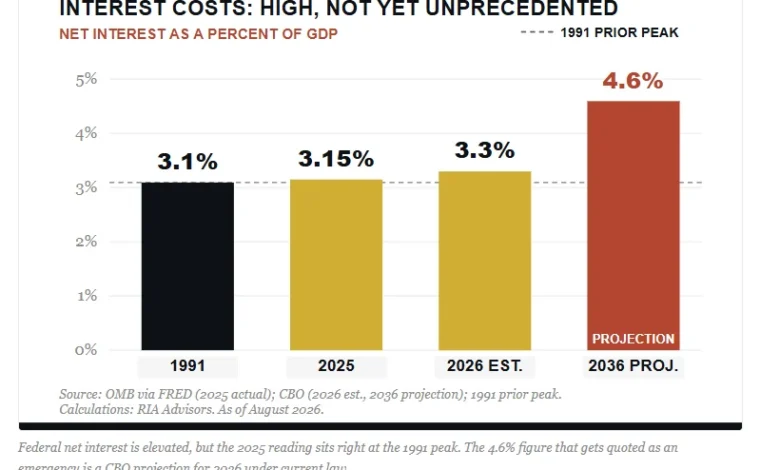
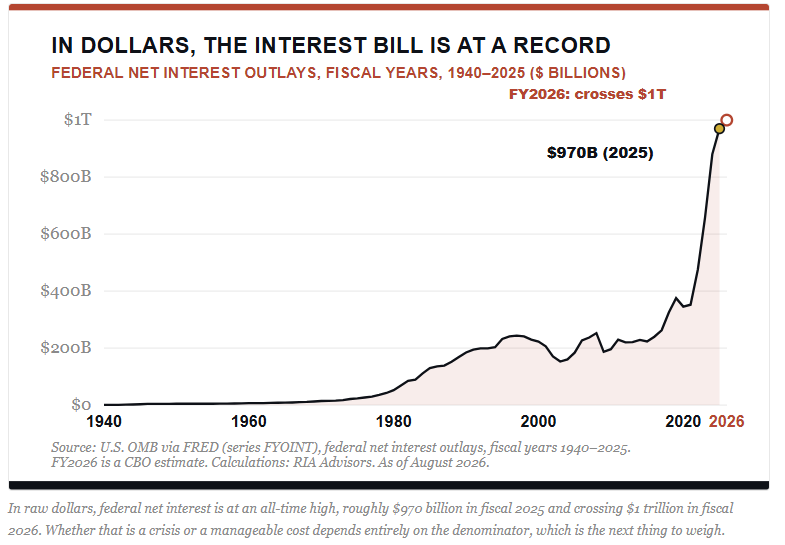
A central exhibit in the doomsday thesis is the sheer magnitude of federal interest expenditures. The milestone of crossing $1 trillion in annual net interest payments—surpassing traditional baseline allocations for national defense—frequently serves as headline material intended to shock observers.
While the nominal dollar figure is undeniably large, evaluating it in isolation distorts its economic significance. A fair assessment requires scaling interest costs against gross domestic product (GDP) and federal revenues. When measured as a share of GDP, federal net interest payments hover near 3.15%, aligning closely with historical peaks recorded in the early 1990s. During that previous period of elevated fiscal pressure, the U.S. financial system absorbed the costs without experiencing sovereign default or systemic operational failure.
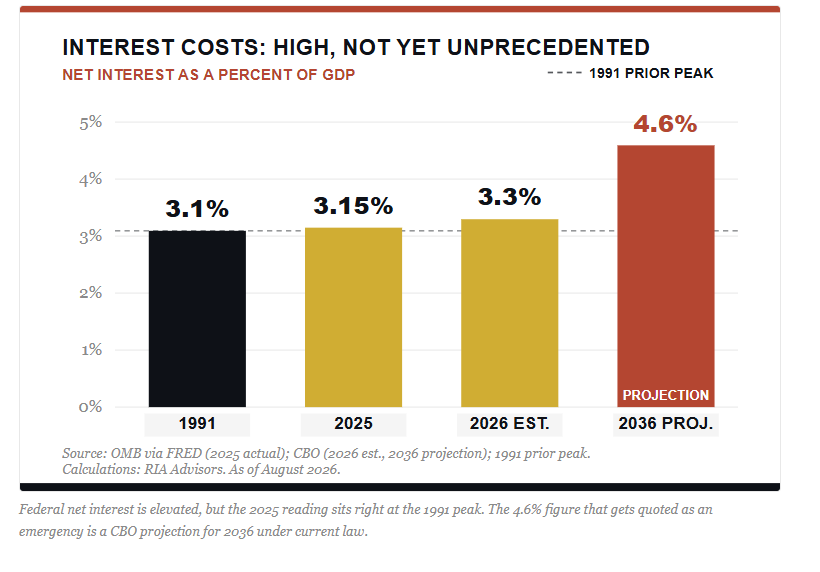
Similarly, net interest as a percentage of federal revenues remains manageable relative to historical parameters. Broader projections pointing toward higher ratios a decade into the future rely heavily on Congressional Budget Office (CBO) models that assume static legislation and persistently elevated borrowing costs—assumptions that rarely reflect the dynamic adjustments of actual fiscal policy over ten-year horizons.
Acknowledging Legitimate Fiscal and Structural Risks
Dismissing immediate alarms of a catastrophic debt trap does not imply that federal fiscal policy is without flaw. Credible analysts and international monitors correctly identify several structural vulnerabilities that warrant ongoing portfolio risk management:
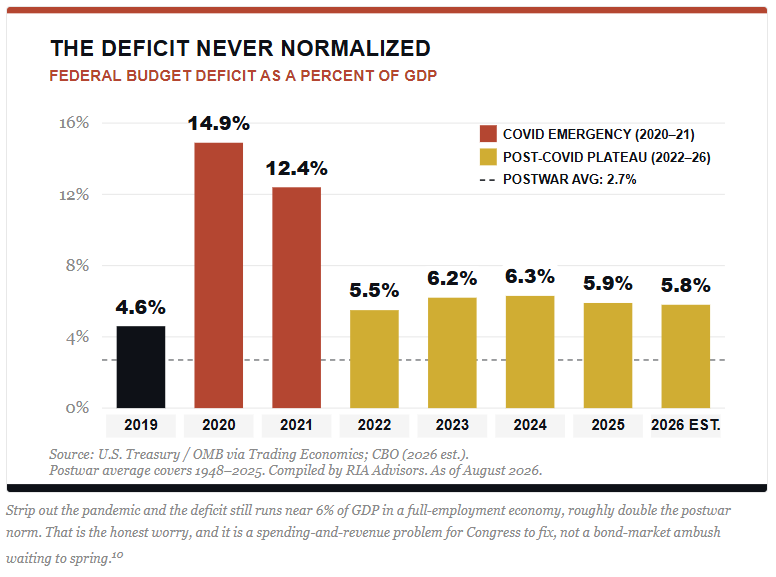
- Persistent Budget Deficits: Federal deficits running between 5% and 6% of GDP, alongside broader general-government metrics exceeding 7%, point to an unsustainable long-term trajectory. Debt-to-GDP ratios are projected to climb significantly over the coming decade, requiring eventual legislative adjustments.
- Short-Term Debt Issuance: The U.S. Treasury’s heavy reliance on short-term Treasury bill issuance helps manage immediate interest expenses in a higher-rate environment, but it increases structural rollover risk. International monitors have flagged this maturity profile as a growing tail risk for debt management operations.
- Market Plumbing and Liquidity: Structural shifts in Treasury market liquidity—amplified by leveraged institutional trading strategies like the basis trade—introduce bouts of financial volatility during periods of macro stress.
However, distinguishing between these manageable structural risks and an imminent systemic detonation is critical for institutional and retail investors alike.
The Global Precedent of Japan
The limitations of the debt-trap narrative become even more apparent when examining international comparisons, most notably Japan. For decades, Japan has maintained the heaviest gross government debt load in the developed world, with debt-to-GDP ratios consistently exceeding 230%—nearly double current U.S. levels.

According to the strict logic of domestic debt-trap forecasts, Japan should have experienced a sovereign debt crisis and monetary collapse a generation ago. Yet, Japanese government bonds continue to trade in orderly markets, domestic institutions absorb the vast majority of sovereign issuance, and the nation remains a major global economic power.
A primary structural differentiator for both Japan and the United States is the status of their sovereign currencies. The U.S. dollar functions as the world’s primary reserve asset, backed by the deepest, most liquid capital markets globally and an entrenched domestic financial ecosystem of pension funds, banks, and monetary reserves. This structural demand provides a powerful shock absorber that shields the U.S. sovereign debt market from abrupt external panics.

Investment Implications and Strategic Outlook
For investors navigating financial media headlines, distinguishing between long-term political challenges and immediate market catalysts is paramount. Treating structural budget deficits as an imminent market-ending catastrophe risks leading investors to adopt overly defensive postures that sacrifice decades of compound growth.
While the United States faces significant fiscal choices in the years ahead, these challenges are slow-moving structural developments rather than sudden operational landmines. Until prognosticators can provide falsifiable, time-tested dates for systemic crises supported by verifiable market data, portfolio management should remain anchored to observable economic conditions, asset valuations, and risk-management principles rather than speculative macroeconomic fear.