Crypto-Linked Stocks Rebound Sharply as Regulators Advance Blockchain Frameworks Following CLARITY Act Stalemate in the Senate

Cryptocurrency-linked equities and major digital assets staged a robust market recovery following a steep mid-week sell-off, as investors digested a series of proactive regulatory initiatives from United States financial watchdogs. The rebound materialized even as comprehensive digital asset legislation remained deadlocked in Congress, signaling that federal agencies are prepared to shape the future of blockchain technology and digital finance using their existing statutory powers.
The market stabilization brought immediate relief to a sector that had experienced sharp downward pressure following the U.S. Senate’s failure to advance the much-anticipated CLARITY Act. Major industry proxies surged across global trading desks. Strategy led the broader equity rebound with a gain exceeding 13%, while crypto exchange giant Coinbase and American Bitcoin advanced by approximately 11% each. Online retail brokerage Robinhood climbed nearly 9%, and stablecoin issuer Circle, digital asset firm Strive, and prominent Bitcoin mining enterprise Riot Platforms posted gains ranging between 5% and 7%, according to data compiled by Yahoo Finance.
Simultaneously, the broader digital asset market regained its footing. Bitcoin, the world’s largest cryptocurrency by market capitalization, recovered roughly 5% over a 24-hour window to trade near the $80,800 threshold. This upward price correction successfully erased a significant portion of the losses incurred in the immediate aftermath of the September 15, 2026, legislative setback in the Senate, which had abruptly derailed broader market-structure reform efforts.
Chronology of the Market Disruption and Policy Pivot
The sequence of events underscores the acute sensitivity of digital asset markets to legislative developments in Washington, D.C., contrasted with the resilient adaptability of regulatory agencies.

On September 15, 2026, the legislative momentum behind the comprehensive crypto market-structure bill, widely known as the CLARITY Act, officially stalled when the Senate failed to muster the necessary votes to move the measure forward. The sudden impasse triggered an immediate wave of risk aversion across traditional equity and crypto markets. Coinbase and Circle absorbed heavy blows, tumbling roughly 10% in value. Strategy and Strive shares retreated by approximately 5%, while American Bitcoin sustained steeper losses, declining by roughly 8% as institutional and retail investors reassessed the regulatory horizon for blockchain innovation in the United States.
However, the market sentiment shifted rapidly within 48 to 72 hours as federal regulatory bodies intervened to clarify their operational stances. Rather than waiting for Congress to resolve its legislative gridlock, both the Commodity Futures Trading Commission (CFTC) and the Securities and Exchange Commission (SEC) moved forward with targeted administrative actions utilizing their established regulatory authority. These announcements provided the structural clarity that investors had temporarily feared was lost with the stalling of the CLARITY Act.
Regulatory Intervention: CFTC and SEC Take the Lead
The catalyst for the market turnaround was a coordinated, albeit independent, series of policy disclosures by America’s top financial regulators.
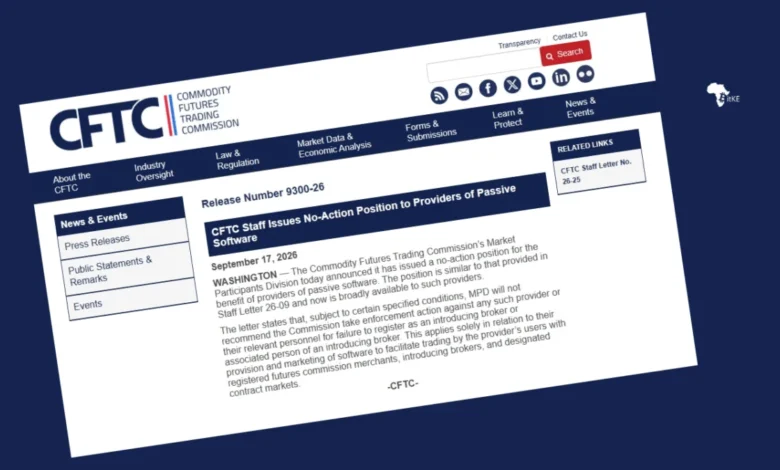
The CFTC issued critical no-action relief designed to protect certain passive software providers from excessive regulatory ambiguity. This move was widely interpreted by legal experts and market participants as a pragmatic step to safeguard foundational decentralized software infrastructure from overreach. Furthermore, the CFTC officially submitted a comprehensive proposed crypto market regulatory framework to the White House for executive review. Although the precise details of the proposed rulebook were not immediately made public, the submission itself signaled to market participants that federal oversight mechanisms for digital commodities are actively being forged behind closed doors.
Concurrently, the SEC introduced a landmark five-year regulatory exemption tailored for qualifying platforms that facilitate the on-chain trading of tokenized securities. This administrative framework addresses a long-standing bottleneck in financial technology by establishing a formal regulatory pathway for platforms to trade blockchain-based representations of traditional corporate equities. Crucially, the SEC’s framework is engineered to preserve fundamental shareholder rights, such as voting privileges and dividend distributions, while also incorporating corporate safeguards that empower publicly traded companies to formally object to the tokenization of their shares.

Market analysts and regulatory compliance experts have noted that the SEC’s five-year exemption represents a pragmatic compromise. It bridges the gap between traditional capital markets and distributed ledger technology, offering traditional financial institutions the legal certainty required to experiment with asset tokenization without fear of immediate regulatory enforcement actions.
Market Implications and Industry Outlook
The events of mid-September 2026 highlight a profound structural shift in how digital asset markets evaluate regulatory risk. While comprehensive, statutory legislation like the CLARITY Act remains the ultimate gold standard for long-term legal certainty, the swift pivot by the SEC and CFTC demonstrates that the regulatory perimeter can expand effectively through administrative rulemaking and enforcement discretion.
Industry leaders have expressed cautious optimism regarding the agencies’ willingness to pursue their rulemaking agendas independently of Capitol Hill. The SEC has repeatedly signaled its intention to advance its digital asset and blockchain oversight framework regardless of whether Congress passes overarching market-structure bills. This regulatory persistence ensures that the tokenization of traditional assets and the integration of decentralized finance principles into mainstream finance will continue to evolve, albeit through a patchwork of administrative directives rather than a unified statutory code.
For institutional investors, the clarity provided by the CFTC’s no-action relief and the SEC’s tokenized security exemptions helps remove the existential regulatory dread that previously triggered widespread liquidations. As corporate treasuries, asset managers, and retail platforms recalibrate their risk models, the ability of blockchain networks to interface with traditional financial instruments—under the watchful eye of existing federal regulators—suggests that the digital asset economy is maturing into a more resilient, policy-compliant ecosystem.
As regulatory reviews continue at the White House and administrative guidelines are finalized, market participants across the globe will remain closely attuned to how federal oversight balances the imperatives of technological innovation with investor protection and market integrity.
Related posts: