Aerodrome Finance Token Faces Selling Pressure Following Binance Listing as Market Volatility and Technical Indicators Signal Near-Term Uncertainty

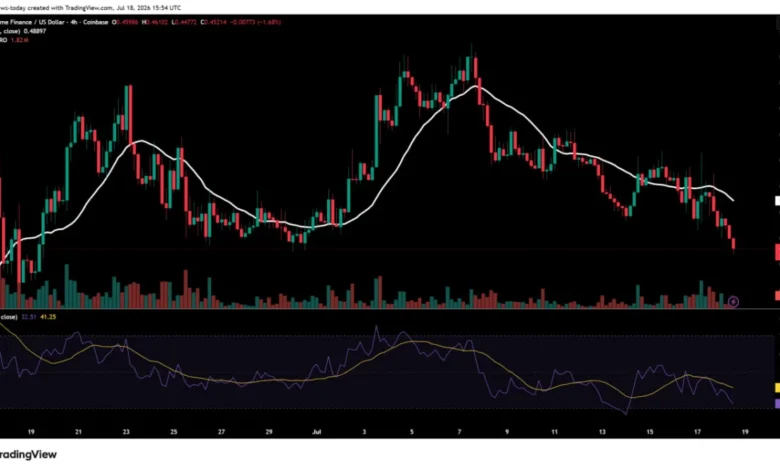
The decentralized finance sector witnessed a notable divergence between protocol adoption and asset valuation this week as Aerodrome Finance’s native token, AERO, experienced a sustained price decline despite securing a high-profile listing on Binance, the world’s largest cryptocurrency exchange by trading volume. On July 18, the AERO token plummeted to a local low of $0.4527, marking a continuation of a downward trend that has stripped more than 15 percent of the asset’s market value over a seven-day period. This bearish momentum persisted even as Binance finalized the integration of AERO into its spot trading platform, highlighting a "sell the news" reaction from market participants amidst a broader cooling of risk appetite across the digital asset landscape.
The listing, which was officially announced on July 17, saw Binance open trading pairs for AERO against Tether (USDT), USD Coin (USDC), and the Turkish Lira (TRY). However, the exchange applied its "Seed Tag" designation to the asset—a label reserved for projects in their early stages that exhibit higher-than-average volatility and potential risks compared to more established tokens. While the listing provides AERO with unprecedented liquidity and exposure to a global retail base, the immediate market reaction was characterized by selling pressure rather than the typical "listing pump" often observed when mid-cap tokens debut on major tier-one exchanges.
A Chronology of the Binance Listing and Market Response
The path to AERO’s listing on Binance followed a compressed timeline that initially sparked optimism among holders but quickly collided with macroeconomic headwinds. On July 17, at 07:30 UTC, Binance released its official listing notice, detailing the commencement of spot trading. The exchange notably waived listing fees for the project and announced an additional $100,000 in USDC earmarked for future marketing campaigns intended to bolster the token’s ecosystem.
Despite the initial excitement, the rollout faced minor operational adjustments. Binance delayed the original trading start time by several hours to ensure technical readiness. During this transition, traders who had previously held AERO on "Binance Alpha"—the exchange’s specialized pre-listing platform—were given a window to migrate their holdings into standard spot accounts before the Alpha version of the token was phased out.
The application of the Seed Tag served as a critical hurdle for some traders. To trade Seed-Tagged assets on Binance, users are required to pass a risk-awareness quiz every 90 days, a move designed to ensure that participants understand the speculative nature of newer DeFi protocols. While this regulatory-style safeguard protects the exchange and its users, it also creates a layer of friction that can temper immediate buying volume. Consequently, instead of a surge in demand, AERO found itself caught in a broader market sell-off triggered by geopolitical tensions and regulatory scrutiny in Washington, specifically revolving around a CLARITY Act hearing that weighed heavily on the decentralized finance sector during the same week.

Technical Analysis: Breakdown of Price Action and Key Indicators
From a technical perspective, AERO’s performance on the four-hour chart provides a clear illustration of the prevailing bearish sentiment. The token has consistently traded below its 20-period moving average (MA), which currently sits at approximately $0.489. In technical analysis, the moving average acts as a dynamic level of resistance; when the price remains suppressed below this line, it indicates that sellers are in control and that the average price over the recent short-term period is higher than the current market value, discouraging new buyers.
The Relative Strength Index (RSI), a momentum oscillator that measures the speed and change of price movements, recently dipped to 32.51. In the context of the 0-to-100 RSI scale, a reading below 30 is traditionally considered "oversold." While AERO is hovering just above this threshold, the indicator suggests that the selling pressure has been aggressive and sustained. Historically, an RSI in the low 30s can precede a relief bounce as the selling momentum exhausts itself; however, without a fundamental catalyst, such bounces are often viewed as opportunities for further distribution by larger holders.
Furthermore, the price action reveals a troubling pattern of "double rejection." In late June and again in the first week of July, AERO attempted to breach the $0.58 to $0.60 resistance zone. On both occasions, the token failed to sustain a breakout, leading to a "lower high" structure that often precedes a deeper correction. The current slide into the $0.40 range represents a retest of support levels that must hold to prevent a move toward the $0.35 psychological floor.
The Fundamentals: Aerodrome’s Dominance on the Base Network
While the token price has struggled, the underlying fundamentals of the Aerodrome Finance protocol remain robust, presenting a stark contrast to the market’s current valuation of AERO. Aerodrome currently functions as the primary liquidity engine for Base, the Layer-2 Ethereum scaling solution developed by Coinbase. As of mid-2024, Aerodrome accounts for approximately 61 percent of all decentralized exchange (DEX) volume on the Base network.
The protocol’s success is rooted in its adaptation of the "ve(3,3)" model, which incentivizes long-term liquidity provision through a system of token locking. Users who lock their AERO tokens receive "veAERO," granting them governance rights and a share of the protocol’s generated fees. To date, Aerodrome has generated over $520 million in cumulative swap fees, a significant portion of which is distributed back to the ecosystem.
In May, the protocol underwent a significant technical upgrade with the introduction of MEV-resistant (Maximal Extractable Value) pools. These pools were designed to protect retail traders from "sandwich attacks" and front-running bots, which often erode the value of trades on decentralized platforms. Despite these improvements in user experience and protocol efficiency, the AERO token has failed to decouple from the broader trend of "altcoin bleeding" that has plagued the DeFi sector throughout the second quarter of the year.

Strategic Evolution: The Merger and Predictive Allocation
Looking ahead, the team behind Aerodrome, Dromos Labs, is preparing for a massive structural shift that could redefine the protocol’s value proposition. The developers have announced a merger between Aerodrome (on Base) and its sister exchange, Velodrome (on Optimism), to create a unified cross-chain liquidity system simply titled "Aero."
This rollout, scheduled to begin in late July, aims to extend Aerodrome’s reach to the Ethereum mainnet and Circle’s recently announced "Arc" chain. A centerpiece of this transition is the introduction of "Predictive Allocation." Currently, AERO rewards are distributed to liquidity pools based on a weekly voting process by veAERO holders. Predictive Allocation seeks to modernize this by using data-driven algorithms to assign incentive rewards based on expected future demand. This shift is intended to make the protocol more responsive to market trends and more efficient in its distribution of emissions, potentially reducing the inflationary pressure that often weighs on DEX tokens.
Market Implications and the Road to Recovery
The current state of AERO reflects a broader maturity phase for the Base ecosystem. As Coinbase continues to onboard millions of users to its on-chain platform, Aerodrome remains the logical destination for liquidity. However, the transition from a "high-growth startup" phase to an "established utility" phase often involves painful price discoveries for early speculators.
The removal of the Binance Seed Tag remains a critical milestone for the token’s recovery. Binance periodically reviews its tagged listings, and should AERO demonstrate stabilized volatility and consistent liquidity, the tag’s removal would open the token to a more conservative class of institutional and retail investors who are currently restricted from trading Seed-Tagged assets.
In conclusion, the $0.4527 price point represents a significant test of investor confidence. While technical indicators like the RSI suggest the token is nearing a point of exhaustion, the fundamental strength of the Aerodrome protocol—evidenced by its 61 percent market share on Base and its impending cross-chain expansion—suggests that the long-term thesis remains intact for those focused on DeFi infrastructure. Nevertheless, the immediate horizon remains clouded by macroeconomic uncertainty and the ongoing digestion of the Binance listing, leaving AERO in a period of consolidation as the market weighs protocol utility against short-term price momentum.