How AI Is Reshaping Service Operations in Mission Critical Infrastructure

Service organizations responsible for the maintenance and operation of energy, infrastructure, and data center assets are currently navigating a significant structural mismatch that threatens the stability of modern industrial systems. As global reliance on digital infrastructure reaches unprecedented levels, the requirements for system uptime have tightened toward near-zero tolerance. However, traditional maintenance models and the available capacity of skilled technicians have failed to keep pace with this demand. This widening gap is forcing a radical shift in how service operations are managed, moving away from reactive and scheduled maintenance toward AI-enabled proactive and prescriptive strategies.
The acceleration of demand is most visible at the "grid edge," where data centers and high-tech manufacturing facilities are putting immense pressure on electrical and cooling infrastructure. According to analysis from the Electric Power Research Institute, cited by the U.S. Department of Energy, data centers could consume as much as 9 percent of total U.S. electricity generation by the year 2030. This represents more than double their share of consumption recorded in 2023. The financial consequences of failing to meet these demands are staggering; the Institute for Supply Management recently reported that unscheduled downtime now costs the world’s 500 largest companies an estimated $1.4 trillion annually—a figure representing roughly 11 percent of their total revenue.
The Converging Crisis of Labor and Data Fragmentation
While the demand for reliability increases, the workforce required to sustain it is in a state of contraction. The U.S. Bureau of Labor Statistics projects approximately 81,000 openings for electricians annually through 2034. These openings are not primarily driven by industry expansion, but rather by the "Silver Tsunami" of retirements as a generation of highly experienced technicians exits the workforce without a sufficient pipeline of new entrants to replace them.
Compounding this labor shortage is the persistent problem of fragmented equipment data. Research from the National Institute of Standards and Technology (NIST) indicates that inadequate interoperability of facility and equipment data costs U.S. capital-facilities owners and operators approximately $10.6 billion every year during the operations and maintenance phase alone. This lack of data cohesion often leaves technicians at the point of service without access to asset history, repair manuals, or real-time guidance, resulting in failed first-time fixes and extended periods of equipment downtime.
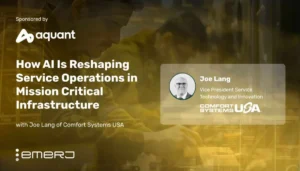
In a recent episode of the AI in Business podcast, Yolandi de Weerdt of Emerj was joined by Joe Lang, Vice President of Service Technology and Innovation at Comfort Systems USA, to discuss how artificial intelligence is being deployed to bridge these operational gaps. Comfort Systems USA, a leading provider of commercial HVAC, electrical, and mechanical services, sits at the center of this transformation, managing critical infrastructure for some of the nation’s most demanding facilities.
Moving Beyond Schedules: Anomaly Detection as an Operational Discipline
A central theme of Lang’s analysis is the move toward condition-based maintenance through the use of anomaly detection. Historically, maintenance cycles have been built on the assumption of predictable intervals—servicing a machine every six months regardless of its actual performance. However, equipment behavior often fluctuates significantly in the unmonitored periods between these scheduled visits.
Lang argues that anomaly detection should not be viewed as a futuristic "add-on" feature, but as a foundational operational discipline. By treating real-time equipment behavior as the primary source of truth, organizations can identify "behavioral drifts"—subtle changes in vibration, temperature, or power consumption—that precede a total system failure.
"AI gives technicians a head start," Lang noted during the discussion. "When the system flags a deviation, it’s often the earliest sign that something is drifting out of normal behavior. Acting at that moment prevents failure rather than reacting to it. It changes the rhythm of service work—teams stop chasing emergencies and start addressing issues before they become critical."
To successfully implement anomaly detection, Lang identifies several operational requirements:
- High-Frequency Sensor Integration: Moving beyond intermittent checks to continuous data streams.
- Standardized Behavioral Baselines: Establishing what "normal" looks like for specific asset classes across different environments.
- Automated Alert Logic: Ensuring that deviations are not just recorded but are automatically routed to the correct service teams for intervention.
From Predictive to Prescriptive: The Evolution of Technician Guidance
One of the most significant shifts Lang describes is the transition from predictive maintenance—which simply forecasts when a failure might happen—to prescriptive guidance, which recommends the "next-best action" for a technician to take.
The industry currently faces a "variability problem." When a technician encounters unfamiliar equipment or an ambiguous symptom, their performance depends heavily on their individual experience level. This leads to inconsistent outcomes across the service organization. Lang posits that this is not a personnel failure, but an information failure. If the diagnostic evidence is buried in disconnected PDFs or locked in the heads of retiring senior engineers, the junior technician is left to rely on guesswork.
Prescriptive guidance stabilizes this variability by consolidating service histories, original equipment manufacturer (OEM) documentation, and historical resolution patterns into a single, AI-driven interface. Before a technician even opens a control panel, the system can surface the most likely fault and the specific steps required to resolve it.
"This is not about replacing technician judgment," Lang emphasized. "It’s about removing the first ten minutes of uncertainty that drive inconsistent outcomes." By providing an evidence-driven starting point, organizations can ensure that a technician with two years of experience can perform with the diagnostic accuracy of a twenty-year veteran.
To make prescriptive guidance effective, Lang identifies several critical data sources that must be integrated:
- Historical Resolution Patterns: Data on what actually fixed the problem in the past.
- OEM Technical Documentation: Digitized and searchable manuals.
- Site-Specific Context: Understanding the unique environmental factors of a specific facility.
- Real-Time Telemetry: Live data from the asset at the moment of service.
The Operational Challenge: Modifying the Plane While Flying It
The transition to an AI-enabled service model is not merely a matter of purchasing new software; it requires a fundamental overhaul of operational workflows. Lang points out that many modernization efforts fail because organizations treat the transition as a part-time project or a "side desk" initiative.
"This is where you’ll modify the plane while you’re flying it," Lang remarked. "You’ve got to modify it so it can continue to fly and land and take off again. You absolutely have to resource this correctly when you start down this path."
Lang argues that the most common reason for failure is under-resourcing. Organizations may spend a year building data infrastructure, but if they do not dedicate full-time personnel to manage the transition, categorize assets, and refine the AI models, the project will stall before it delivers measurable ROI.
Successful transformation requires:
- Dedicated Leadership: An executive-level owner who is responsible for the digital service strategy.
- Structured Asset Data: A rigorous process for organizing equipment into logical groups and cleaning historical data.
- Feedback Loops: A system where technicians can validate or correct AI recommendations, allowing the model to learn from real-world outcomes.
Broader Implications and Industry Impact
The insights shared by Lang reflect a broader trend across the industrial sector. As the "knowledge gap" widens due to the retiring workforce, AI is becoming the repository for "tribal knowledge." By capturing the expertise of senior technicians and embedding it into prescriptive tools, companies like Comfort Systems USA are essentially "software-encoding" the skills required to keep the world’s most critical infrastructure running.
The implications extend beyond just cost savings. In the context of data centers and the energy grid, the ability to prevent unscheduled downtime is a matter of national economic security. As AI itself drives the demand for more data centers, the industry is ironically turning to AI to manage the very infrastructure that makes AI possible.
The shift toward proactive, AI-driven service operations represents the end of the "break-fix" era. For service organizations, the path forward is clear: those who successfully integrate real-time anomaly detection and prescriptive guidance will thrive in a high-demand, low-labor environment. Those who continue to rely on manual schedules and fragmented data risk being overwhelmed by the increasing complexity and cost of maintaining the modern world.