Navigating Modern Market Volatility Through Prediction Markets Bond Correlations and Strategic AI Financing

The financial landscape of the mid-2020s is increasingly defined by a shift away from traditional sentiment indicators and toward real-time, high-stakes data points that reflect "skin in the game." Recent market activity has highlighted a growing divergence between historical sentiment tools and the immediate, capital-backed insights provided by prediction markets, alongside a tightening correlation between energy prices and sovereign debt yields. Furthermore, the aggressive expansion of the artificial intelligence (AI) and aerospace sectors has introduced complex financial structures, such as circular financing and astronomical valuation benchmarks, that challenge conventional fundamental analysis. As investors grapple with these shifts, understanding the mechanics of prediction markets, the geopolitical drivers of inflation, and the nuances of vendor-financed hardware deals has become essential for navigating the current economic cycle.

The Rise and Current Limitations of Prediction Markets as Sentiment Gauges
Prediction markets, led by platforms such as Polymarket, have emerged as a disruptive force in the realm of market sentiment analysis. Unlike traditional tools—such as the University of Michigan Consumer Sentiment Index or the Conference Board’s Consumer Confidence Survey—prediction markets require participants to commit capital to a specific outcome. This "real money" aspect is intended to filter out the noise and biases often found in opinion-based surveys, providing a more clinical view of what traders actually expect to happen.
A recent case study involving the S&P 500 illustrates this utility. On a day following a nearly 1% gain in the index, a Polymarket contract betting on whether the S&P 500 would open higher the next day implied only a 30% probability of an "up" open. Traditional sentiment might have suggested a "follow-through" rally based on the previous day’s momentum. However, the prediction market correctly anticipated a lower open, signaling a lack of conviction among active traders despite the prior day’s green close. This ability to reflect real-time reactions to overnight headlines and global shifts makes these platforms a valuable, if still maturing, addition to the investor’s toolbox.
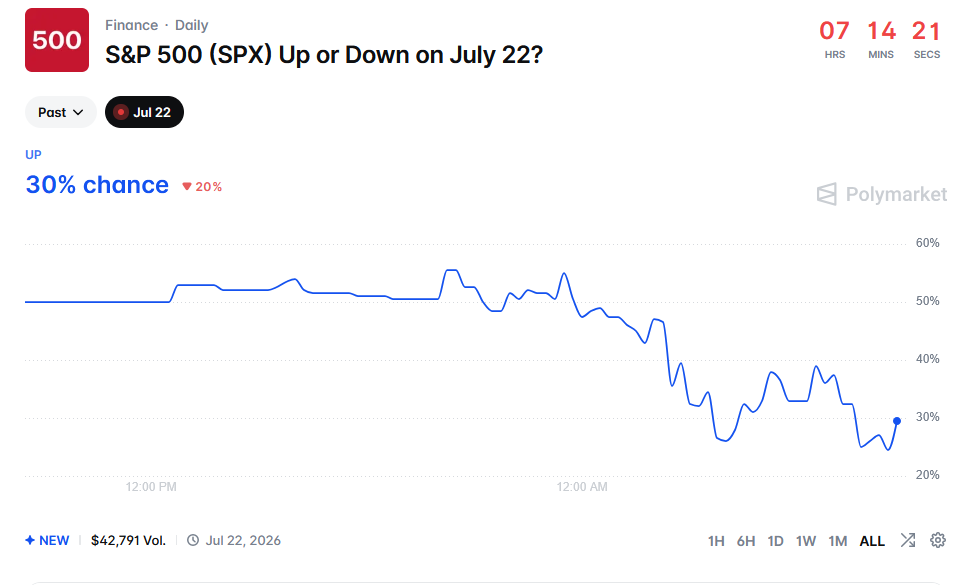
However, the reliability of these markets is currently under scrutiny due to fluctuating participation. Data from Benzinga indicates that trading volume on daily S&P 500 direction contracts has been declining. For instance, a contract on July 21 saw only $20,156 in total volume, marking one of the quietest periods in weeks. Low liquidity in prediction markets can lead to skewed results and increased volatility, reducing their efficacy as a broad sentiment gauge. While the concept of a decentralized, real-time "truth machine" remains compelling, the long-run reliability of these platforms will depend on sustained institutional and retail participation.
The Oil-Bond Nexus: Energy Prices as the Primary Driver of Yields
In the fixed-income markets, a powerful correlation has re-emerged between crude oil prices and Treasury yields. As of late July 2026, West Texas Intermediate (WTI) crude is trading near $86 per barrel, while Brent crude sits near $92. This represents a fourth consecutive session of gains, driven largely by supply-side premiums linked to geopolitical tensions in the Middle East, including strikes involving Iran and renewed threats to shipping lanes by Houthi rebels.
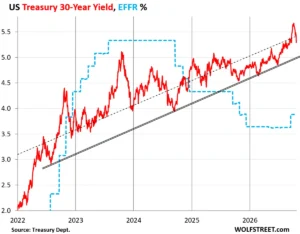
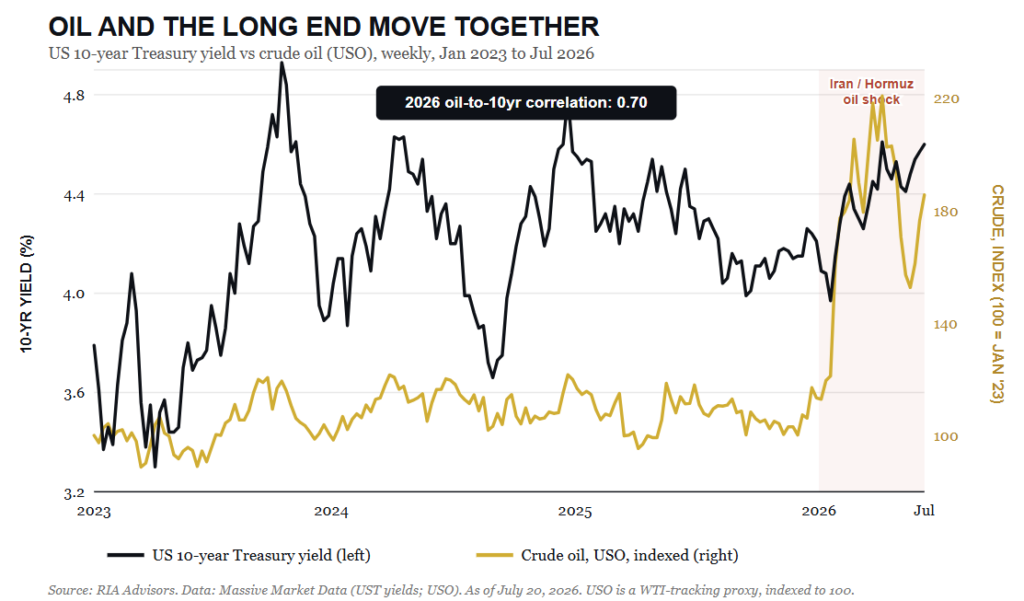
The impact on the bond market has been direct and significant. The 10-year Treasury yield has firmed to 4.60%, while the 30-year yield has reached 5.11%. Analysis shows that since the escalation of regional conflicts in mid-February, the correlation between crude oil and the 10-year yield has fluctuated between 0.70 and 0.75. This high degree of correlation suggests that the recent backup in long-term yields is not necessarily a reflection of robust economic growth or fresh concerns over fiscal deficits, but rather an "oil-driven inflation premium."
Supporting this thesis is the fact that underlying disinflationary trends remain visible when the energy component is isolated. One-year market inflation expectations have actually fallen from 3.5% in May to 2.4% in July. This divergence implies that bond investors are primarily pricing in the risk of higher energy costs rather than a broader overheating of the economy. For portfolio managers, this creates a strategic dilemma: if oil prices retreat, the inflation premium in the bond market could evaporate, leading to a significant rally in bond prices.

Forward Scenarios for Energy and Duration Positioning
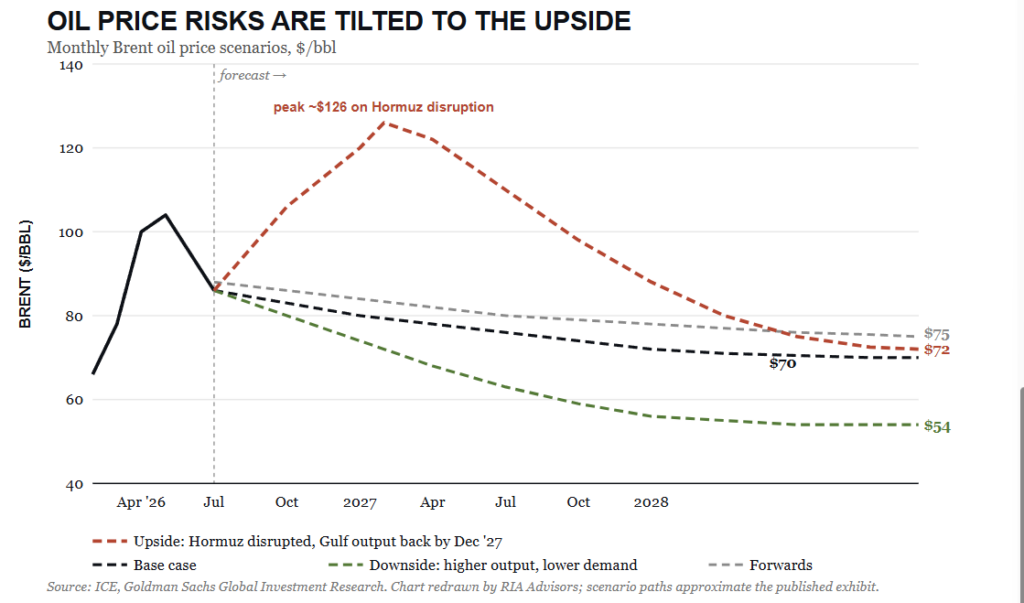
The future trajectory of bond yields appears tethered to the "three paths" of the oil market. According to recent scenarios modeled by Goldman Sachs and reflected in the forward curve, the most likely outcomes lean toward lower energy prices over the next 18 to 24 months.
- The Base Case: Goldman Sachs projects crude oil to drift into the low $70s by 2028 as supply chains stabilize and global production remains steady.
- The Downside Case: A combination of higher-than-expected production and softer global demand could push prices toward $55 per barrel.
- The Upside Case: A prolonged disruption in the Strait of Hormuz could send Brent back to $125 per barrel by 2027.
Because two of the three primary paths point to lower prices, there is a growing argument for increasing "duration" in bond portfolios—essentially buying longer-dated bonds to lock in current yields. If oil follows the base or downside path, yields are likely to fall, providing investors with both coupon income and capital appreciation. However, the "upside tail" risk remains live. A sudden shock to energy supplies would likely spike yields further before any eventual rollover. Consequently, many advisors are maintaining shorter-duration positions for the time being, waiting for a resolution of geopolitical tensions before "laddering" into longer-term holdings.
AMD and Anthropic: The Mechanics of Circular Financing in AI
The competitive landscape for AI hardware has taken a complex turn with the announcement of a major deal between Advanced Micro Devices (AMD) and AI safety and research company Anthropic. Under the agreement, Anthropic will purchase up to 2 gigawatts of compute capacity powered by AMD’s latest Instinct MI450 chips, with deliveries starting in the first half of 2027.
While the deal establishes AMD as a formidable challenger to Nvidia’s dominance, the financial structure of the arrangement has drawn attention. AMD has committed to investing as much as $5 billion in Anthropic, subject to certain contingencies. This creates a "circular financing" wrinkle: the capital provided by the chipmaker is essentially helping to fund the customer’s purchase of the chipmaker’s own hardware.
This practice is not unique to AMD; Nvidia has utilized similar vendor-financing arrangements to bolster its ecosystem. From a corporate strategy perspective, these deals ensure that next-generation chips have a guaranteed "anchor tenant" and help startups secure the massive capital required for AI infrastructure. However, from an accounting and valuation perspective, circular financing raises questions about the "arm’s length" nature of reported revenue. Investors must discern how much of the demand for AI chips is organic and how much is being subsidized by the manufacturers themselves to maintain growth narratives and market share.
SpaceX and the Challenge of "Amazon-Scale" Growth
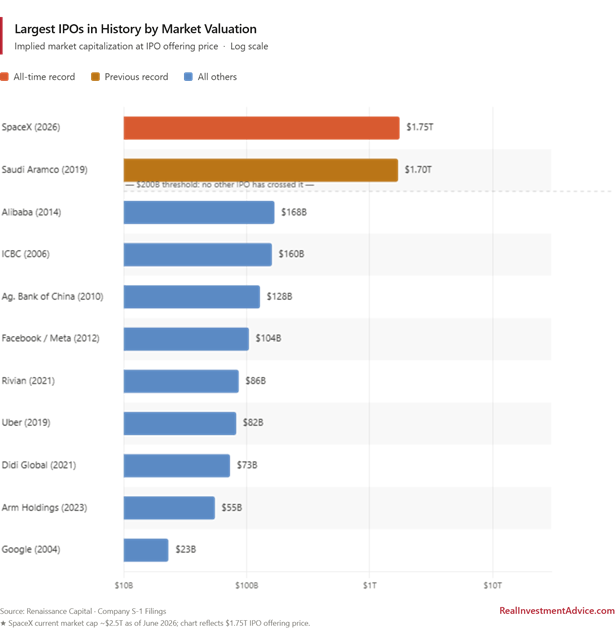
The aerospace sector is facing its own valuation reckoning. Following a landmark initial public offering (IPO) in June, SpaceX saw its market capitalization briefly touch $2.5 trillion before settling near $1.84 trillion. To justify such a valuation, analysts are comparing SpaceX’s trajectory to that of Amazon, which evolved from a $438 million IPO to a global leader in e-commerce and cloud computing.

However, the mathematical reality of SpaceX’s current valuation is daunting. To provide a 20% annual return to investors from a $1.84 trillion starting point, SpaceX would need to sustain an annualized revenue growth rate of between 41% and 67% for the next decade. For context, even Amazon, during its most explosive periods of growth, struggled to maintain such a pace at this scale.
While Elon Musk has forecasted $1 trillion in annual revenue for SpaceX by 2030, Wall Street institutions like Morgan Stanley and Goldman Sachs maintain far more conservative models. The "Musk Premium" clearly plays a role in the stock’s pricing, but the underlying requirement for the company to "fire on all cylinders"—from Starlink’s global expansion to the commercialization of Mars missions—leaves little room for error.

Broader Implications for the 2026-2027 Market Cycle
The convergence of these trends suggests a market that is increasingly sensitive to liquidity, geopolitical shocks, and unconventional corporate financing. The reliance on prediction markets indicates a desperate search for "truth" in an era of information overload, while the oil-bond correlation highlights the fragility of the current disinflationary narrative.
In the technology sector, the move toward circular financing may signal that the "easy" phase of the AI buildout is transitioning into a more capital-intensive and competitive era where chipmakers must fight harder for every dollar of revenue. Meanwhile, the staggering valuations in the private-to-public transition of space tech firms like SpaceX suggest that investor optimism may be outpacing the historical precedents of corporate growth.
For the remainder of the 2026 trading year, market participants will likely focus on three key indicators: the stability of energy prices in the face of Middle Eastern tensions, the transparency of revenue recognition in AI hardware deals, and the ability of high-valuation "mega-cap" firms to meet the aggressive growth targets priced into their shares. As the "tools in the toolbox" evolve, the fundamental principles of risk management—maintaining liquidity, monitoring correlations, and questioning the sustainability of rapid growth—remain as relevant as ever.