Prediction Markets and the Convergence of Energy Volatility AI Infrastructure and Aerospace Growth Realities

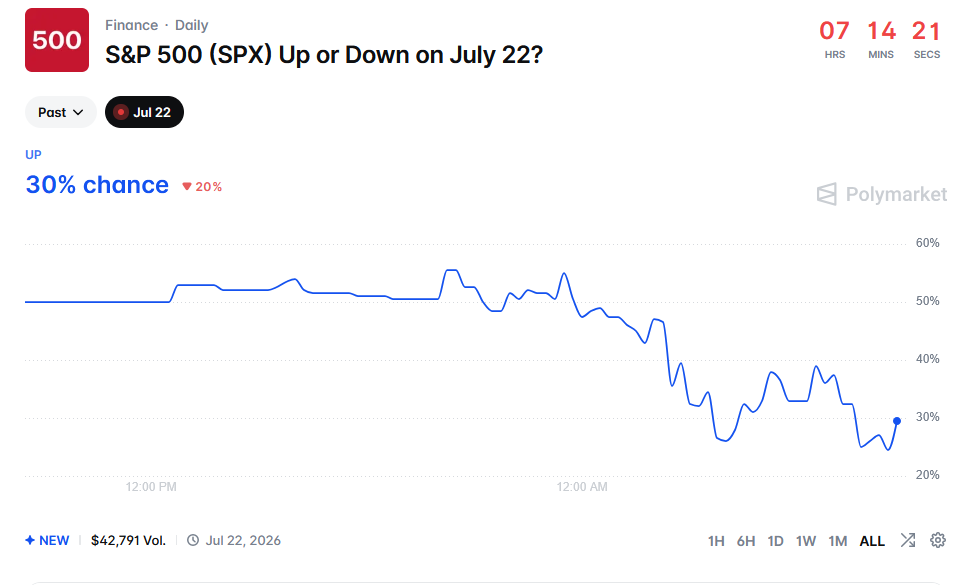
The landscape of modern financial analysis is undergoing a fundamental shift as traditional sentiment indicators are increasingly supplemented, and sometimes supplanted, by real-time prediction markets and complex cross-asset correlations. Recent activity on Polymarket, a leading decentralized prediction platform, has highlighted this evolution. On a recent trading day, Polymarket’s daily contract regarding the S&P 500’s opening direction implied a mere 30% probability of an "up" open. This pessimistic outlook stood in stark contrast to the previous day’s performance, where the index had gained nearly 1%. Ultimately, the prediction market proved more prescient than the trailing momentum, as the market indeed opened lower. This divergence between prior-day gains and next-day expectations offers a critical window into the current mindset of sophisticated market participants who are looking beyond simple trend-following.

Prediction markets represent a departure from traditional sentiment tools like the University of Michigan Consumer Sentiment Index or the AAII Investor Sentiment Survey. While surveys capture subjective opinions often clouded by cognitive biases or social desirability, prediction markets require participants to commit "real money" to a specific outcome. This financial skin in the game tends to filter out noise and force a more rigorous assessment of available data. Furthermore, while technical indicators such as "options skew" provide insight into institutional positioning, they are often lagging or reflective of hedges that may remain static for several days. In contrast, a Polymarket contract is updated in real-time, reacting instantaneously to breaking headlines, geopolitical shifts, or unexpected economic data releases.
However, the efficacy of these markets as a reliable sentiment gauge is currently under scrutiny due to fluctuating participation levels. Financial news outlet Benzinga recently observed that trading volumes on daily S&P 500 up/down contracts have begun to wane. For example, a recent contract saw only $20,156 in total volume, marking one of the quietest periods in weeks. This cooling of participation suggests that while prediction markets offer a unique data point, their value is inherently tied to liquidity. Without sufficient volume, the "wisdom of the crowd" becomes susceptible to the influence of a few large trades, potentially distorting the signal for broader market sentiment. As these platforms are still in a relatively nascent stage of adoption, their long-run reliability compared to established benchmarks like the CBOE Volatility Index (VIX) remains a subject of ongoing debate among macro analysts.
The Energy-Bond Nexus: Oil Prices as a Driver of Yield Volatility
Beyond the realm of sentiment, the mechanical relationship between energy commodities and the fixed-income market is currently serving as a primary driver of portfolio volatility. As of late July, West Texas Intermediate (WTI) crude is trading near $86 per barrel, with Brent crude hovering around $92. This represents a four-session winning streak fueled by geopolitical tensions, including strikes involving Iran and persistent threats from Houthi rebels toward commercial shipping lanes in the Red Sea. On a monthly basis, crude prices have surged by approximately 18%, a move that has had immediate repercussions for the Treasury market.
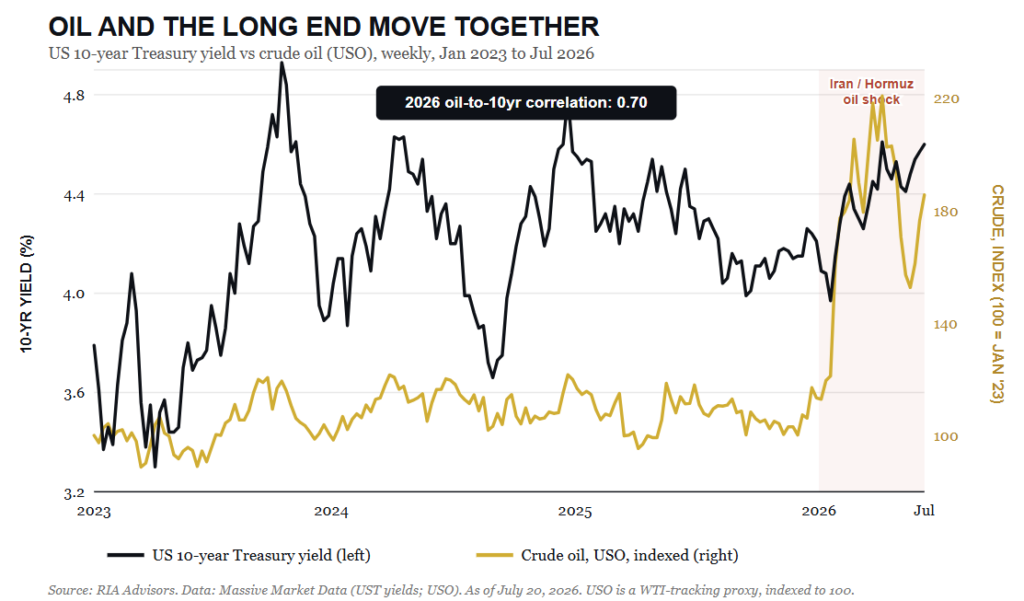
The correlation between crude oil and the 10-year Treasury yield has strengthened significantly, reaching a coefficient of 0.70 to 0.75 since the escalation of Middle Eastern conflicts in mid-February. Currently, the 10-year yield sits at 4.60%, while the 30-year yield has firmed to 5.11%. Analysis suggests that this backup in yields is not necessarily a reflection of a "growth story" or renewed concerns over fiscal deficits, but rather an "oil-driven inflation premium." When the energy-related premium is stripped away, the underlying disinflationary trend in the U.S. economy appears largely intact. This is evidenced by one-year market inflation expectations, which have retreated from 3.5% in May to 2.4% recently. Effectively, the bond market is currently "paying up" for the cost of a barrel of oil rather than pricing in a structurally hotter economy.
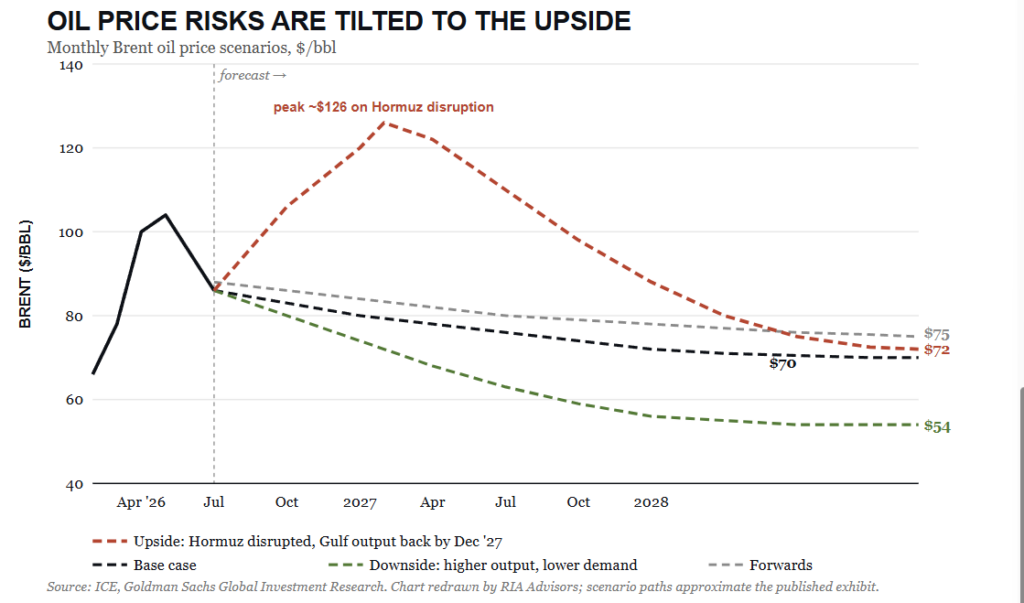
For investors, this correlation presents a strategic crossroads. Goldman Sachs has outlined three primary scenarios for the future of oil prices. The base case suggests crude will drift into the low $70s by 2028, while a downside case—characterized by higher production and softer global demand—could see prices fall toward $55. Conversely, an upside "tail risk" involving a prolonged disruption in the Strait of Hormuz could push Brent back toward $125 by 2027. Given that two of the three likely paths point toward lower prices, a significant opportunity may be emerging in long-duration bonds. If oil follows the base or downside path, the inflation premium currently embedded in the long end of the curve is likely to bleed out, leading to falling yields and capital appreciation for bondholders. However, because the upside risk remains "live," many institutional managers are maintaining shorter-duration positions, waiting for a resolution of geopolitical tensions before "laddering" into longer-term holdings.
AI Infrastructure and the Rise of Circular Financing
The semiconductor industry is also witnessing a shift in strategic financing as companies race to secure dominance in the artificial intelligence (AI) sector. Advanced Micro Devices (AMD) recently announced a landmark deal with Anthropic, an AI safety and research company. Under the agreement, Anthropic will purchase up to 2 gigawatts of AMD’s latest-generation Instinct MI450 chips, with deliveries scheduled to begin in the first half of 2027. This partnership is a significant win for AMD CEO Lisa Su as the company seeks to erode Nvidia’s dominant market share in the AI hardware space.

However, the deal includes a "circular financing" wrinkle that has drawn the attention of financial analysts. Alongside the hardware purchase agreement, AMD has committed to investing as much as $5 billion in Anthropic, subject to certain contingencies. This arrangement essentially means that AMD’s capital is helping to fund Anthropic’s ability to purchase AMD’s own products. While this is not an uncommon practice in high-growth technology sectors—Nvidia has utilized similar vendor financing models—it raises questions regarding the "organic" nature of AI chip demand.
From a journalistic and analytical perspective, circular financing does not invalidate the underlying demand; Anthropic clearly requires massive amounts of compute power to train its large language models. Nevertheless, it complicates the interpretation of financial statements. When a chipmaker provides the capital that is then returned to it as revenue, the transaction is not entirely "arm’s length." Investors must carefully evaluate how much of the reported revenue growth in the AI sector is driven by genuine market need versus financial engineering designed to underwrite demand. This distinction is critical for determining the long-term sustainability of the current AI infrastructure buildout.
SpaceX and the Mathematics of Trillion-Dollar Valuations
The private aerospace sector is providing another case study in high-stakes valuation and investor expectations. Following its secondary offering in June, SpaceX saw its market capitalization reach a staggering $1.84 trillion, after briefly touching $2.5 trillion. While SpaceX is widely regarded as a generational company, analysts are beginning to question whether the current valuation leaves room for meaningful future returns.
To put the $1.84 trillion valuation into perspective, analysts often use Amazon’s historical trajectory as a benchmark. From its IPO valuation of $438 million to its current status as a global leader in e-commerce and cloud computing, Amazon’s growth was unprecedented. However, for SpaceX to deliver a standard 20% annual return to investors from its current valuation, it would need to sustain an annualized revenue growth rate of between 41% and 67% for the next decade. This is a pace that very few companies in history have ever achieved, and one that even Amazon did not maintain once it reached a similar scale.
Elon Musk has forecasted a $1 trillion revenue target for SpaceX by 2030, but Wall Street remains more skeptical. Conservative models from firms like Morgan Stanley and Goldman Sachs suggest a much slower ramp-up. The disparity between Musk’s ambitions and institutional models highlights the "valuation gap" that often exists in speculative, high-tech industries. While SpaceX’s technological achievements—such as the reusable Starship and the Starlink satellite constellation—are undeniable, the math of its valuation requires near-perfect execution across all business segments for the next ten years.
Conclusion: Navigating a Multi-Dimensional Market
The current market environment is defined by the intersection of these diverse factors: the real-time feedback of prediction markets, the inflationary influence of energy costs on the bond market, the financial complexities of the AI boom, and the extreme growth expectations baked into private aerospace valuations.

For the modern investor, "mainstream" indicators are no longer sufficient. Understanding the collective mindset of the market now requires a "toolbox" approach, combining traditional economic data with the insights provided by decentralized platforms and a deep understanding of cross-asset mechanics. Whether it is monitoring the volume on Polymarket to gauge short-term sentiment or analyzing the "oil-leads-yields" mechanic to time bond entries, the premium is increasingly placed on the ability to synthesize disparate data points into a cohesive macro view. As the global economy continues to navigate geopolitical instability and rapid technological disruption, the ability to distinguish between organic growth and financial engineering will remain the hallmark of successful risk management.