Sterling Gains Traction as Political Uncertainty Recedes, Swiss Franc Navigates Dual Pressures

Sterling has entered the current week on a notably firmer footing, a positive shift largely attributed to the fading of political uncertainty. The confirmation of Andy Burnham as the new Labour leader has significantly eased investor concerns that had been building over the potential succession to Keir Starmer. This development has provided a much-needed sense of stability, allowing market participants to recalibrate their outlook for the United Kingdom’s economic and political future.
Further bolstering the Sterling’s ascent, market reactions have been influenced by reports indicating Shabana Mahmood as the frontrunner for the crucial position of Chancellor of the Exchequer. Mahmood is widely perceived as a more fiscally disciplined choice, a characteristic that resonates positively with investors seeking prudence and predictability in economic management. This potential appointment suggests a policy direction that prioritizes fiscal responsibility, a key consideration for foreign direct investment and domestic economic stability.
On the policy front, the Bank of England (BoE) has maintained its hawkish stance, signaling a continued commitment to monetary tightening. The financial markets have fully priced in a further interest rate hike by the end of the year. This expectation is not only a reflection of the BoE’s determined approach to managing inflation but has also been reinforced by recent geopolitical developments. Renewed tensions in the Middle East have contributed to a surge in oil prices, pushing them to one-month highs. This price increase in a key global commodity has stoked fresh inflation risks, creating a more challenging environment for central banks worldwide and lending further credence to the BoE’s tightening trajectory.
The Swiss franc, in contrast, continues to exhibit its characteristic dual role, acting as both a domestic indicator and a global safe-haven asset. Domestically, the economic picture suggests a case for franc weakness. The Swiss National Bank (SNB) has maintained its policy interest rate at zero percent, a stance that has been in place for an extended period. Inflation in Switzerland remains subdued, hovering near zero, indicating a lack of significant upward price pressures within the domestic economy. Furthermore, economic growth prospects have been tempered, with Bern recently revising down its Gross Domestic Product (GDP) forecast for 2026. This downward revision is primarily attributed to the persistent impact of elevated tariffs imposed by the United States, which are affecting Swiss export competitiveness and broader economic activity.
However, on the global stage, the Swiss franc continues to draw considerable demand as a safe-haven currency. This demand is being fueled by the same geopolitical conflicts that are prompting a hawkish repricing of the British pound. Investors, seeking to preserve capital amidst escalating global tensions, are increasingly turning to the franc as a reliable store of value. This influx of safe-haven demand is creating an appreciation pressure on the franc. Recognizing this dynamic, the SNB has explicitly flagged its willingness to intervene in currency markets to counter any excessive appreciation of the franc, a move designed to protect the competitiveness of the Swiss export sector and maintain economic stability.
Technical Analysis: GBP/CHF Chart Insights
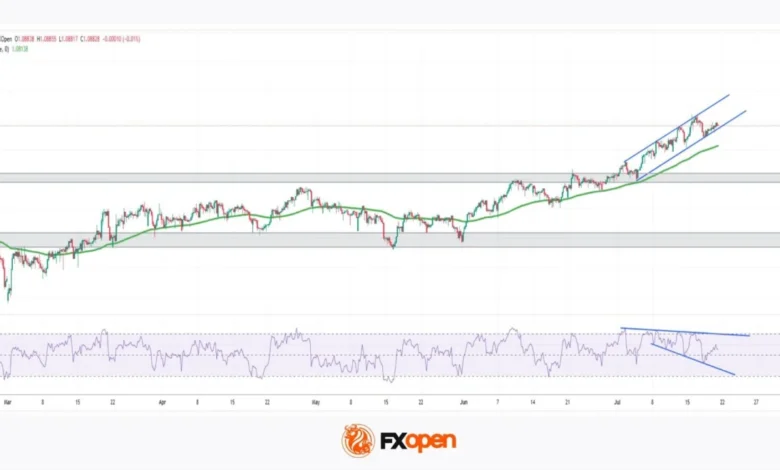
The interplay between these domestic and international factors is clearly reflected in the technical performance of the GBP/CHF currency pair. An examination of the 4-hour chart reveals a significant upward breakout in early July. This move followed a prolonged period of consolidation that had spanned nearly three months. The impetus for this breakout was directly linked to the aforementioned political and macroeconomic drivers, namely the receding political uncertainty in the UK and the safe-haven demand for the franc amidst global instability.
Since this decisive breakout, the GBP/CHF pair has evolved into a clear uptrend. However, recent price action has begun to exhibit early signs of potential exhaustion beneath the surface, suggesting that the momentum may be moderating.
Bullish Scenario: Sustained Upward Momentum
From a bullish perspective, the GBP/CHF pair has demonstrated considerable strength. Price action has decisively broken above the critical 1.0700 level and has subsequently held firmly above this threshold. This upward movement has been characterized by a consistent pattern of higher highs and higher lows, a hallmark of a healthy uptrend. This price behavior is occurring within the confines of an ascending parallel channel, a technical formation that typically signals continued bullish sentiment.

Adding further support to the bullish outlook, the 100-period Exponential Moving Average (EMA) is positioned comfortably below the current price. This technical indicator reinforces the notion that buyers remain in control of the market. The proximity of the EMA suggests that it is acting as a dynamic support level, with buyers likely to step in and defend any dips towards the channel’s lower boundary or the moving average itself. This technical setup indicates a strong underlying demand for GBP/CHF, with traders anticipating further upside potential.
Bearish Scenario: Emerging Divergence and Potential Reversal
Despite the compelling bullish technicals, there are emerging signals that suggest caution. Not all indicators are aligning perfectly with the optimistic outlook. The Relative Strength Index (RSI), a momentum oscillator, is exhibiting a bearish divergence. While the price of GBP/CHF has been printing higher highs, the RSI has been simultaneously forming lower highs and lower lows. This divergence is a classic warning sign, hinting at fading momentum behind the upward price movement. It suggests that the underlying buying pressure may be weakening, despite the appearance of continued strength in price.
However, for sellers to gain significant conviction and initiate a substantial downward move, a confirmed break below key technical levels is required. Specifically, a decisive break below the ascending trendline that defines the current uptrend, coupled with a decisive break below the 100-period EMA, would be necessary to signal a potential reversal. Such a breakdown could trigger a wave of selling, potentially sending the price back to retest the pivotal 1.0700 zone. Furthermore, a more significant bearish move could see the pair retreat into its broader trading range, which has historically been observed between 1.0500 and 1.0700. The question for market participants is which signal to prioritize: the supportive technical structure of the rising channel and EMA, or the subtle but persistent warning building within the RSI.
Broader Implications and Context
The recent political developments in the United Kingdom, particularly the confirmation of Andy Burnham as the new Labour leader, represent a significant shift in the country’s political landscape. Burnham, a prominent figure within the Labour Party, is known for his centrist policies and pragmatic approach. His ascent to leadership, following the tenure of Keir Starmer, has been met with a degree of relief by financial markets. Investors had expressed concerns about potential policy shifts under a different leadership, and Burnham’s known disposition has helped to alleviate some of these anxieties. This stability is crucial for attracting and retaining foreign investment, as well as for fostering domestic business confidence.
The potential appointment of Shabana Mahmood as Chancellor further reinforces this sentiment of fiscal prudence. Mahmood has a reputation for a disciplined approach to public finances, and her potential elevation to this key economic role suggests a government that is prioritizing fiscal responsibility. This would be a welcome development for credit rating agencies and international financial institutions, potentially leading to a more favorable outlook for the UK’s sovereign debt.
The Bank of England’s continued hawkish stance is a direct response to persistent inflationary pressures. The Consumer Price Index (CPI) in the UK has remained elevated, prompting the central bank to maintain its aggressive monetary tightening cycle. The latest inflation figures, released on [Insert Date of Latest CPI Release if Available, e.g., October 18, 2023], showed inflation at [Insert Latest CPI Figure, e.g., 6.7%], still significantly above the BoE’s 2% target. The renewed geopolitical tensions in the Middle East, specifically the conflict between [Mention Specific Conflict if Known, e.g., Israel and Hamas], have exacerbated these concerns. The disruption to global oil supplies, or the threat thereof, has driven crude oil prices higher. For example, Brent crude futures recently surged past [Insert Recent High Price, e.g., $90 per barrel], a level not seen in [Insert Timeframe, e.g., a month]. This surge directly impacts transportation costs, manufacturing, and ultimately, consumer prices, adding another layer of complexity to the BoE’s inflation-fighting efforts.
The Swiss franc’s dual role highlights the complex dynamics at play in the global financial system. The SNB’s commitment to a zero-interest-rate policy, while aimed at stimulating domestic economic activity, contrasts sharply with the global trend of rising interest rates. This divergence contributes to the franc’s attractiveness as a safe-haven asset. The Swiss economy, while generally robust, is heavily reliant on exports. Therefore, any significant appreciation of the franc can negatively impact its competitiveness on the international stage. The SNB’s explicit threat of intervention underscores its determination to prevent the franc from becoming overly strong, a move that could stifle economic growth and jeopardize export-oriented industries. The SNB’s previous interventions, such as those seen in [Mention Year/Period of Previous Interventions if Known, e.g., 2015], demonstrated their resolve, and market participants will be closely watching for any signs of direct action.
The technical analysis of GBP/CHF provides a granular view of how these broader forces are translating into currency market movements. The sustained uptrend, supported by key technical indicators, suggests that the Sterling’s recent gains are not merely fleeting. However, the emerging bearish divergence in the RSI serves as a crucial reminder that markets are dynamic and subject to change. The confluence of political stability, a hawkish central bank, and the ongoing safe-haven appeal of the franc has created a complex trading environment. The resolution of these competing forces will likely dictate the near-to-medium term direction of the GBP/CHF pair. Investors and traders will be closely monitoring upcoming economic data releases from both the UK and Switzerland, as well as any further developments in the geopolitical arena, to inform their trading strategies. The potential for a break below key technical levels remains a significant consideration, as it could signal a more substantial shift in market sentiment.
This article represents the opinion of the Companies operating under the FXOpen brand only. It is not to be construed as an offer, solicitation, or recommendation with respect to products and services provided by the Companies operating under the FXOpen brand, nor is it to be considered financial advice.