Earnings Mean Reversion: When Wall Street Estimates Snap Back and Threaten Market Valuations

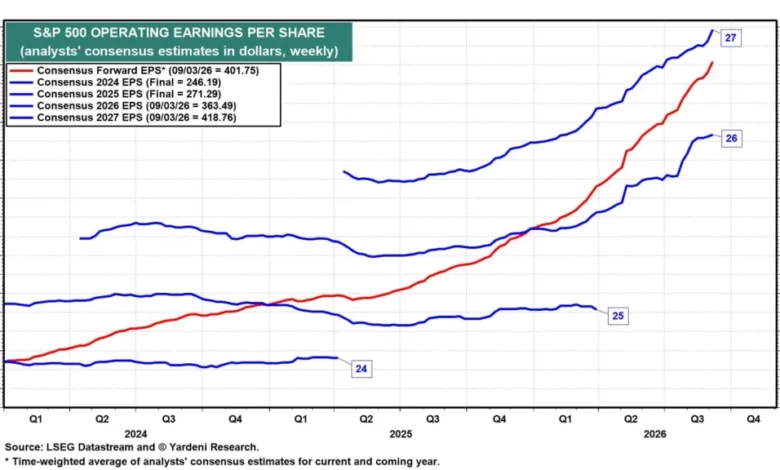
The modern equity market is currently navigating a precarious high-wire act defined by surging corporate profit expectations, unprecedented capital expenditure cycles, and an increasingly narrow concentration of economic leadership. Consensus earnings estimates for the S&P 500 now sit roughly 50% above their long-term historical growth trend line, creating a widening chasm that financial historians and market strategists recognize as a classic precursor to an earnings mean reversion. This divergence between actual long-term macroeconomic output and projected corporate profitability has sparked intense debate across Wall Street as analysts, portfolio managers, and institutional investors grapple with whether the current cycle represents a permanent structural shift in global commerce or merely another late-cycle speculative peak.

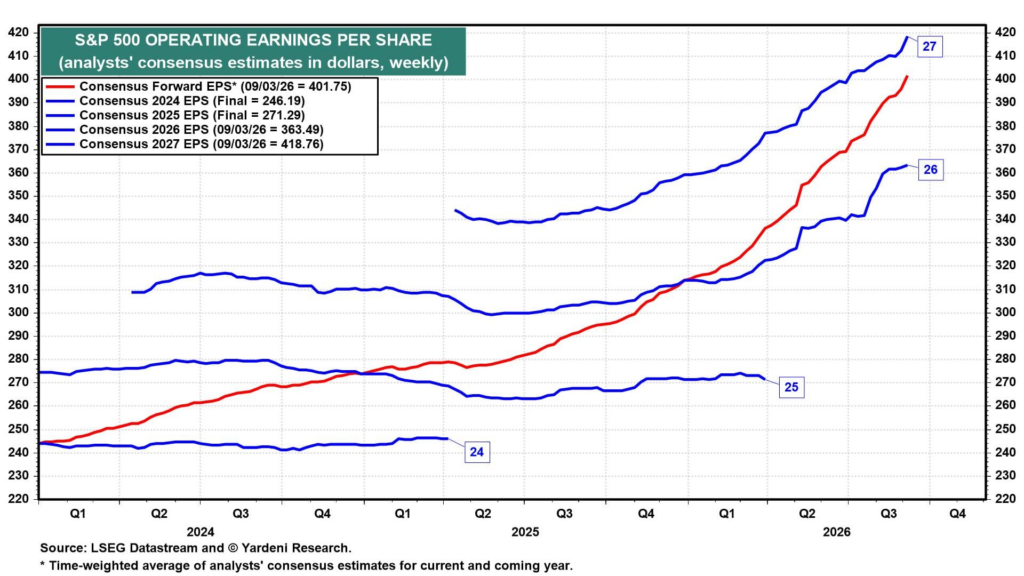
The trajectory of corporate earnings throughout the year has been characterized by aggressive, upward revisions from Wall Street analysts. At the onset of the year, consensus estimates anticipated S&P 500 earnings to expand by approximately 15%. However, strong performance reports through the second-quarter earnings season accelerated this momentum, pushing full-year projections to roughly 24%. Optimism has even spilled over into long-term forecasting, with expectations for 2027 and 2028 drifting steadily higher. While rising corporate profits are fundamentally positive for equity valuations, the sheer steepness of these upward revisions raises critical questions regarding sustainability. When forward earnings detach from historical growth channels by nearly 50%, the risk profile of the broader market shifts dramatically, leaving portfolios vulnerable to sudden disappointment should macroeconomic or sector-specific tailwinds falter.
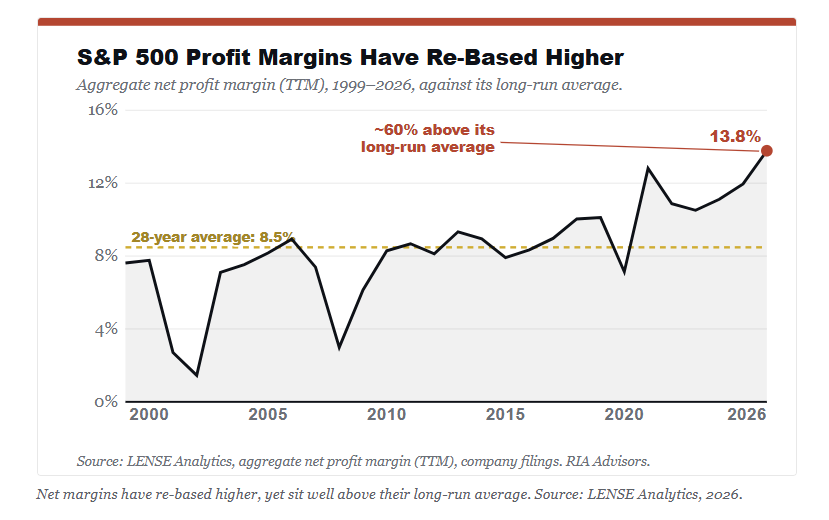
A retrospective examination of financial data reveals that S&P 500 operating earnings tracked their historical long-term growth trend closely until the macroeconomic disruptions of 2020. Since that pivotal year, actual and projected earnings have broken away from the baseline trend, establishing a permanently higher absolute level without returning to historical norms. Wall Street has increasingly extrapolated this post-pandemic deviation into multi-year forecasts, a process supercharged by robust second-quarter prints. Blended earnings growth for the second quarter approached 38%, marking the second consecutive quarter exceeding the 20% threshold. Beneath the headline figures, however, financial analysts have pointed to structural distortions. Stripping out large, non-recurring accounting gains—such as those recorded by Alphabet—reduces organic growth closer to 26%. Similar distortions appear in corporate profit margins, which achieved record highs propelled by one-time windfalls among a handful of mega-cap technology enterprises rather than broad-based operational efficiencies across the wider economy.

The central debate dividing market participants centers on the validity of the paradigm shift argument—specifically, the notion that "this time is different." Proponents of continued high valuations argue that structural changes within the S&P 500 render historical trend lines obsolete. Technology and communication services sectors now account for nearly half of total S&P 500 profits, a massive expansion compared to just two decades ago. These sectors inherently command structurally fatter profit margins than the industrial, manufacturing, and traditional retail companies that previously dominated the index. Furthermore, the implementation of lower corporate tax rates following the 2018 legislative changes, combined with an extended era of low financing costs, provided a permanent baseline elevation to corporate profitability.
Nevertheless, experienced market observers caution that while the absolute level of profit margins may have undergone a permanent structural re-basing, the rate of change and cyclical trajectory cannot escape gravitational economic laws. Famed investor Jeremy Grantham has frequently emphasized that profit margins remain among the most reliable mean-reverting series in global finance, noting that a functional capitalist economy inherently relies on supply and demand dynamics to correct excess profitability. As economic growth eventually moderates or enters a contractionary phase, competitive pressures, rising input costs, and decelerating consumer demand will naturally compress elevated margins.

Compounding this cyclical vulnerability is the extraordinary concentration of earnings growth. According to recent quantitative analysis from Goldman Sachs, approximately half of the projected earnings expansion is directly tied to artificial intelligence infrastructure spending, with a remarkably small cohort of mega-cap firms driving the vast majority of upward revisions. Much of this dynamic operates within a closed financial loop. Hyperscale technology companies are projected to ramp up capital expenditures significantly, with spending estimates reaching record heights. This immense capital outlay flows directly onto the income statements of semiconductor manufacturers, hardware suppliers, and cloud infrastructure providers, registering as explosive revenue growth. Wall Street forecasts suggest aggregate hyperscaler budgets could test or exceed $900 billion in the coming years, sustaining the earnings boom for the suppliers. Yet, this reliance on a single, highly concentrated investment theme exposes the broader index to systemic vulnerability if return-on-investment metrics fail to materialize on schedule.
Furthermore, historical data illustrates that sell-side analysts consistently demonstrate excessive optimism regarding out-year estimates that remain distant from immediate visibility. Over the past 25 years, bottom-up consensus estimates published at the beginning of a calendar year have historically overshot final reported outcomes by an average of more than 6 percent. While forecasts often prove accurate during steady expansions, they frequently experience sharp, catastrophic downward revisions when macroeconomic conditions shift unexpectedly. Tellingly, even the current consensus acknowledges an impending deceleration, with Goldman Sachs and FactSet projecting significantly tamer growth rates for subsequent years.
Market strategists note that when an earnings mean reversion ultimately triggers, it rarely arrives through the anticipated doorway. While retail and institutional investors frequently monitor traditional recession indicators, monetary policy tightening, or aggressive Federal Reserve interest rate hikes as primary catalysts, the impending adjustment is more likely to originate from within the concentrated leadership cohort itself. As the market transitions, the primary risk is not whether artificial intelligence technology is commercially viable, but rather what financial expectations have already been priced into the leading equities.
Recent market behavior indicates early signs of friction. Intra-sector correlation among major artificial intelligence hyperscalers has begun to decline as investors increasingly differentiate between firms successfully tying infrastructure spending to tangible revenue generation and those funding capital expenditures through debt accumulation. Industry projections suggest that supply and demand dynamics within the artificial intelligence hardware ecosystem may not fully balance until late 2027. If one or more major technology giants eventually signal that the financial returns on trillion-dollar investments are lagging behind schedule, the revision engine could quickly shift into reverse, disproportionately impacting equities with the most stretched out-year valuations.
Consequently, financial analysts recommend monitoring capital expenditure announcements within the artificial intelligence sector rather than solely tracking traditional lagging indicators like the unemployment rate. As the market navigates this late-cycle environment, the divergence between structural margin levels and cyclical earnings growth will ultimately test the resilience of equity valuations, making an eventual earnings mean reversion a critical focal point for disciplined portfolio management.