MEXC Reports Significant Growth in TradFi Trading Volume as Investors Pivot Toward Semiconductor and AI-Linked Assets


Mutsamudu, Comoros, September 11, 2026 — Global digital asset platform MEXC has announced a major surge in its traditional finance (TradFi) trading performance for the month of August, signaling a profound shift in retail investor behavior. The exchange, recognized for its zero-fee trading model, reported that trading volume across its stock, index, and ETF futures products climbed 130% month-over-month. This expansion coincides with a 35% increase in the variety of available contracts, which now exceed 400 unique listings. Alongside the futures market, tokenized stock and ETF spot trading volumes experienced a 30% uptick, reflecting a widespread trend of capital deployment into technology-heavy and sector-specific equities.
The Strategic Shift Toward Semiconductor Dominance
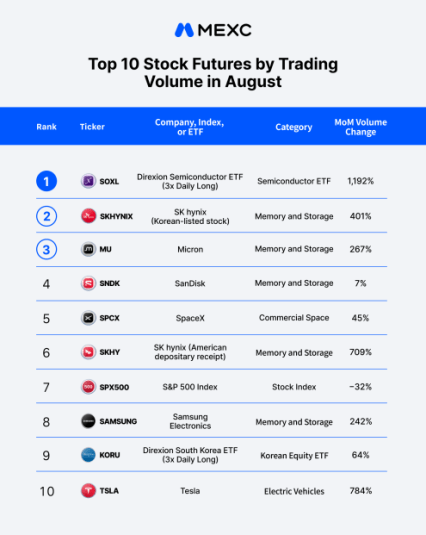
The data for August reveals a decisive move by market participants away from broad-market indices, such as the S&P 500, and toward high-growth, industry-specific assets. While broad-market exposure through SPX500 Stock Futures saw a decline of approximately 32% in trading volume, investors aggressively shifted their focus to the semiconductor supply chain, specifically memory and storage technology companies.
This trend is most visible in the performance of individual stock futures. Five of the top 10 most traded Stock Futures on the platform are now comprised of companies linked to the memory and semiconductor sectors. SK hynix (SKHYNIX) emerged as the definitive leader, capturing the top spot among individual stock futures with a staggering 401% growth in monthly trading volume. Micron (MU) followed closely behind, recording a 267% increase.
The geographic focus of these trades also signaled a broader global interest in Korean technology markets. Combined trading volume for stock futures tied to Korean firms—including SKHYNIX, SKHY, SAMSUNG, and the KORU index—soared by approximately 348%. Collectively, these Korean-market-linked assets accounted for 27% of total Stock Futures trading volume in August, nearly doubling their 14% share from the previous month. This surge highlights a growing appetite among international retail traders for exposure to key players in the global silicon ecosystem, which serves as the backbone for both mobile and enterprise-grade artificial intelligence infrastructure.
Leveraged Exposure and Sector-Specific Volatility
A critical component of the August data is the rapid adoption of leveraged ETF futures. The most notable performance came from SOXL Stock Futures, which track a semiconductor-focused ETF providing 3x daily long exposure. Trading volume for SOXL surged by an unprecedented 1,192% month-over-month. To put this in perspective, SOXL’s share of total Stock Futures trading volume rose from less than 4% in July to 20% by the end of August, effectively becoming a primary vehicle for traders looking to capitalize on semiconductor market volatility.
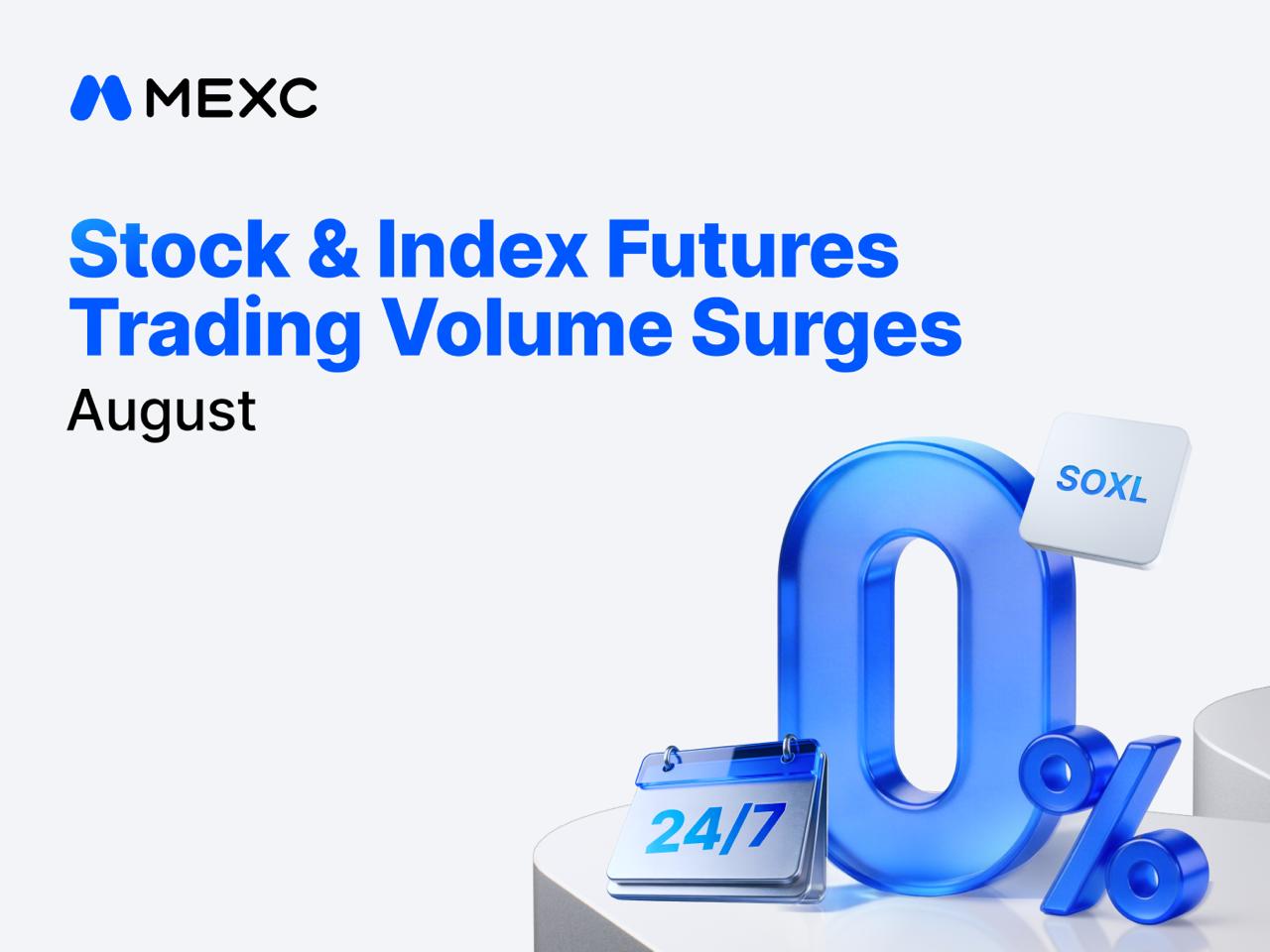
Simultaneously, the inverse side of this trade—represented by SOXS Stock Futures, which provide 3x daily inverse leveraged exposure to the U.S. Semiconductor Index—recorded a robust 436% increase in volume. This indicates a bifurcated market strategy where traders are not only betting on the continued growth of the AI and semiconductor boom but are also utilizing sophisticated hedging tools to manage risks associated with potential market corrections.
Beyond the semiconductor space, other high-interest sectors continued to draw significant capital. SpaceX (SPCX) and Tesla (TSLA) stock futures recorded volume increases of 45% and 784%, respectively. These figures reinforce the role of MEXC as a gateway for retail traders to participate in the capital-intensive sectors of commercial space exploration and electric vehicle manufacturing—industries that are traditionally difficult for retail investors to access via conventional brokerage accounts due to high barriers to entry or restricted market hours.
Spot Market Dynamics and Broad-Based AI Interest
The growth observed in the futures market was mirrored in the spot trading segment, where tokenized stocks and ETFs saw a 30% increase in volume. Significantly, this growth was not concentrated in a handful of "whale" accounts or top-tier assets. Approximately 99% of all existing spot listings recorded higher trading volumes throughout August. The top 10 most traded assets accounted for only 12% of the total segment volume, suggesting a healthy, broad-based distribution of trading interest across the platform’s diverse portfolio.
Among these, Nebius (NBIS), an AI cloud infrastructure firm, saw its trading volume jump by 188%, marking the highest growth rate within the top 10 list. The popularity of NBIS, alongside NVIDIA (NVDA), which recorded a 54% volume increase, underscores the market’s intense focus on the foundational layers of the AI economy. Furthermore, crypto-linked equities also performed well; Circle (CRCL), Coinbase (COIN), and Robinhood (HOOD) remained fixtures in the top 10, with their combined trading volume rising by 47%.
24/7 Accessibility and Global Market Integration
The structural advantage of the MEXC platform lies in its ability to bridge disparate global markets. By enabling users to trade products linked to U.S., Korean, and Hong Kong equities using USDT through a single account, the exchange removes the logistical friction of managing multiple regional brokerage accounts.
This model proved particularly valuable during the month of August, as market participants increasingly utilized the platform’s 24/7 trading capabilities. Notably, trading activity during the 10 weekend days in August accounted for approximately 11% of the total monthly volume. This demonstrates a strong demand among retail traders for "always-on" market access, particularly during times of high volatility when traditional financial exchanges are closed.
The "0808: Stock Season" zero-fee promotion acted as a catalyst for this volume spike, attracting over 86,000 active participants. The promotion resulted in more than $1 million in saved trading fees for users, further incentivizing high-frequency trading and portfolio rebalancing during a volatile summer month.
Official Commentary and Future Outlook
Reflecting on the record-breaking month, Vugar Usi, CEO of MEXC, emphasized the platform’s role in democratizing access to global capital markets. "The sustained growth in stock-related trading across multiple asset classes and markets underscores the accelerating global demand for accessible, diversified market exposure," Usi stated. "We remain committed to expanding our equity-linked offerings and simplifying access for users worldwide, consolidating trading into a single account and delivering on our core proposition: trading Wall Street, without walls."
The implications of these data points are significant for the broader fintech landscape. The rapid shift toward tokenized assets suggests that retail investors are increasingly comfortable with the efficiency and transparency provided by blockchain-based trading platforms. By collapsing the barriers between traditional equities and digital assets, platforms like MEXC are positioning themselves as critical infrastructure for the next generation of global investors.
As the industry looks toward the final quarter of 2026, the focus will likely remain on whether this trend of sector-specific, high-leverage trading continues. With semiconductor demand expected to remain high due to ongoing AI integration and the increasing commercialization of space, the trading patterns observed in August may well serve as a blueprint for investor behavior in the coming months. The ability of retail investors to pivot rapidly between long and short positions on sector-specific indices, regardless of geography or time zone, indicates a permanent evolution in how global capital is allocated and managed in the digital age.