Operating as an independent quantitative trader requires an individual to master multiple distinct professional disciplines that are traditionally distributed across an entire corporate firm. In a standard institutional trading environment or hedge fund, job segregation is strictly enforced. Researchers focus exclusively on alpha generation, software engineers build low-latency infrastructure and execution pipelines, portfolio managers oversee capital allocation and risk governance, and operations teams handle trade reconciliation, middle-office clearing, and daily administrative burdens.
For the independent practitioner, however, these specialized roles collapse into a single individual. The solo trader must navigate diverse responsibilities simultaneously, a reality that frequently introduces operational friction, cognitive fatigue, and strategic missteps. Industry observers and veteran quantitative analysts note that failing to separate these distinct operational modes is one of the leading causes of failure among independent algorithmic traders. When an individual blurs the boundaries between scientific inquiry, engineering execution, portfolio architecture, and day-to-day operations, troubleshooting systemic flaws becomes nearly impossible, as the root causes of underperformance are obscured by overlapping methodologies.
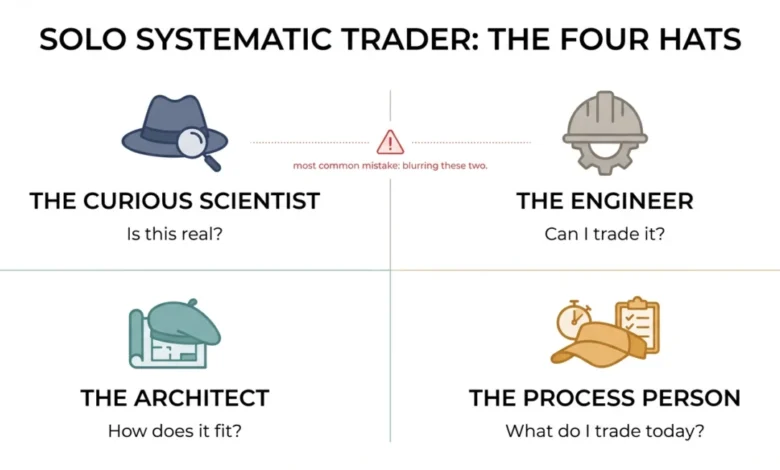
To address this structural challenge, seasoned quantitative educators have developed a comprehensive operational framework known as the "Four Hats" model. This paradigm posits that while a solo trader must wear every hat required to run a modern trading enterprise, sustainable success depends entirely on wearing them strictly one at a time. By compartmentalizing mindsets, tools, and objectives, independent operators can systematically diagnose flaws, protect their capital, and build robust, scalable strategies.
Hat 1: Edge Research and the Curious Scientist
The foundational phase of any quantitative trading lifecycle begins with edge research, a role characterized by pure intellectual curiosity and empirical observation. Operating under the persona of the scientist, the solo trader examines raw financial datasets to identify anomalies, structural inefficiencies, or behavioral patterns that deviate from standard market equilibrium.
During this phase, the primary objective is not to design a profitable trading system, but rather to understand a phenomenon. The researcher investigates fundamental questions: Is a specific market effect statistically significant, or is it merely the artifact of data snooping and random noise? What macroeconomic, behavioral, or structural market mechanics sustain this anomaly over time? Most importantly, the scientist asks who occupies the opposite side of the transaction and what economic rationale compels those market participants to absorb consistent losses.
Market historians and quantitative researchers emphasize that this stage must remain entirely unburdened by commercial constraints, execution logistics, or optimization metrics. Introducing parameters such as transaction costs, slippage, or position sizing too early in the scientific phase compromises the integrity of the research. The scientist must remain focused exclusively on causal mechanisms and empirical validation. Without a deep, intuitive comprehension of why an edge exists, a trader lacks the foundational insights necessary to navigate inevitable market regime shifts.
Hat 2: Strategy Research and the Engineer
Once empirical research validates the existence of a genuine market anomaly, the practitioner transitions from the scientific laboratory to the engineering workshop. The engineer’s mandate is to determine whether the discovered edge can be translated into a viable, tradeable financial instrument.
This phase involves rigorous backtesting, algorithmic simulation, historical stress testing, and the integration of realistic market friction variables. The engineer calculates the impact of transaction costs, bid-ask spreads, borrowing fees for short positions, and execution latency. Furthermore, this role defines the precise boundary conditions and operational constraints under which the strategy will function.
Industry experts frequently warn against the common pitfall of bypassing the scientist’s hat to begin immediately with engineering simulations. Novice traders often gravitate toward optimization software, tweaking entry and exit parameters on unverified market patterns in search of historical profitability. Quantitative analysts describe this premature optimization as building an advanced suspension system for a vehicle that lacks an engine; optimizing rules for a market dynamic that is fundamentally misunderstood inevitably results in curve-fitted strategies that fail catastrophically when deployed into live market conditions. The research phase must be completed and thoroughly understood to earn the right to construct the strategy.
Hat 3: Portfolio Research and the Architect
An individual trading strategy rarely exists in isolation within a professional environment. Even if a quantitative model demonstrates exceptional performance during backtesting, deploying it as a standalone vehicle exposes the trader to severe concentration risk and idiosyncratic drawdowns. Consequently, the solo trader must don the hat of the portfolio architect.
The architect operates at a macro level, synthesizing multiple individual strategies into a cohesive, diversified portfolio. This discipline addresses capital allocation, risk budgeting, and the dynamic interaction between different quantitative models. When two independent strategies generate contradictory signals—such as one model demanding a long position in a specific asset class while another dictates a short exposure—the architect must govern the overarching portfolio balance.
By sizing positions sensibly and spreading risk across uncorrelated assets, sectors, or time horizons, the architect maximizes the portfolio’s risk-adjusted return profile. This strategic oversight ensures that the broader trading operation can absorb adverse market environments and continue generating alpha even when historical performance correlations temporarily break down.
Hat 4: Operations and the Process Person
The final, least glamorous, yet arguably most critical role in the solo trading ecosystem is the operational process manager. This persona governs the daily mechanical execution required to translate abstract mathematical signals into live market orders.
Operations encompass trade routing, position tracking, daily accounting reconciliation, cash management, and the management of brokerage interfaces. While creative research and complex algorithmic design command higher intellectual prestige, operational efficiency determines whether a theoretically profitable strategy survives in the real world. Unforeseen execution failures, software bugs, connectivity disruptions, and neglected compliance or administrative tasks can rapidly erode the financial gains generated by sophisticated quantitative models. Establishing simple, repeatable, and resilient operational routines is essential for maintaining consistency, particularly during periods of psychological stress or market volatility.
Implications for Independent Quantitative Practitioners
The systemic failure to delineate these four functional domains frequently manifests as strategic paralysis among independent traders. A common error observed in the retail and independent prop-trading sectors is the conflation of the scientific research phase with the engineering optimization phase. When traders attempt to evaluate transaction costs and optimize parameters before understanding the underlying behavioral drivers of a market anomaly, they construct fragile systems built on unproven assumptions.
Financial engineers frequently draw analogies to traditional civil engineering to illustrate this vulnerability. A structural engineer designing a suspension bridge can immediately proceed to mathematical modeling and load calculations because centuries of empirical research have definitively established the governing laws of physics, material science, and gravity. In contrast, financial markets represent complex, adaptive socioeconomic systems characterized by non-stationary data regimes and strategic market participants. Independent quantitative traders rarely possess exhaustive, universally accepted laws governing every market micro-structure they encounter. Consequently, the exploratory research phase cannot be abbreviated or omitted.
Institutional Responses and Educational Frameworks
Recognizing the immense cognitive load placed upon solo operators, specialized quantitative education and prop-trading incubators have begun structuring their curricula around functional role separation. Organizations such as Robot Wealth have formalized the four-hats paradigm into structured developmental programs designed to guide independent traders through the maturation process.
Educational initiatives, including specialized quantitative bootcamps, focus heavily on the preliminary tiers of the framework—teaching practitioners how to rigorously identify genuine market edges, conduct robust out-of-sample backtests, and construct diversified portfolios capable of weathering adverse macroeconomic regimes. Advanced professional communities extend this support into operational deployment, assisting independent traders with live portfolio management, risk infrastructure, and end-to-end strategy implementation, such as developing statistical arbitrage frameworks from raw historical data feeds to automated execution.
Strategic Framework for Daily Operations
To maintain operational hygiene, independent traders are advised to consciously audit their daily workflows by explicitly identifying which functional hat they are wearing at any given moment.
When operating as the scientist, the practitioner must deliberately suspend all commercial metrics, profit targets, and implementation logistics, dedicating their time entirely to open-ended data exploration and hypothesis testing. When transitioning to the engineer, the trader must possess a clear, articulable thesis that explains the strategy’s edge within minutes, subjecting the model to rigorous cost-benefit analyses and constraint testing. As the architect, the operator steps back to evaluate aggregate capital distribution and cross-strategy correlations, ensuring that overall portfolio resilience takes precedence over the performance of any single model. Finally, during operational hours, the process manager must execute established protocols with disciplined adherence, prioritizing error-free execution and robust daily routines over creative experimentation.
By establishing strict psychological and operational boundaries between these four distinct professional roles, solo traders can significantly reduce cognitive dissonance, diagnose structural trading errors with precision, and construct sustainable, professional-grade quantitative trading operations.