The S&P 500’s Remarkable Resilience: Navigating Market Peaks and Valleys

The S&P 500 has demonstrated significant resilience and growth, even when investing at market peaks, underscoring the importance of a long-term perspective over the ability to time market turns. Analysis of recent market history reveals substantial gains for investors regardless of their entry point, suggesting that strategic patience often outweighs the pursuit of perfect market timing.
A Year of Recovery and Beyond
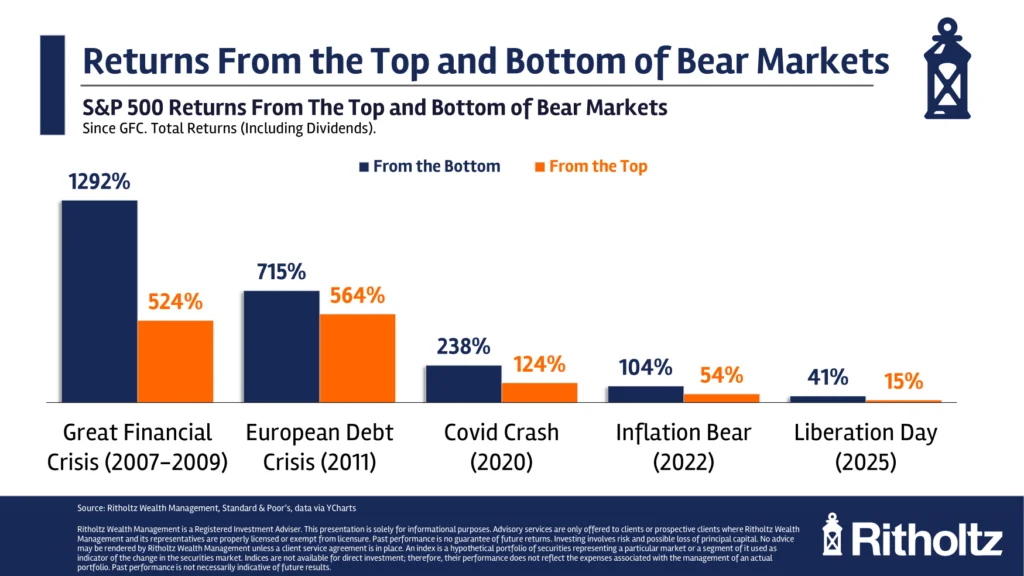
Approximately one year ago, around the period referred to as "Liberation Day," the S&P 500 experienced a notable sell-off. From its lowest point during this downturn, the index has surged by an impressive 41%. This rebound highlights the cyclical nature of financial markets, where periods of decline are often followed by recovery and subsequent growth.
Looking back further, the S&P 500’s performance from the nadir of the 2022 bear market presents an even more compelling narrative of recovery. Investors who entered the market at that low point have seen their investments grow by an extraordinary 104%. This period marked a significant test for many market participants, with widespread concerns about inflation, interest rate hikes, and geopolitical instability contributing to a challenging investment environment. The subsequent recovery underscores the inherent ability of equity markets to rebound from significant drawdowns.
The recovery from the COVID-19 crash in March 2020 is perhaps one of the most remarkable in recent history. From its lowest point during that unprecedented period of market turmoil, the S&P 500 has delivered a staggering 238% return. The rapid onset and global impact of the pandemic triggered a swift and severe market decline, but the subsequent economic stimulus measures and the unexpected speed of recovery in many sectors fueled a powerful bull run.
Even further back, the S&P 500’s performance from the bottom of the mini-bear market in 2011 shows sustained long-term growth. During that period, the index has appreciated by 715%. This demonstrates that even less severe market corrections, when followed by extended periods of economic expansion and market recovery, can yield substantial returns for patient investors.
The most significant historical benchmark, the bottom of the Great Financial Crisis in March 2009, has seen the S&P 500 climb by an astonishing 1,292%. This period, marked by a severe global recession and the near collapse of the financial system, represents a challenging entry point for many. However, the subsequent decade-long bull market, fueled by accommodative monetary policies and a period of relative economic stability, has rewarded those who remained invested.
While it is often stated that buying at the exact bottom of a bear market leads to superior returns when followed by a bull market, this observation, though factually correct, simplifies the reality of market participation. The data clearly illustrates the potential for significant gains when entering at these opportune moments.
Performance from Market Peaks
Beyond the gains realized from market bottoms, an equally important, and often more relevant, question for many investors is performance when entering the market near its peaks. This perspective is crucial because most individuals do not possess the foresight or the fortuna to invest precisely at the nadir of a market cycle.
From the peak that preceded the "Liberation Day" sell-off, the S&P 500 has still managed to gain 15%. This indicates that even an entry point just before a modest correction can still yield positive returns over a subsequent recovery period.
When considering the peak just before the start of the 2022 bear market, investors who entered at that juncture have seen their holdings increase by 54%. This demonstrates that despite the subsequent downturn, the long-term upward trajectory of the market has allowed for significant recovery and growth.
The peak preceding the COVID-19 Crash in March 2020, a period of significant market exuberance, has also yielded substantial returns. From that high point, the S&P 500 has climbed by 124%. This illustrates the market’s capacity to not only recover from sharp declines but to surpass previous highs, rewarding investors who remained committed.
Looking at the peak before the 2011 double-dip recession, investors who entered at that time have witnessed a remarkable 564% increase in their investments. This period, characterized by fears of a recessionary relapse, ultimately saw the market continue its upward trend, underscoring the resilience of equity markets over extended periods.
Finally, the peak in October 2007, just before the onset of the Great Financial Crisis, has also resulted in significant long-term gains. From that historic high, the S&P 500 has grown by an impressive 524%. This period represents a particularly challenging entry point, as it was followed by one of the most severe market crashes in modern history. The fact that the index has more than quintupled from that point highlights the power of long-term compounding and market recovery.
While these gains from market peaks are not as substantial as those from market bottoms, they are nevertheless significant. It is crucial to remember that these figures follow substantial drawdowns. For instance, the peak just before the "Liberation Day" sell-off was followed by a drawdown of -19%. The peak before the 2022 bear market saw a -25% decline. The peak before the COVID-19 Crash experienced a -34% drop. The peak before the 2011 double-dip saw a -19% decline, and the peak in October 2007 was followed by a devastating -57% drawdown. The fact that the S&P 500 has recovered and grown substantially from these points is a testament to the enduring strength of the stock market.
The Irrelevance of Perfect Timing
The presented data powerfully illustrates a fundamental truth in investing: the ability to consistently pick market tops and bottoms is exceptionally rare, if not impossible, for the vast majority of investors. The notion of perfectly timing the market, entering at the absolute lowest point and exiting at the absolute highest, is more of a theoretical ideal than a practical reality.
As the analysis suggests, very few individuals are fortunate enough to invest at the precise nadir of a market downturn. Conversely, it is equally improbable for anyone to experience the extreme misfortune of investing exclusively at market peaks immediately preceding significant declines. While anecdotal examples, like the hypothetical "Bob" who might only invest at market tops, can serve as cautionary tales, they represent outliers rather than the norm.
The reality for most investors is that they deploy capital at various points along the market’s trajectory. Investments are often made during periods of moderate growth, sideways consolidation, or even during the initial stages of a downturn or recovery. The distribution of entry points is typically a blend, sometimes closer to a top or a bottom, but more frequently somewhere in the middle.
The crucial takeaway from this extensive data is that the precise timing of market entry, while often a focus of investor anxiety, does not hold the same weight as commonly perceived. The ability to forecast market turning points with accuracy and consistency is a formidable challenge, and the pursuit of this elusive goal can often lead to suboptimal investment decisions, such as missing out on periods of growth due to premature exits or entering at inopportune times due to delayed action.
The Primacy of Time Horizon
Instead of fixating on market timing, the data strongly suggests that an investor’s time horizon is a far more significant determinant of investment success. A longer time horizon allows for the compounding of returns, the weathering of market volatility, and the capture of the market’s secular growth trends.
For instance, an investor who entered the market in March 2009, at the bottom of the Great Financial Crisis, and remained invested would have benefited from a 12-year bull market. This extended period allowed their initial investment to grow exponentially, significantly mitigating the impact of any short-term fluctuations. Similarly, investors who entered near the peak of the COVID-19 crash and held on have also seen their portfolios rebound and grow, demonstrating the power of staying invested through market cycles.
The inherent volatility of the stock market means that short-term predictions are inherently unreliable. Economic indicators can shift rapidly, geopolitical events can emerge unexpectedly, and investor sentiment can change on a dime. However, over longer periods, the fundamental drivers of economic growth, corporate innovation, and increasing productivity tend to propel equity markets upward.
A longer time horizon also provides a buffer against the psychological pressures that can lead to poor investment decisions. When markets are declining, the temptation to sell can be overwhelming. However, with a long-term perspective, investors are better equipped to view short-term dips as opportunities rather than existential threats. This mindset shift is critical for maintaining discipline and adhering to a well-defined investment strategy.
Broader Implications for Investors
The evidence presented has significant implications for how individuals approach their investment strategies. It underscores the value of diversification, asset allocation, and consistent saving over attempts at market timing. Building a diversified portfolio across different asset classes and geographies can help mitigate risk and improve risk-adjusted returns over the long term.
Furthermore, the practice of dollar-cost averaging, where a fixed amount of money is invested at regular intervals, inherently mitigates the risk of investing a lump sum at a market peak. This strategy allows investors to buy more shares when prices are low and fewer shares when prices are high, effectively averaging out their purchase price over time.
For financial advisors and investment managers, this data reinforces the importance of educating clients about the long-term nature of investing and managing expectations regarding market timing. Focusing on financial planning, goal setting, and risk tolerance can help clients stay disciplined and avoid making emotionally driven decisions.
The historical performance of the S&P 500, whether from market bottoms or even from market peaks, paints a consistent picture of long-term growth and resilience. While short-term market fluctuations are inevitable and can be unsettling, the overarching trend of upward movement, driven by economic expansion and innovation, remains a powerful force. By prioritizing a long-term investment horizon and maintaining a disciplined approach, investors can navigate the inherent volatility of the markets and work towards achieving their financial objectives.
Further Insights
For those seeking to delve deeper into market behavior following periods of correction, further reading on "How the Stock Market Performs After a Correction" can provide valuable context. Understanding the historical patterns of recovery and subsequent growth can further bolster the confidence of long-term investors. The cyclical nature of markets, while sometimes appearing daunting, ultimately presents opportunities for disciplined and patient participants to benefit from the enduring power of compound growth.