A sophisticated cyber-espionage campaign has come to light, revealing targeted digital operations directed at domestic Australian organizations and offshore energy firms operating within the contested waters of the South China Sea. Security researchers from Proofpoint and PwC’s Threat Intelligence teams recently uncovered a series of watering hole attacks orchestrated by TA423—a threat actor widely associated with the Chinese government. The campaign relies on the deployment of ScanBox, a versatile JavaScript-based reconnaissance tool designed to map victim infrastructure, gather browser telemetry, and harvest user credentials without requiring the installation of traditional, file-based malware on compromised endpoints.
The discovery underscores the persistent nature of state-sponsored cyber operations targeting geopolitical flashpoints and economic assets in the Indo-Pacific region. By combining targeted phishing lures with compromised web infrastructure, the threat actors demonstrated a methodical approach to intelligence collection, prioritizing entities relevant to maritime security, energy exploration, and regional diplomacy.
Overview of the Threat Actor: TA423 and the Hainan Connection
TA423, also tracked in threat intelligence circles by the moniker Red Ladon, is assessed with moderate confidence by security researchers to operate out of Hainan Island, China. The group has long been scrutinized by cybersecurity firms and law enforcement agencies for its alignment with strategic intelligence objectives set by Beijing.
According to a landmark 2021 indictment by the United States Department of Justice, TA423 is linked to the Hainan Province Ministry of State Security (MSS), the civilian intelligence, security, and cyber-policing agency of the People’s Republic of China. The MSS is broadly tasked with domestic counter-intelligence, foreign intelligence gathering, political security, and the oversight of industrial and cyber-espionage campaigns designed to advance China’s geopolitical and economic interests.
Historically, the threat group’s operational scope extends far beyond the Australasian theater. The 2021 federal indictment detailed a global campaign of computer intrusions attributed to operatives working with the MSS, highlighting the theft of trade secrets and confidential business information across multiple continents. Targeted sectors included aviation, defense, education, government, healthcare, biopharmaceutical, and maritime industries in countries such as the United States, Canada, the United Kingdom, Germany, Norway, Saudi Arabia, and South Africa. Despite international exposure and legal indictments, analysts note that TA423 has maintained its operational tempo, showing no signs of scaling back its intelligence-gathering missions.
Chronology and Campaign Mechanics: April to June 2022
The newly documented cyber-espionage cycle took place between April 2022 and mid-June 2022. The operation began with carefully crafted phishing emails designed to entice professionals in targeted organizations. The email lures utilized seemingly innocuous subject lines, such as "Sick Leave," "User Research," and "Request Cooperation."
The communications frequently purported to originate from representatives of a fabricated media outlet named the "Australian Morning News." The senders implored recipients to visit the newly established domain, australianmorningnews[.]com, to review news stories or participate in collaborative research.
When unsuspecting targets clicked the embedded links, they were redirected to the malicious website. The landing page successfully mimicked legitimate news portals by mirroring content scraped from established international media organizations, such as the BBC and Sky News. However, behind the veneer of standard journalistic content, the web server delivered the ScanBox reconnaissance framework to the visitor’s browser.
The ScanBox Framework: Anatomy of a Browser-Based Surveillance Tool
ScanBox is a multifunctional, customizable JavaScript framework that has been utilized by various threat actors for nearly a decade. Its primary utility lies in its ability to conduct covert reconnaissance and user tracking without dropping traditional binaries onto a target’s hard drive. This stealthy characteristic makes ScanBox a preferred tool for preliminary intelligence gathering, allowing adversaries to profile a victim’s network environment before committing more conspicuous or resource-intensive exploits.
Security analysts emphasize the inherent risks associated with fileless reconnaissance tools. Because the keylogging and telemetry-gathering functionalities rely entirely on JavaScript execution within a web browser, traditional antivirus software often fails to flag the activity as malicious malware.
When a target visits a compromised watering hole website embedded with ScanBox, the script initiates a multi-stage browser fingerprinting process. The initial script queries the host machine for extensive system information, including:
- Operating system details and system architecture
- Installed browser versions and active language settings
- Specific browser plugins, extensions, and legacy components such as Adobe Flash
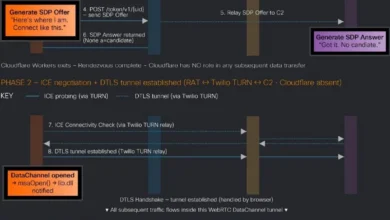
Furthermore, advanced iterations of ScanBox leverage modern browser capabilities, including WebRTC (Web Real-Time Communication), to interact directly with internal network configurations. WebRTC allows web browsers and mobile applications to perform real-time communications over standardized application programming interfaces.
By integrating STUN (Session Traversal Utilities for NAT) servers into its operational workflow, ScanBox can discover mapped IP addresses and port numbers allocated by Network Address Translators (NAT). Utilizing Interactive Connectivity Establishment (ICE), a peer-to-peer communication protocol, the framework establishes direct communication channels with command-and-control infrastructure, bypassing standard firewalls and NAT gateways. Consequently, threat actors can map internal network topologies and monitor user activity even when victim machines are situated behind robust corporate perimeter defenses.
Strategic Intent and Regional Implications
Industry experts have highlighted the strategic alignment between TA423’s recent targeting patterns and broader geopolitical developments in the Asia-Pacific region. Sherrod DeGrippo, vice president of threat research and detection at Proofpoint, noted that the threat group’s operational focus directly mirrors Beijing’s strategic priorities regarding the South China Sea and regional maritime sovereignty.
"This group specifically wants to know who is active in the region," DeGrippo stated, pointing out that ongoing tensions involving maritime boundaries, energy exploration rights, and naval deployments in countries such as Malaysia, Singapore, Taiwan, and Australia remain central drivers for state-sponsored espionage. As offshore energy firms in the South China Sea continue to explore contested petroleum and natural gas reserves, they represent high-value intelligence targets for foreign governments seeking to project regional influence.
The targeting of Australian organizations further reflects a sustained effort to monitor domestic political, economic, and military developments within the country. Australia’s strategic partnerships, defense agreements, and critical infrastructure sectors have frequently drawn the attention of foreign intelligence services, making domestic institutions prime candidates for long-term cyber surveillance.
Analysis of Threat Landscape and Future Outlook
The persistence of campaigns utilizing frameworks like ScanBox illustrates the evolving nature of modern cyber-espionage. As perimeter defenses and endpoint detection and response (EDR) solutions become increasingly effective at neutralizing traditional malware payloads, threat actors continue to pivot toward living-off-the-land techniques, credential harvesting, and browser-based reconnaissance.
Watering hole attacks present a distinct challenge for corporate security teams because they exploit trusted relationships between users and legitimate information sources. When threat actors compromise or simulate trusted news portals, they leverage human psychology to bypass traditional skepticism toward unsolicited communications.
Cybersecurity analysts project that TA423 and similar state-sponsored syndicates will maintain their strategic focus on the Indo-Pacific region, adapting their delivery mechanisms to evade emerging detection capabilities. Organizations operating in sensitive sectors—particularly maritime energy, defense contracting, and government policy—are advised to implement robust web-filtering policies, monitor for unauthorized browser-based script executions, and maintain heightened awareness regarding spear-phishing campaigns designed to mimic media outlets and professional networks.
As international law enforcement agencies continue to issue indictments and public attributions against state-backed hackers, the operational resilience of groups like TA423 demonstrates that legal measures alone are insufficient to deter sophisticated cyber-espionage. Mitigating these persistent threats requires a combination of proactive threat intelligence sharing, rigorous endpoint monitoring, and continuous security awareness training across vulnerable industries.