Build Alpha Introduces Prop Firm Simulator to Optimize Algorithmic Trading Portfolios Beyond Traditional Backtesting Metrics

Algorithmic trading software provider Build Alpha has officially launched its new Prop Firm Simulator, a comprehensive quantitative tool designed to replay trading portfolios bar-by-bar against the complex rules of proprietary trading firm evaluations and funded accounts. Developed by founder and quantitative developer David Bergstrom, the simulator moves past conventional backtesting metrics like net profit and maximum drawdown, focusing instead on financial outcomes such as pass probabilities, payout frequencies, and expected net cash per attempt after all associated fees.
The proprietary trading firm landscape has expanded rapidly over the past decade, attracting retail and professional traders seeking access to large pools of institutional-grade capital via evaluation challenges. However, the economic structure of trading through a prop firm differs fundamentally from trading one’s own capital. While standard backtests evaluate a strategy’s raw P&L, prop firm accounts introduce a rigid multi-tiered architecture consisting of evaluation phases, trailing or end-of-day drawdowns, daily loss limits, contract caps, minimum trading days, consistency rules, monthly subscriptions, and specific payout gates.
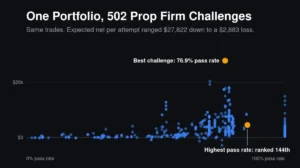
Historically, traders have relied on pass rates to gauge the viability of a strategy within a prop environment. Build Alpha’s research and simulator data indicate that pass rates are frequently misleading, as the portfolio that successfully passes evaluations most often does not necessarily yield the highest net cash returns once profit splits and withdrawal constraints are factored in. To address this discrepancy, the Prop Firm Simulator introduces a core metric known as Expected Net / Attempt. This formulation multiplies the probability of passing the evaluation by the probability of reaching a payout, factors in the expected net profit of the funded account, and subtracts average evaluation and reset fees.
The Mechanics of Prop Firm Economics and Risk Asymmetry
The economic framework of prop trading fundamentally alters the risk profile of negatively skewed trading strategies—those characterized by frequent small gains and occasional large losses. When traded with personal capital, a strategy featuring high tail risk can slowly bleed an account or suffer catastrophic losses during a single market regime shift. Under a prop firm model, however, the trader’s downside risk per evaluation attempt is strictly capped at the evaluation fee or subscription cost, while the prop firm essentially absorbs the remaining left-tail risk.
In a theoretical scenario modeled by Build Alpha, a strategy exhibiting a negative daily expectancy of twenty dollars when traded personally can generate a positive expected value of approximately $179 per attempt inside a structured prop evaluation and funded account framework. Because the trader’s maximum loss is limited to a nominal challenge fee, the asymmetric payout structure flips the mathematical expectancy from a steady personal capital drain to a profitable mathematical venture.
Nevertheless, real-world application requires rigorous filtering, as professional prop firms design payout gates, consistency scores, and profit caps to mitigate such mathematical edges. Consequently, the Prop Firm Simulator is engineered to test positive-expectancy strategies whose underlying tail risks might otherwise render them unappealing for personal capital deployment.
Comprehensive Simulator Architecture and Rule Modeling
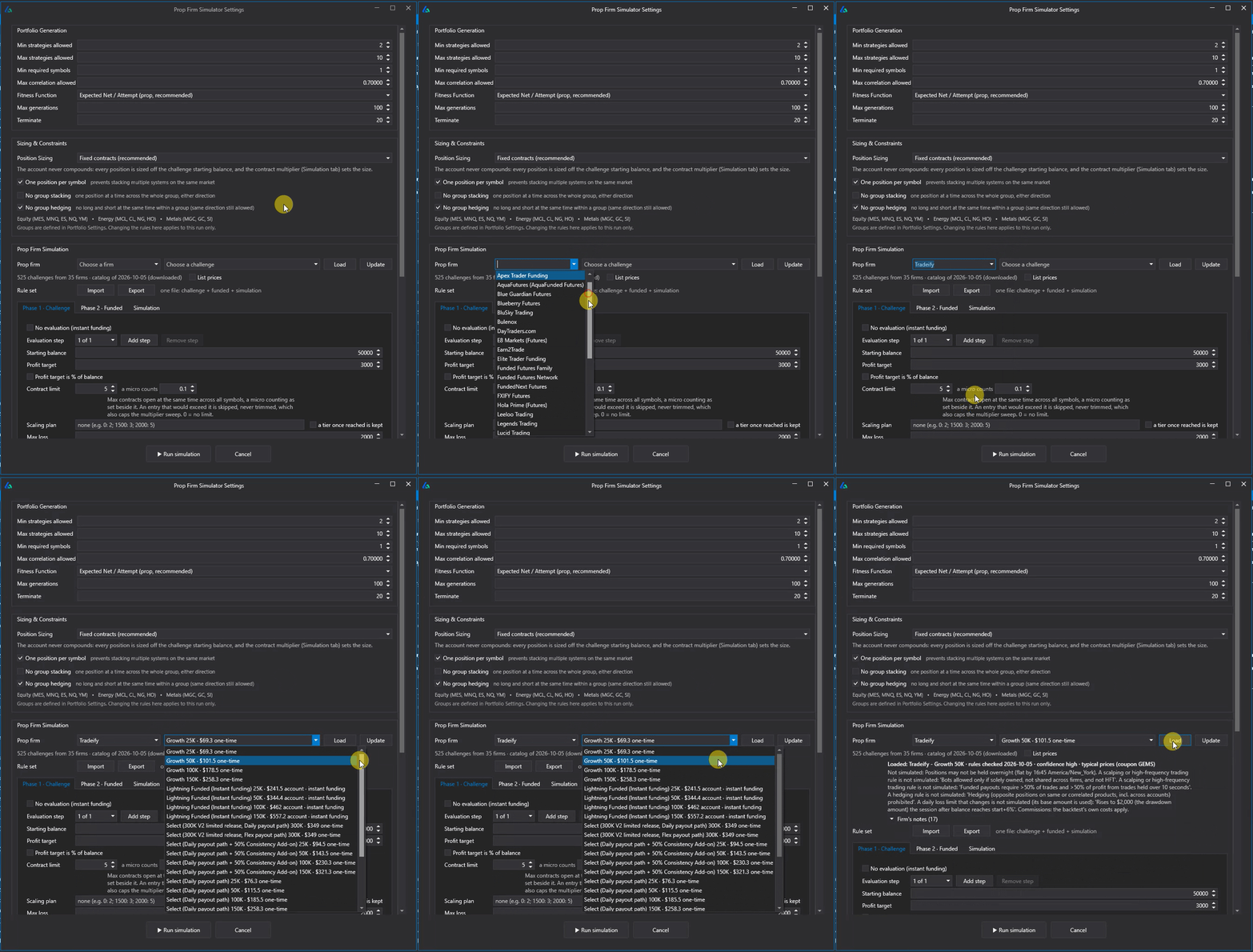
The Prop Firm Simulator features a multi-tiered configuration window divided into portfolio generation, sizing constraints, and explicit rule modeling for Phase 1 evaluations, Phase 2 funded accounts, and overall simulation horizons.
Unlike traditional optimizers that analyze isolated return streams, Build Alpha’s tool evaluates portfolios constructed from thousands of candidate strategies spanning varied timeframes, asset classes, and technical mechanics. The software uses fixed contract sizing, ensuring accounts never compound improperly, while applying a uniform whole-number contract multiplier across all portfolio components.
The evaluation and funded rule engines accommodate nearly every operational constraint enforced by modern futures and forex prop firms. These include:
- Profit targets expressed in flat dollar amounts or percentages.
- Drawdown classifications, including end-of-day (EOD) trailing drawdowns with optional lock levels.
- Daily loss limits paired with specific account-locking or termination actions.
- Contract limits that account for fractional micro-contracts (such as Micro E-mini contracts scaled at 0.1 of standard sizing), which trigger complete order skips rather than partial fills if breached.
- Minimum trading days, monthly platform fees, reset policies, and consistency caps.
Furthermore, Build Alpha maintains an active database containing over 800 active challenges across more than 40 futures proprietary trading firms. Supported by an automated AI agent that continuously scans and updates regulatory terms, pricing, and evaluation parameters, traders can instantly load pre-configured rule sets into the simulator.
Evaluating Performance: Beyond Pass Rates and Traditional Fitness Functions
The platform introduces four specialized prop-firm-specific fitness functions designed to guide automated strategy searches and portfolio construction:
- Expected Net / Attempt: The primary metric representing the true net economic value of purchasing a challenge.
- Prop ROI: Total trader payouts divided by total costs, including evaluation fees, resets, and funded fee deductions.
- Pass Probability: The percentage of historical start dates that successfully achieve the evaluation profit target without violating drawdown limits.
- Survival Prop: Measures the persistence of funded accounts remaining open and unbreached at the conclusion of the simulation horizon.
Empirical testing within Build Alpha demonstrates significant divergence between pass-rate leadership and actual cash generation. In comparative studies, portfolios boasting a 90.7% pass probability yielded lower Expected Net / Attempt values compared to alternative portfolios with a 73.2% pass rate, which achieved superior financial returns due to shorter durations to initial payouts and higher overall payout frequencies.
Historical Start-Date Replay Versus Monte Carlo Resampling
A key methodological differentiator in Build Alpha’s Prop Firm Simulator is its reliance on historical start-date replays rather than traditional trade-shuffle Monte Carlo simulations. Standard trade-shuffling algorithms strip away chronological order, inter-trade duration, calendar constraints, and regime persistence. Because prop firm rules—such as winning-day counts, monthly billing cycles, and payout windows—strictly depend on real calendar time, trade-shuffling models fail to capture realistic drawdown triggers.
By replaying strategies bar-by-bar across multiple historical start dates, the simulator preserves market clustering, volatility regimes, and autocorrelation. To account for statistical overlap between adjacent start dates, the software calculates "Independent Episodes," providing users with a clear statistical estimate of the distinct evidentiary weight supporting the simulation results.
Granular Diagnostics via Account Paths and Challenge Finders
For deeper risk assessment, the simulator provides an Account Paths diagnostic tool, generating visual equity curves for every funded start date. Traders can inspect individual trajectories, track specific withdrawal dates, and monitor how recurring payouts erode structural drawdown cushions over time.
Additionally, the integrated Find Challenges utility enables users to run a single portfolio across the entire database of prop firm programs simultaneously. Because identical trading strategies can produce highly divergent results depending on a firm’s specific drawdown mechanics—ranging from multi-thousand-dollar expected returns in favorable programs to net losses in restrictive ones—this feature allows quantitative traders to match their specific return streams with the optimal proprietary environment before committing capital.
Live Trading Implementation and Industry Implications
Once an optimal portfolio and prop firm rule set are identified, Build Alpha allows users to export the simulation parameters directly into live trading code. Supported platforms, including NinjaTrader, integrate the prop logic—such as position stacking limits, max loss thresholds, and group-level risk constraints—directly into the execution code, ensuring that live operational behavior closely mirrors backtested expectations.
While the Prop Firm Simulator does not act as a predictive crystal ball regarding future market anomalies or sudden regulatory shifts by prop operators, it provides a rigorous quantitative framework for navigating the modern proprietary trading evaluation sector. By reframing the optimization objective from achieving evaluation passes to maximizing net cash payouts after fees, Build Alpha offers market participants an advanced empirical tool for institutional-grade prop firm strategy development.