HaasOnline Launches Smart Trade on TradeServer Cloud to Revolutionize Manual Crypto Trading

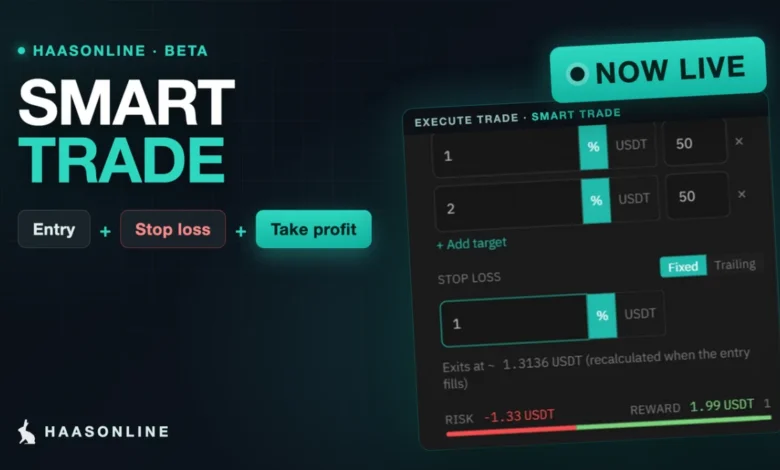
The landscape of cryptocurrency trading has long been divided between two distinct camps: the automated algorithmic trader, who relies on complex scripts and bots to execute high-frequency strategies, and the manual trader, who relies on intuition, technical analysis, and rapid execution. HaasOnline, a prominent provider of institutional-grade trading automation software, has officially bridged this divide with the introduction of "Smart Trade," a feature now live in beta on the HaasOnline TradeServer Cloud. By providing manual traders with the sophisticated exit-strategy tools typically reserved for automated bots, the platform is aiming to bring institutional-level risk management to the retail user interface.
Bridging the Gap: The Need for Smart Trade
Historically, traders who preferred to initiate positions manually were often left vulnerable to the volatility of the crypto markets once an order was placed. Without an automated exit strategy, a trader who stepped away from their terminal risked significant losses if the market turned, or missed optimal profit-taking opportunities if they were unable to monitor the ticker in real time.
HaasOnline’s introduction of Smart Trade is a strategic pivot to address the "human factor" in trading. The system allows users to attach pre-configured take-profit and stop-loss orders to manual trades, effectively creating a "set-and-forget" framework that maintains the trader’s original intent even when they are offline. This feature does not require the user to build a bot, write HaasScript, or possess advanced coding knowledge; rather, it embeds risk management directly into the order entry process itself.
Functional Mechanics: How Smart Trade Operates
The implementation of Smart Trade is integrated directly into the "Execute Trade" panel within the HaasOnline TradeServer interface. By selecting the target market, direction, and asset volume, users can toggle the Smart Trade feature to define their exit parameters before the transaction is finalized.
Once activated, the system provides several key functionalities:
- Targeting and Protection: Users can designate specific price points for profit-taking and stop-loss execution. The system supports "stop-loss only" configurations for those who wish to protect capital without capping potential upside.
- Dynamic Management: Open positions are displayed in the "Order Overview" module, which provides real-time Profit and Loss (PnL) tracking, along with a visual representation of the distance between the current market price, the stop-loss level, and the take-profit target.
- External Integration: One of the most significant aspects of this rollout is the ability to attach Smart Trade parameters to positions already held, or even to positions opened directly on an exchange’s native platform. By "adopting" these external trades, HaasOnline monitors the position and executes the exit according to the user’s defined logic, effectively turning an exchange-native manual trade into a managed Smart Trade.
- Visual Precision: Through the Marketview interface, traders can manipulate their strategy visually. By dragging entry, target, and stop lines directly on the chart, users can adjust their risk parameters dynamically, ensuring that their technical analysis aligns perfectly with their order execution.
Institutional Discipline in a Retail Package
A core component of the Smart Trade philosophy is the enforcement of trading discipline. Emotional decision-making—specifically the tendency to move stop-loss orders further away when a trade goes against a user, or "revenge trading" after a loss—is a leading cause of retail failure in cryptocurrency markets. By automating the exit, HaasOnline ensures that the exit strategy planned with a "clear head" is the one that is actually executed.
However, users must be aware of the technical infrastructure underlying these trades. On the majority of supported exchanges, Smart Trade parameters are held by the HaasOnline server rather than being pushed to the exchange’s order book. When the price reaches the designated threshold, the TradeServer initiates a market order to close the position.
This architecture necessitates an active connection to the TradeServer. If the server is offline or the API connection is severed, the automated exit triggers may not fire. This distinction is critical for risk management; while the system provides significant automation benefits, it does not function as a "hard" exchange-side stop-loss order that would execute regardless of the software’s connectivity status.
Market Context and Strategic Implications
The introduction of Smart Trade arrives at a time when the retail cryptocurrency market is maturing, shifting away from speculative "meme" trading toward more sophisticated, risk-averse methodologies. According to recent industry reports, the volatility of digital assets remains a primary barrier to entry for institutional and professional retail traders alike. By lowering the barrier to sophisticated risk management, HaasOnline is positioning itself to capture a broader segment of the market—traders who want the power of institutional software without the technical burden of coding.
For spot market participants, the platform includes a feature known as "Lots," which allows for the execution of multiple simultaneous trades on a single market. A user can, for instance, hold a long-term "swing" position with wide stop-losses while simultaneously scalping smaller, short-term trades in the same asset. This granularity is typically associated with high-end terminal software like Bloomberg or proprietary hedge fund tools, marking a significant evolution in the accessibility of professional-grade trading tools.
Operational Guidelines and User Security
HaasOnline has prioritized accessibility in this rollout, providing comprehensive documentation through their help portal. For those currently using the TradeServer Cloud, the feature is available immediately. The firm has also emphasized the utility of the feature for paper trading, allowing users to test their strategies and the mechanics of Smart Trade without putting actual capital at risk.
Regarding the technical limitations and risks, the company maintains a clear stance:
- Connectivity: As the logic is held on the TradeServer, maintaining a stable, authenticated API connection is paramount.
- Market Slippage: Because the exit is executed via a market order upon reaching the target, the final execution price may deviate slightly from the target price depending on current market liquidity and volatility.
- Risk Disclosure: HaasOnline consistently reiterates that their software is a tool for automation and does not provide financial advice. The inherent risks of cryptocurrency, including extreme price swings and the potential for total capital loss, remain unchanged regardless of the tool used.
The Future of Automated Manual Trading
The beta launch of Smart Trade is indicative of a broader trend in the fintech sector: the "democratization of complexity." By abstracting away the code-heavy requirements of traditional trading bots and focusing on the UI/UX of manual trade management, HaasOnline is effectively turning every user into a systematic trader.
As the beta progresses, the integration of real-time PnL data and chart-based order management will likely serve as a benchmark for other service providers in the crypto-automation space. The ability to "take over" trades initiated on an exchange, in particular, offers a level of flexibility that many competing platforms lack, potentially making the TradeServer Cloud an essential utility for active traders who rely on multiple venues.
For the modern crypto investor, the arrival of Smart Trade represents a shift from reactive to proactive management. By removing the need for 24/7 screen time, HaasOnline is providing a vital safeguard for the retail trader, ensuring that even when the market is at its most volatile, the trader’s original strategy remains the primary driver of their portfolio’s performance. The success of this beta phase will likely dictate the speed at which these features are expanded, potentially paving the way for more complex, multi-exchange order routing in the near future.