AI and the Mission Critical Infrastructure Crisis Transforming Service Operations for the Data Driven Age

Service organizations responsible for the maintenance of global energy, infrastructure, and data-center assets are currently grappling with a severe structural mismatch that threatens the stability of the modern economy. As uptime requirements for critical systems move toward a "near-zero" tolerance for failure, traditional maintenance models and technician capacity have failed to keep pace. This widening gap is particularly visible at the "grid edge," where the rapid expansion of data centers and the electrification of the economy are placing unprecedented strain on existing infrastructure.
The scale of this challenge is underscored by recent analysis from the U.S. Department of Energy and the Electric Power Research Institute (EPRI), which suggests that data centers could consume as much as 9 percent of total U.S. electricity generation by 2030. This represents a doubling of their 2023 share in less than a decade. The financial consequences of failing to maintain these systems are already staggering. According to the Institute for Supply Management, unscheduled downtime now costs the world’s 500 largest companies approximately $1.4 trillion annually, a figure representing roughly 11 percent of their total revenue.
Despite the escalating demand for reliability, the workforce required to sustain these systems is in decline. The U.S. Bureau of Labor Statistics projects approximately 81,000 electrician openings annually through 2034. Critically, these openings are being driven by a "silver tsunami" of retirements rather than an influx of new talent, leaving organizations with a profound loss of institutional knowledge. Compounding this labor shortage is the issue of fragmented equipment data. Research from the National Institute of Standards and Technology (NIST) indicates that inadequate interoperability of facility and equipment data costs U.S. capital-facilities owners and operators $10.6 billion annually during the operations and maintenance phase alone.
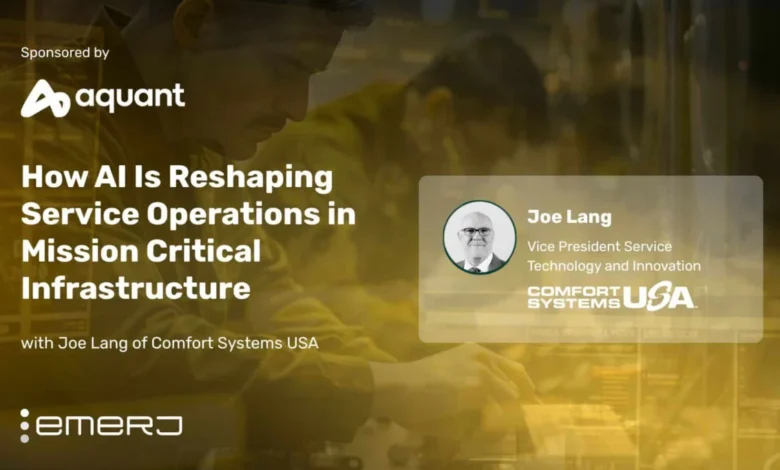
In a recent episode of the AI in Business podcast, Yolandi de Weerdt of Emerj was joined by Joe Lang, Vice President of Service Technology and Innovation at Comfort Systems USA, to discuss how artificial intelligence is being deployed to bridge these operational gaps. Lang, an industry veteran with nearly two decades of experience at Comfort Systems USA and previous leadership roles at Johnson Controls and York International, argues that the transition to AI-enabled service operations is no longer optional for organizations managing mission-critical infrastructure.
The Shift from Scheduled to Condition-Based Maintenance
The traditional model of industrial maintenance relies heavily on predictable intervals—the idea that equipment should be serviced every six months or after a set number of run-hours. However, Lang points out that equipment behavior often deviates significantly during the unmonitored periods between these scheduled visits. When these anomalies go unaddressed, they inevitably progress into catastrophic failures and avoidable downtime.
Lang contends that organizations must treat real-time equipment behavior as their primary source of truth. He distinguishes anomaly detection not as a futuristic "add-on," but as a fundamental operational discipline. The goal is to surface behavioral "drifts"—subtle changes in vibration, temperature, or power consumption—before they escalate.
"AI gives technicians a head start," Lang explained during the interview. "When the system flags a deviation, it’s often the earliest sign that something is drifting out of normal behavior. Acting at that moment prevents failure rather than reacting to it. It changes the rhythm of service work—teams stop chasing emergencies and start addressing issues before they become critical."
To successfully implement anomaly detection, Lang identifies several operational requirements. First, organizations must have a continuous stream of sensor data from critical assets. Second, they need AI models capable of establishing a "normal" baseline for diverse equipment types. Finally, there must be a workflow that automatically triggers a service alert when a deviation is detected. This approach moves the organization away from guesswork and toward a proactive stance that maximizes the lifespan of expensive assets.
Closing the Information Gap with Prescriptive Guidance
One of the most significant hurdles in field service is the variability of technician performance. When faced with unfamiliar equipment or ambiguous symptoms, even experienced technicians can struggle to find a solution, leading to multiple service calls for the same issue. Lang argues that this variability is rarely a matter of individual skill; rather, it is an "information issue."
Diagnostic evidence is often scattered across disconnected systems, buried in static PDF manuals, or siloed within the minds of senior staff. To solve this, Lang advocates for a shift from predictive maintenance (forecasting when something will break) to prescriptive guidance (recommending the specific "next-best action" to fix it).
Prescriptive guidance functions by consolidating service histories, Original Equipment Manufacturer (OEM) documentation, resolution patterns, and real-time equipment context into a single structured data environment. When a technician arrives at a site, the AI can surface the most likely fault and the recommended steps for repair before the technician even opens a control panel.
"This is not about replacing technician judgment," Lang emphasized. "It’s about removing the first ten minutes of uncertainty that drive inconsistent outcomes." By providing every technician with the organization’s accumulated diagnostic intelligence, service providers can narrow the gap between their top-performing experts and their newest recruits. This consistency is vital for improving "first-time-fix" rates, which is a key metric for reducing operational costs and improving customer satisfaction.
The Economic Impact of Data Interoperability
The $10.6 billion cost of inadequate data interoperability cited by NIST highlights a major bottleneck in infrastructure management. In many facilities, the data generated by HVAC systems, power distribution units, and security hardware exists in "walled gardens." Technicians often lack access to the asset history or the specific manual they need at the point of service.
Lang suggests that for prescriptive guidance to be effective, these disparate evidence sources—including SCADA system logs, IoT sensor feeds, and historical work order data—must be integrated. This requires a strategic commitment to data cleaning and categorization. Without a unified data layer, AI models cannot "reason" over the information or provide the real-time insights necessary to support a technician in the field.
The implications of solving this data problem extend beyond simple maintenance. It allows for better capital planning, as owners can see which assets are consistently underperforming or requiring more frequent repairs than their peers. It also enables a more "surgical" approach to maintenance, such as replacing air filters based on actual pressure-drop data rather than a fixed calendar date, thereby reducing waste and labor costs.
Operational Transformation: Modifying the Plane While Flying It
Modernizing a service organization is a complex undertaking that requires more than just purchasing new software. Lang observes that many digital transformation efforts fail because organizations treat them as part-time initiatives. They may assign a few employees to gather data or test a platform, but they fail to resource the project as a core strategic priority.
"This is where you’ll modify the plane while you’re flying it," Lang noted. "You’ve got to modify it so it can continue to fly and land and take off again. You absolutely have to resource this correctly when you start down this path."
Successful transformation requires dedicated leadership and clear ownership of the data infrastructure. This includes identifying and categorizing every asset into logical groups, centralizing manuals, and ensuring that service histories are recorded in a way that AI can analyze. Lang argues that the difference between a successful modernization and a stalled project is the commitment to building a "single source of truth" for all asset data.
Chronology of the Infrastructure Service Evolution
To understand the current state of the industry, it is helpful to look at the timeline of service technology:
- The Reactive Era (Pre-1990s): Maintenance was almost entirely "break-fix." Equipment was run until failure, leading to high downtime and unpredictable costs.
- The Preventative Era (1990s–2010s): The industry adopted calendar-based maintenance schedules. While this reduced catastrophic failures, it led to significant "over-maintenance" and wasted resources.
- The Predictive Era (2010s–2020): The rise of IoT and sensors allowed for basic trend analysis. Organizations began to predict failures, but technicians still struggled with how to respond efficiently to those predictions.
- The Prescriptive Era (2021–Present): AI-driven platforms now provide specific repair recommendations. The focus has shifted from "what might happen" to "what is the specific action required to maintain 100% uptime."
Broader Implications and Industry Outlook
The transition to AI-enabled service operations has implications that reach far beyond the maintenance department. For industries like healthcare, telecommunications, and finance—all of which rely on data center stability—the ability of service providers to guarantee uptime is a matter of business continuity.
Furthermore, the adoption of these technologies may provide a partial solution to the labor crisis. While AI cannot replace the physical labor of an electrician or a mechanical engineer, it can act as a "force multiplier," allowing a smaller workforce to manage a larger and more complex fleet of assets. By lowering the barrier to entry for new technicians through prescriptive guidance, organizations can onboard workers more quickly and reduce the time it takes for them to become "field-ready."
As the energy transition accelerates and the demand for data processing continues to climb, the pressure on mission-critical infrastructure will only intensify. The insights provided by Joe Lang and the ongoing innovations at firms like Comfort Systems USA suggest that the future of the industry lies in the seamless integration of human expertise and machine intelligence. Organizations that fail to build the necessary data foundations and resource their digital transformations today may find themselves unable to compete in an era where downtime is no longer an option.