From Pairs to Portfolio: The Evolution of Statistical Arbitrage for Independent Traders

The landscape of quantitative trading for independent market participants is undergoing a structural transformation, shifting away from rigid, traditional pairs trading models toward more capital-efficient network-based methodologies. For years, retail and independent quantitative traders have relied on classic pairs trading—a market-neutral strategy involving the simultaneous purchase of an undervalued asset and the short sale of an overvalued asset within a correlated sector. While this strategy offers robust variance reduction and insulation from broader market volatility, it presents significant operational constraints that limit profitability, particularly for smaller funds and independent desks.
Recent analyses within quantitative trading communities highlight a growing disillusionment with the capital inefficiency inherent in traditional spread execution. Industry practitioners note that tying up half of a portfolio’s capital in a leg that may already be fairly valued severely caps scalability. Furthermore, burgeoning interest in alternative signal extraction methods has brought attention to a sophisticated evolutionary step known as Triangulated Statistical Arbitrage. This advanced framework collapses traditional spread-level signals down to individual ticker-level metrics, offering a modern solution to the long-standing bottlenecks of independent quantitative finance.
The Structural Limitations of Traditional Pairs Trading
To understand the necessity of this methodological shift, one must examine the operational hurdles of classical pairs trading. Historically, the strategy has appealed to independent traders due to its mathematical elegance. By isolating two historically cointegrated assets—such as major energy corporations or technology giants—traders can construct a spread whose mean-reverting properties offer a predictable statistical edge. When the spread diverges beyond a designated threshold, typically measured by a z-score exceeding two standard deviations, positions are initiated on both legs.
However, this execution model carries heavy hidden costs. Chief among them is capital lockup. In a standard pair trade, 50 percent of the allocated capital is deployed into a hedge leg that may lack any intrinsic mispricing, functioning merely as a variance-reduction vehicle. Transaction costs are similarly doubled, as traders must pay commissions and fees on both legs of the trade.
Additionally, portfolio managers frequently encounter what quantitative researchers term the "selection pipeline bottleneck." Modern screening algorithms can easily identify hundreds of statistically viable pairs within a given equity universe. Yet, due to capital inefficiency and margin constraints, a trader might only be able to execute ten of them. Consequently, the vast majority of valuable alpha generation signals go unused, remaining trapped behind structural portfolio limits.
The Illusion of Simple Beta Modeling
Efforts to bypass these limitations have historically focused on isolating the single mispriced leg of a pair. Practitioners often attempt to deduce which asset triggered a divergence by observing raw price movements. For example, if ExxonMobil rallies by 10 percent while Schlumberger remains flat, basic observation might suggest that ExxonMobil is the mispriced, overvalued leg.
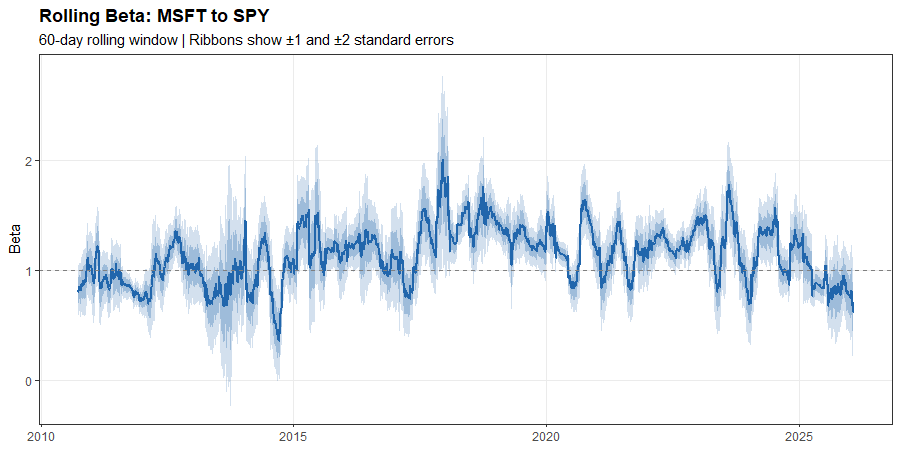
Yet, market veterans warn that this naive approach is fraught with danger. Assets frequently drift or surge based on broader market beta or idiosyncratic sector developments, meaning the asset left behind may actually be the one suffering from mispricing.
To rectify this, quantitative analysts have attempted to directly model market and sector betas within spread construction. While theoretically sound, empirical execution reveals severe practical limitations. Market betas are notoriously unstable, fluctuating dynamically across different market regimes and introducing significant measurement error. For independent traders operating with limited computational infrastructure and time, attempting to continuously recalibrate complex beta models often introduces more noise than signal. This operational friction has created an urgent demand for alternative methods that capture market relationships without requiring hyper-complex, error-prone econometric modeling.
Enter Triangulated Statistical Arbitrage
To solve these compounding challenges, quantitative researchers have pioneered Triangulated Statistical Arbitrage, a technique that leverages the network topology of multiple overlapping spreads rather than evaluating pairs in isolation. By examining a universe of interconnected assets, traders can extract market intelligence that remains hidden when viewing individual spreads.
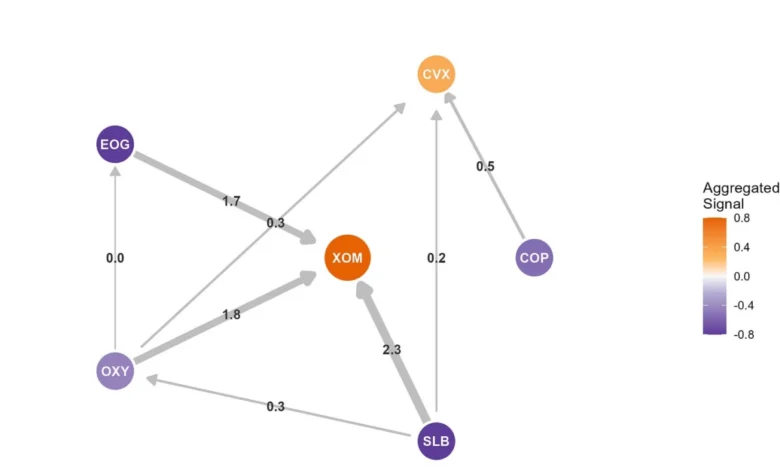
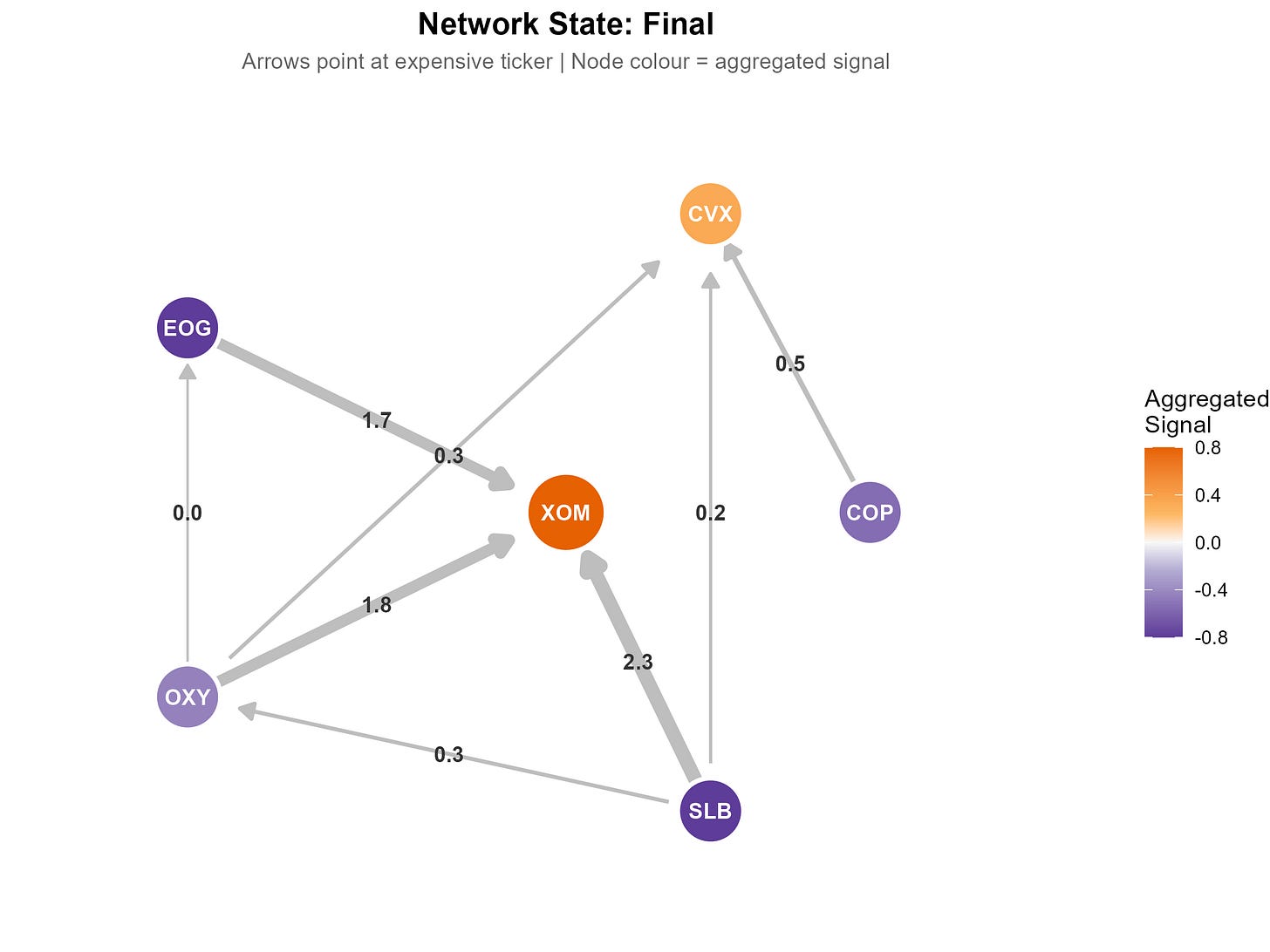
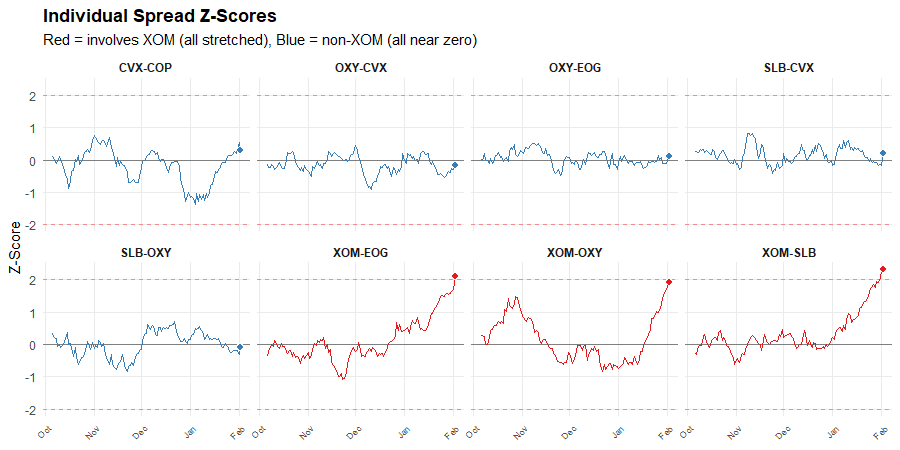
Consider a small universe of energy sector equities, including ExxonMobil (XOM), Schlumberger (SLB), Chevron (CVX), Occidental Petroleum (OXY), EOG Resources (EOG), and ConocoPhillips (COP). By constructing all possible pairwise spreads among these six entities, analysts generate a network of eight distinct spread relationships.
When evaluating the z-scores of these interconnected spreads, a distinct structural pattern frequently emerges. If every spread involving ExxonMobil registers a significant statistical stretch—while spreads not involving XOM hover near zero—the network provides collective, high-conviction evidence. The data reveals that CVX, OXY, EOG, SLB, and COP are trading fairly against one another, identifying ExxonMobil as the definitive outlier and the true source of mispricing.
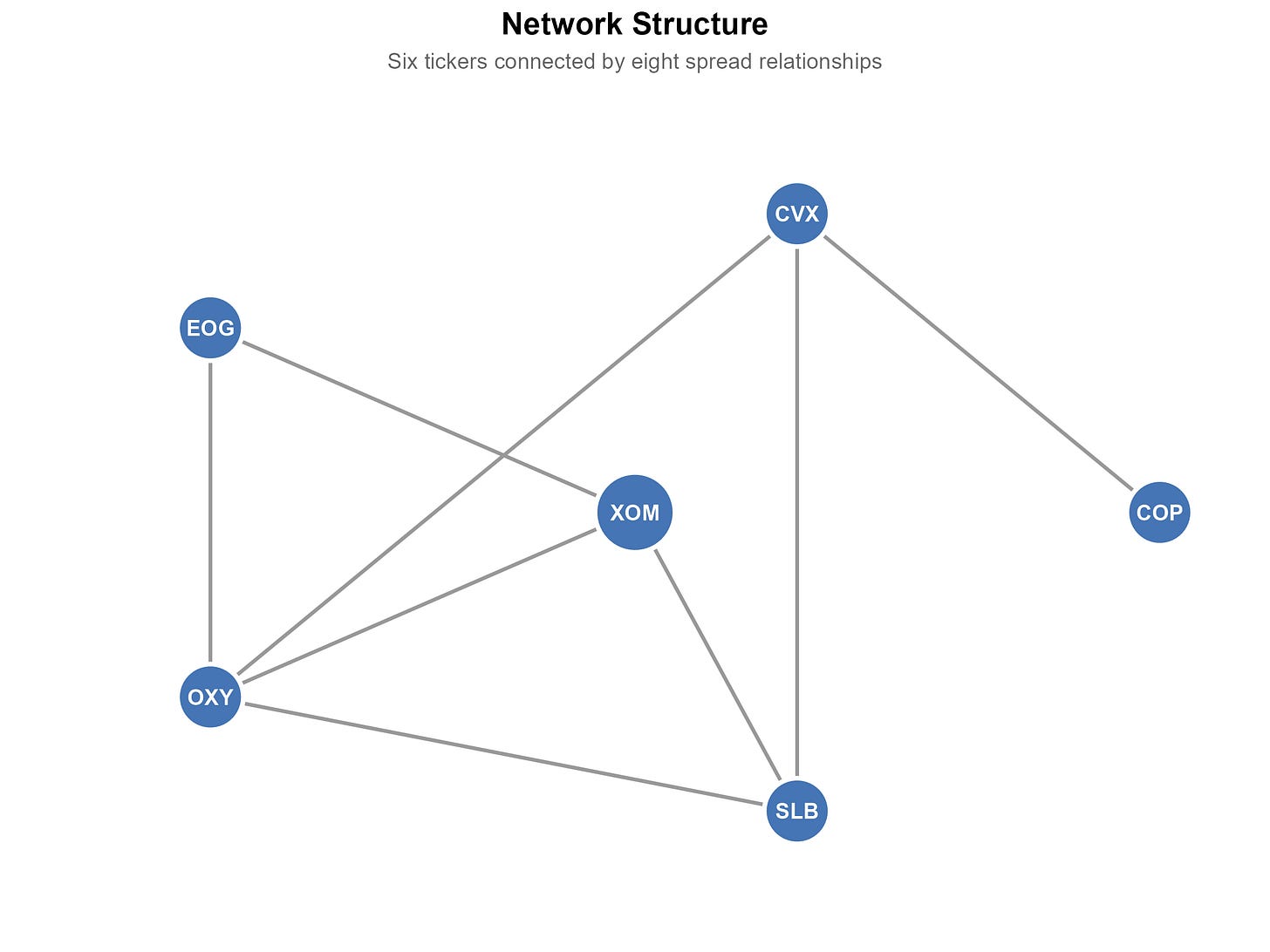
This network-based approach shifts the analytical paradigm from the spread level to the individual security level. Rather than treating each pair as a self-contained island, the entire web of spreads acts as a voting mechanism for each component ticker.
Mechanics of the "Flattening" Process
The operational mechanics of Triangulated Statistical Arbitrage rely on a process known as "flattening," where spread-level signals are systematically decomposed into ticker-level metrics.
When a specific spread—such as the XOM-SLB pair—registers a z-score of +2.3, indicating that ExxonMobil is rich relative to Schlumberger, this single data point is broken down into two distinct directional votes. ExxonMobil receives a strong positive signal indicating overvaluation, while Schlumberger receives a corresponding negative signal indicating undervaluation of identical magnitude.
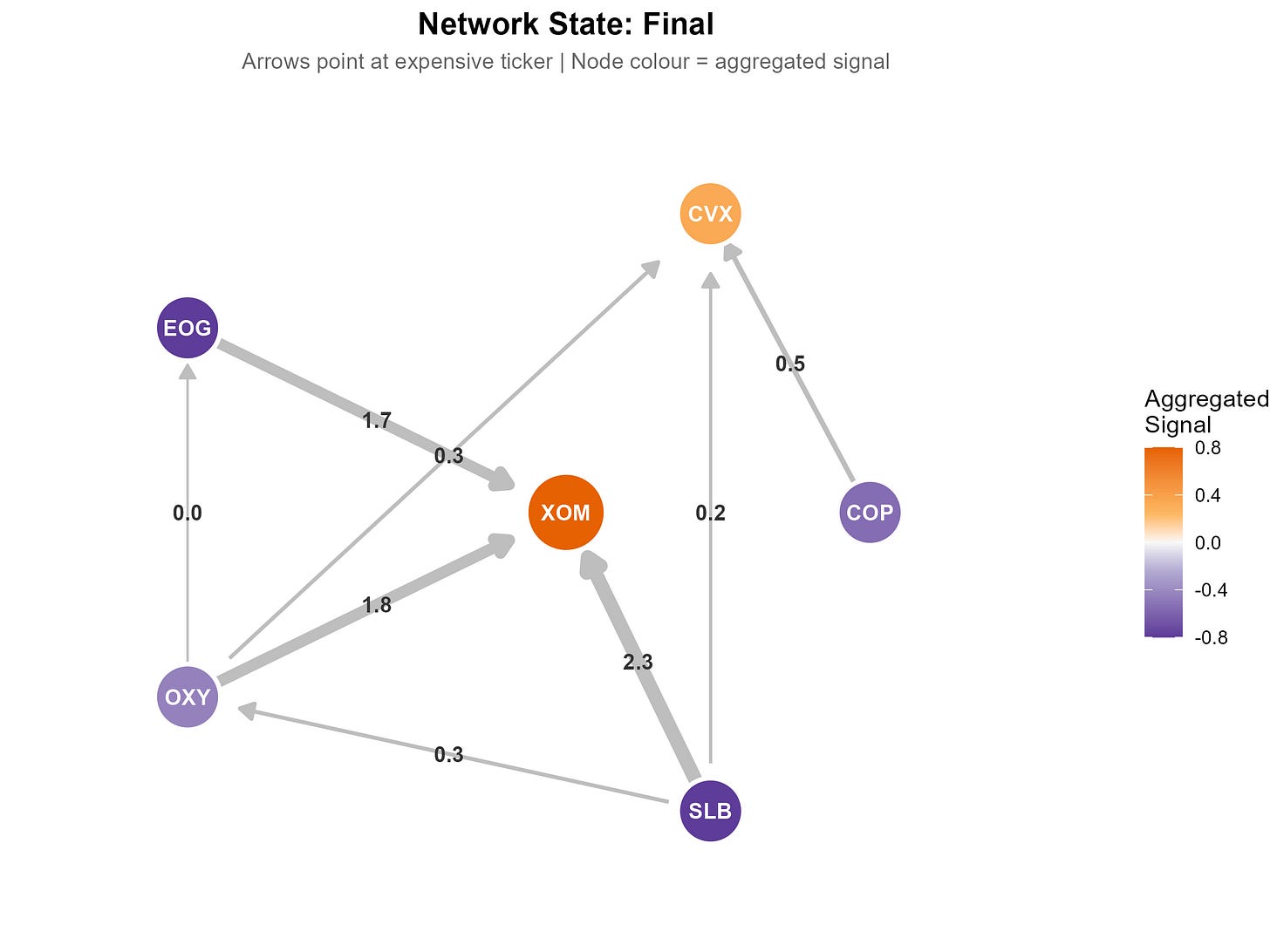
When this decomposition is applied across an entire universe of overlapping spreads, every ticker accumulates a distribution of votes. Tickers that appear across multiple spreads accumulate reinforcing evidence. If ExxonMobil appears in three separate spreads and consistently registers as overvalued, the aggregated signal generates high conviction. Conversely, if an asset appears in multiple spreads with conflicting signals, the noise tends to wash out, signaling lower conviction.
Industry analysts emphasize that this aggregation directly addresses the core inefficiencies of traditional quantitative setups:
- Capital Efficiency: Capital is deployed exclusively into baskets of assets that exhibit genuine, network-validated mispricing, eliminating dead capital tied up in fair-value hedges.
- Signal Utilization: Research pipelines no longer suffer from the filtering bottlenecks of traditional pairs trading. Signals from across the entire network are synthesized, ensuring that analytical work translates directly into portfolio allocations.
- Optimized Transaction Costs: Traders execute transactions only on targeted legs, substantially reducing friction and commission drag.
- Natural Diversification: Portfolios are constructed as broad long and short baskets of individual securities rather than rigid paired obligations, allowing managers to dynamically scale net market exposure.
Implications for Independent and Institutional Portfolios
The broader implications of Triangulated Statistical Arbitrage extend well beyond niche quantitative circles. By translating relational pricing data into ticker-level signals, independent traders can seamlessly integrate statistical arbitrage factors into broader multi-factor long/short equity frameworks.
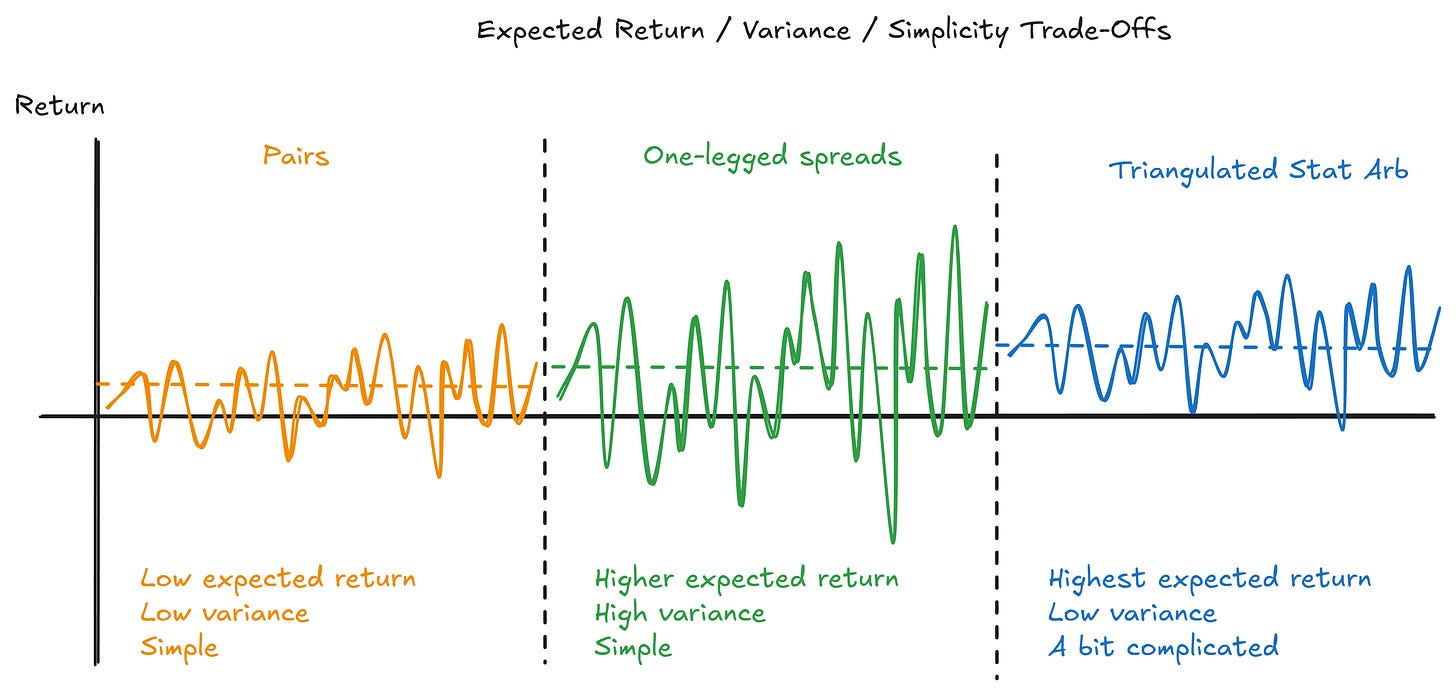
Market observers note that this methodology bridges the gap between the high-conviction directional bets favored by discretionary traders and the rigorous risk-management controls demanded by quantitative practitioners. By going long a basket of statistically undervalued tickers and shorting a basket of overvalued tickers, portfolio managers capture the variance-reduction benefits of market-neutral strategies while maintaining the return potential of direct directional exposure.
As computational tools become increasingly accessible to independent market participants, the adoption of network-based quantitative strategies is expected to accelerate. Financial engineers continue to refine algorithms that measure network agreement and filter out noisy sector betas, pushing the boundaries of what independent trading desks can achieve.
Ultimately, Triangulated Statistical Arbitrage offers a compelling resolution to the long-standing compromise between capital efficiency and risk control. By viewing securities not as isolated pairs, but as interconnected nodes within a dynamic market network, traders can unlock hidden alpha, maximize signal throughput, and navigate complex market environments with unprecedented precision.