Crypto-Linked Equities and Bitcoin Stage Powerful Recovery Following Regulatory Pivots Despite CLARITY Act Stalemate

The digital asset ecosystem and its associated public equities have staged a dramatic market turnaround, erasing steep losses sustained earlier in the week. This recovery was catalyzed by aggressive regulatory maneuvering from United States financial watchdogs, who stepped into the vacuum left by legislative delays. Despite the sudden failure of the Senate to advance the highly anticipated CLARITY Act on September 15, 2026, market participants quickly regained their footing as key regulatory agencies demonstrated a proactive commitment to establishing operational frameworks using their existing statutory authority.
By the end of the trading week, crypto-linked stocks recorded substantial double-digit gains across major exchanges. Strategy led the charge with a surge of more than 13%, while industry heavyweights Coinbase and American Bitcoin followed closely behind, each appreciating by approximately 11%. Retail-favorite brokerage platform Robinhood climbed nearly 9%, while Circle, Strive, and prominent Bitcoin mining enterprise Riot Platforms posted robust gains ranging between 5% and 7%, according to comprehensive market data from Yahoo Finance.
Simultaneously, the world’s flagship cryptocurrency, Bitcoin, mirrored the equity market’s resilience. Bitcoin rallied roughly 5% over a 24-hour window, clawing its way back to trade at approximately $80,800. This upward momentum successfully reversed a significant portion of the downward pressure that gripped the market immediately following the legislative setback in the Senate.
The Anatomy of a Legislative Stalls and Initial Market Shock
To understand the magnitude of the recent market recovery, one must examine the volatility that preceded it. The turbulence began in earnest on September 15, 2026, when the U.S. Senate failed to advance the broader crypto market-structure legislation known as the CLARITY Act. The bill had been widely viewed by institutional and retail investors alike as a potential watershed moment that would provide definitive statutory clarity, streamline regulatory oversight between the Commodity Futures Trading Commission (CFTC) and the Securities and Exchange Commission (SEC), and foster a more predictable environment for blockchain innovation in the United States.

The unexpected stall sent immediate shockwaves through traditional financial markets and digital asset trading desks. Because institutional investors had heavily priced in the expectation of impending legislative certainty, the sudden roadblock triggered a sharp risk-off sentiment.
During the immediate aftermath of the Senate vote, crypto-related equities suffered severe contractions. Industry leader Coinbase and stablecoin issuer Circle experienced sharp drawdowns of approximately 10%. Corporate treasury holders and asset managers Strategy and Strive took immediate hits, dropping roughly 5%, while American Bitcoin faced steeper headwinds with a decline of approximately 8%. The abrupt sell-off underscored the crypto sector’s ongoing sensitivity to the shifting winds of Washington politics and the high stakes surrounding federal oversight.
Regulatory Pivots: CFTC and SEC Take Independent Action
The swift narrative shift from panic to recovery was driven not by Capitol Hill lawmakers, but by federal regulatory agencies demonstrating that they would not wait for comprehensive congressional action to address the burgeoning digital asset economy.
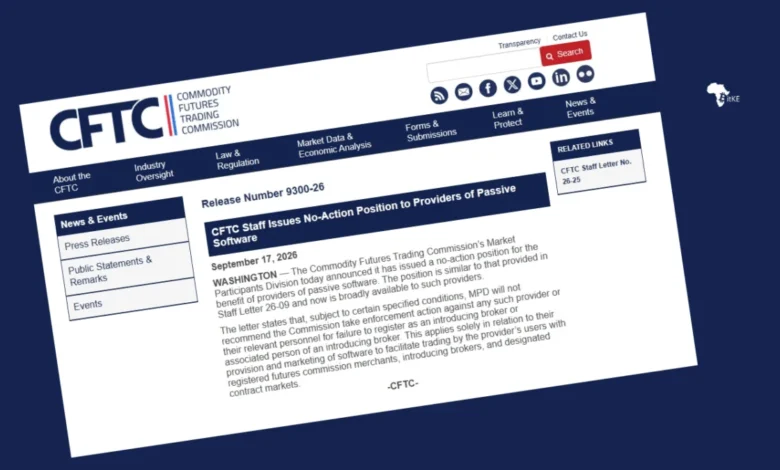
In a coordinated display of administrative momentum, both the CFTC and the SEC advanced distinct regulatory initiatives designed to provide clarity and structured pathways for blockchain-based enterprises. The CFTC issued critical no-action relief tailored specifically for certain passive software providers. This move alleviated longstanding fears among decentralized finance (DeFi) developers and software architects that mere code deployment could invite severe regulatory enforcement actions under existing derivatives laws.
Concurrently, the SEC unveiled a landmark five-year regulatory exemption explicitly designed for qualifying platforms that facilitate the on-chain trading of tokenized securities. This SEC framework represents a monumental shift in how traditional equity markets intersect with distributed ledger technology. By establishing a formalized regulatory pathway, the agency has opened the door for compliant platforms to trade blockchain-based representations of corporate stocks. Crucially, the framework is meticulously engineered to preserve core shareholder rights—such as dividend distributions and voting privileges—while granting issuing companies the explicit right to object to having their shares tokenized.

Furthermore, regulatory insiders confirmed that the CFTC had separately submitted a comprehensive, proposed crypto market regulatory framework directly to the White House for interagency review. Although specific details regarding the proposed rules were withheld from the public filing, the mere submission signaled to investors that federal regulators are actively engineering a cohesive supervisory architecture behind closed doors.
Analyzing the Implications for Market Structure and Innovation
Financial analysts and market observers have noted that these independent regulatory maneuvers serve as a vital bridge for the digital asset industry. While comprehensive legislation like the CLARITY Act remains mired in the complexities of congressional politics, the willingness of the SEC and CFTC to utilize their preexisting statutory toolkits provides a workable roadmap for industry participants.
The SEC’s tokenized securities exemption, in particular, carries profound long-term implications for global finance. By legally bridging traditional corporate equity with blockchain infrastructure, the framework addresses one of the most persistent hurdles in capital markets: the friction-laden settlement and clearing process. Tokenized shares have the potential to enable near-instantaneous settlement, enhanced transparency, and round-the-clock trading capabilities. However, by embedding corporate veto rights and preserving traditional governance protections, the SEC has successfully balanced technological innovation with investor protection.
For the cryptocurrency market at large, the swift recovery of Bitcoin and related equities highlights a maturing investor base. Earlier market cycles might have seen prolonged capitulation following a major legislative failure. The rapid stabilization observed in mid-September 2026 suggests that investors are increasingly capable of differentiating between legislative stagnation and practical regulatory evolution. As federal agencies continue to press forward with their respective rulemaking agendas independently of Capitol Hill, the digital asset sector appears to be finding a functional, if decentralized, path toward regulatory integration.