EUR/USD Weekly Outlook: Resilient Euro Faces Technical Correction After Multi-Year Highs


The EUR/USD currency pair experienced a week of high volatility, characterized by initial pro-euro momentum that pushed the greenback to multi-year lows before a notable recovery trimmed those gains. Throughout the week, foreign exchange markets grappled with shifting geopolitical developments in Washington, mixed macroeconomic data releases from both the United States and the Eurozone, and evolving monetary policy expectations for both the Federal Reserve and the European Central Bank. While the overarching structural narrative continues to weigh the potential for a multi-year downward cycle for the US dollar, short-term technical indicators suggest the currency pair is currently undergoing a healthy corrective phase beneath the key 1.1900 threshold.
Geopolitical Pressures and US Fiscal Developments
The week began under a cloud of geopolitical uncertainty and institutional concern surrounding the perceived independence of the Federal Reserve. Early selling pressure drove the US dollar index down significantly as investors reacted to swirling political headlines. However, market sentiment shifted markedly mid-week after President Donald Trump and congressional leaders in the Senate reached an agreement to avert a potentially disruptive government shutdown. This resolution injected a dose of fiscal stability into the markets, curbing the rapid flight from greenback-denominated assets.
Adding to the stabilization of the US dollar was the political nomination of former Federal Reserve Governor Kevin Warsh as the next Chair of the central bank. Market participants largely interpreted Warsh’s nomination as a positive development for institutional continuity and central bank autonomy. Investors perceived his selection as a signal that the traditional boundaries of monetary policy independence would be respected, helping to calm nerves that had been frayed by prior political rhetoric. Despite this relief rally, the dollar remains sensitive to broader macroeconomic inputs, particularly incoming inflation and employment metrics.
US Economic Data and Federal Reserve Outlook
On the macroeconomic front, United States data painted a complex and contradictory picture of the world’s largest economy. Factory orders surpassed consensus expectations, signaling underlying industrial resilience. Conversely, initial jobless claims ticked higher, and the nation’s trade deficit widened, pointing to pockets of labor market softening and persistent external imbalances.
Perhaps most critical for currency traders were the Producer Price Index (PPI) figures. Both headline PPI and Core PPI readings came in stronger than forecast, demonstrating that inflationary pressures remain remarkably sticky. This data reinforced the consensus view that the Federal Reserve will maintain a cautious stance, avoiding any rush toward aggressive monetary easing.
These suspicions were further confirmed by public commentary from regional Federal Reserve officials. Atlanta Fed President Raphael Bostic stated unequivocally that inflation remains uncomfortably high, arguing that the central bank must exercise patience. Bostic emphasized that the threshold for near-term interest rate cuts remains high, effectively dampening market bets on an imminent pivot toward aggressive policy loosening. Consequently, yield differentials continue to play a vital role in dictating the near-term valuation of the EUR/USD pair.
Eurozone Resilience and ECB Policy Stance
In contrast to the mixed signals emerging from the United States, economic fundamentals within the Eurozone provided modest yet consistent support for the single currency. Fourth-quarter Gross Domestic Product (GDP) figures for the Eurozone, alongside stronger-than-expected German growth data, beat consensus forecasts. These figures indicate that the European economy maintains a modest degree of resilience despite facing structural headwinds and sluggish growth over the preceding year.
Inflation metrics in Germany also aligned with expectations, hovering comfortably close to the European Central Bank’s medium-term target. Both the Harmonised Index of Consumer Prices (HICP) and core inflation measures remained broadly stable, reducing the probability of an emergency policy shift by Frankfurt.
Institutional analysts at major financial institutions, including Rabobank, TD Securities, and Brown Brothers Harriman, anticipate that the European Central Bank will keep its benchmark deposit rate anchored around 2.00% for an extended duration. According to these analysts, the central bank faces little urgency to implement further rate cuts or hikes. Nevertheless, some policymakers have privately expressed caution regarding the persistent strength of the euro, noting that an excessively strong currency could weigh on the competitiveness of Eurozone export industries.

Long-Term Perspectives on the US Dollar Cycle
While short-term trading is dominated by incoming data and interest rate differentials, longer-term structural strategists are increasingly examining macro cycles. Analysts at Nordea and UOB have highlighted the growing risk of a multi-year downward cycle for the US dollar. Their assessments draw on historical market patterns, which frequently demonstrate prolonged periods of dollar depreciation following major multi-year peaks.
Furthermore, shifting structural behavior among foreign investors—who are diversifying portfolios away from US-centric assets—adds weight to this long-term bearish dollar thesis. These institutional projections suggest that the EUR/USD pair has substantial room for further upside over the coming years, provided that Eurozone economic growth remains stable, domestic inflation stays contained, and the European Central Bank maintains a steady monetary course without resorting to unexpected policy shocks.
Upcoming Economic Calendar and High-Impact Risks
Looking ahead, currency traders are preparing for a dense, high-impact macroeconomic calendar that could dictate the trajectory of the EUR/USD pair in the near term. Market participants will closely monitor preliminary inflation prints from major Eurozone economies alongside upcoming labor market reports from the United States.
The European Central Bank is widely expected to keep its monetary policy settings unchanged. However, market attention will focus heavily on the press conference accompanying the rate decision, particularly any verbal pushback from ECB officials regarding the recent strength of the euro. If policymakers signal acute discomfort with the exchange rate, it could cap upward momentum for the single currency.
On the American side of the ledger, upcoming Non-Farm Payrolls (NFP) and average hourly earnings data will be critical for refining expectations regarding the Federal Reserve’s rate path. Any significant statistical deviation from consensus forecasts—whether in job creation or wage growth—could trigger sharp, volatility-driven moves in the EUR/USD pair as global markets rapidly reprice relative central bank trajectories.
EUR/USD Technical Analysis: Corrective Downside Under 1.19
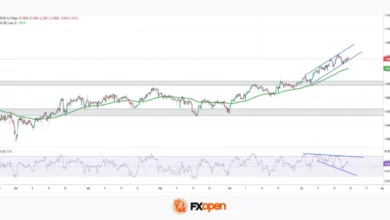
From a technical perspective, the daily chart for the EUR/USD pair illustrates a classic corrective phase following a powerful rally that pushed prices to four-year highs above the psychological 1.2000 milestone. Following that rejection at multi-year peaks, the currency pair retreated beneath the broken supply zone, slipping back below the 1.1900 handle.
Momentum indicators reflect this cooling phase. The Relative Strength Index (RSI) has successfully retreated from overbought territory, drifting lower in a gradual descent that highlights fading near-term buying pressure and underlying short-term weakness. Despite this corrective pullback, the broader technical structure remains supported by key moving averages. Major moving averages continue to display an upward slope, acting as a foundational support layer for the broader bullish trend.
On the downside, immediate structural support is located near the bullish gap area around 1.1830. Should selling pressure intensify, deeper support is expected near the horizontal technical level at 1.1800, which is likely to attract institutional demand.
Conversely, for bullish momentum to resume and challenge the broader downtrend, the currency pair needs to achieve a decisive daily close and acceptance above the 1.2000 psychological threshold. A sustained break above 1.2000 would clear the path for an advance toward the 1.2100 resistance level, with subsequent upside targets extending toward 1.2200 over the medium term. Traders are advised to exercise rigorous risk management as macroeconomic volatility remains elevated across major global exchanges.
Related posts: