How native transaction assertions could enforce a transaction’s final outcome


The Mechanics of Transactional Risk
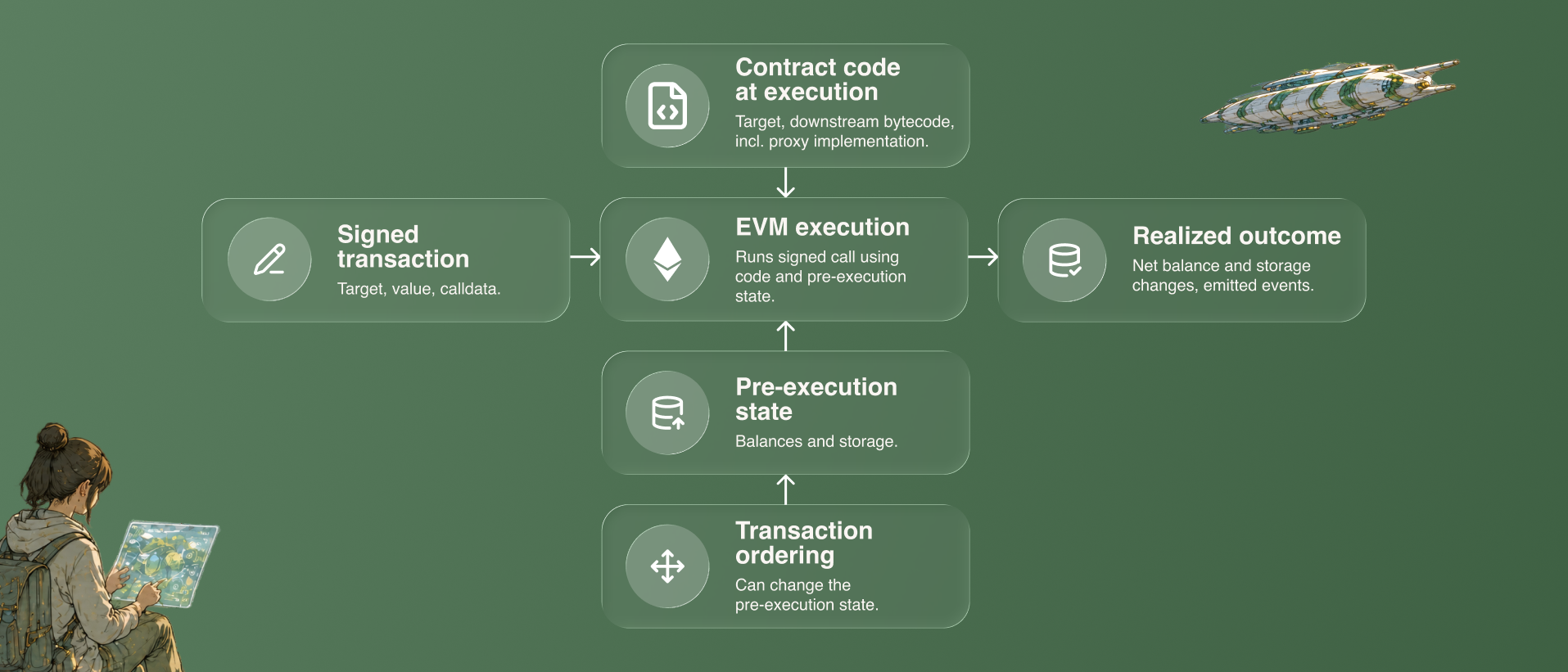
At its core, the Ethereum network operates on a deterministic but rigid principle: it executes precisely what is requested. A digital signature serves as a cryptographically verifiable command, yet it remains oblivious to the context of the environment. When a user signs a transaction, they are committing to a specific set of instructions—the "what"—but the "result" is contingent upon the state of the blockchain at the exact moment of inclusion. This gap has historically been exploited through two primary vectors: intent mismatch and outcome mismatch.
Intent mismatch occurs when a user is misled into authorizing an action that differs from their perception. A prominent example is the high-profile Bybit incident, where attackers compromised front-end interfaces to trick users into signing transactions that effectively transferred control of Safe multisig wallets to malicious actors. Similarly, the BadgerDAO attack saw users granting token spending approvals to unauthorized smart contracts. In these scenarios, the signature was valid, but the user’s intent was subverted by a malicious interface.
Outcome mismatch, conversely, represents a failure of expectation even when the user’s underlying instruction is legitimate. In a notable 2026 incident involving Aave and CoW Swap, a user attempted to swap roughly $50.4 million worth of aEthUSDT for aEthAAVE. Due to thin liquidity and specific gas ceiling constraints, the transaction executed against a vastly unfavorable price, resulting in a 99.9% price impact. Despite the interface warning, the lack of a protocol-level enforcement mechanism to prevent such catastrophic slippage meant the user essentially authorized their own financial ruin. These events underscore a systemic reality: Ethereum currently lacks a mechanism for onchain code to inspect the net state changes of a transaction before finality.
The Evolution of Defense: Beyond Simulation
Current security defenses, while robust, have inherent ceilings. Clear Signing has been a significant leap forward, providing users with human-readable interpretations of their calldata. However, it relies on the accuracy of the decoding logic. Simulation, another pillar of current security, predicts outcomes based on a snapshot of the current chain state. Yet, the blockchain is a dynamic, adversarial environment. A transaction simulated at block N may behave differently when included in block N+1, as sandwich attacks and state changes can alter the execution path between the moment of simulation and the moment of mining.

Furthermore, existing guards like Uniswap’s amountOutMinimum or Safe’s checkAfterExecution hooks are reactive or highly specific. They require developers to pre-program checks for specific variables. They cannot, however, provide a comprehensive, holistic inspection of all net state changes—such as unintended balance shifts, storage modifications, or the deployment of unauthorized proxy contracts. This is where the proposed native transaction assertions seek to disrupt the status quo.
Defining EIP-7906 and the Path to Implementation
EIP-7906, currently under review as a potential solution, introduces the concept of a "post-execution" check. Building upon the frame transactions established in EIP-8141, it proposes a read-only POST_TX frame that executes at the conclusion of a transaction. This frame is not merely a suggestion; it acts as a gatekeeper. If the defined assertions—which could range from minimum output requirements to strict prohibitions on state changes—are not met, the entire transaction is reverted.
The technical architecture involves three primary opcodes: TXTRACE, TXDIFF, and EVENTDATACOPY.
TXTRACEallows the system to enumerate the net differences in ETH balances, storage slots, and event logs.TXDIFFretrieves the delta between starting and ending values for specific addresses.EVENTDATACOPYfacilitates the inspection of event logs to ensure that the expected outputs occurred.
By integrating these into the EVM, the Ethereum Foundation aims to create a "trustless" verification layer. Critically, the POST_TX frame runs as a static call, meaning it cannot alter the state, only validate it. If an assertion fails, the gas used for the transaction is still charged, providing an economic disincentive for attackers to spam the network with failed, malicious transactions.
Broader Implications and Strategic Vision
The implications of native transaction assertions extend far beyond retail user safety. In the context of institutional finance and agentic automation, these assertions provide a necessary layer of "governance by code." For instance, when a user delegates authority to an automated agent or a solver, they can enforce hard constraints on the agent’s behavior. An assertion can dictate that regardless of the route taken by the solver, the user’s final balance must not decrease below a certain threshold, or that no new permissions can be granted to third-party contracts.
This creates a framework of "constrained delegation," where the principal retains ultimate control over the outcome, even while granting the agent operational flexibility. From a protocol design perspective, this could eliminate the need for complex, bespoke security guards, as protocols could simply require that all incoming transactions include a standard, cryptographically proven assertion.
Official Stance and Community Feedback
The Ethereum Foundation’s "Trillion Dollar Security" initiative serves as the primary incubator for this research. While EIP-8141 is already slated for the upcoming "Hegot" upgrade, EIP-7906 remains in the "Considered for Inclusion" phase. This staging is intentional; the Foundation is actively soliciting input from wallet developers, liquidity providers, and security researchers to refine the implementation.
Industry experts have largely welcomed the focus on transaction finality. "The ability to assert an outcome rather than just a process is the missing piece of the DeFi safety stack," remarked a lead security engineer at a major layer-2 scaling project. "We are moving from a world where we hope the code behaves as expected, to a world where we can prove the outcome meets our requirements before the state is permanently altered."
Future Outlook: Toward a More Resilient Layer-1
The success of this initiative will depend on the balance between flexibility and performance. Too rigid a system could increase gas costs or limit innovation, while too permissive a system would fail to catch sophisticated edge-case attacks. The Foundation’s approach—working closely with the community through the Ethereum Magicians forums—indicates a commitment to a transparent, consensus-driven development process.
As the ecosystem prepares for the implementation of these standards, the goal is clear: to ensure that the security of Ethereum scales alongside its utility. By codifying user intent into the transaction lifecycle itself, the Ethereum Foundation is laying the groundwork for a future where catastrophic failures resulting from unexpected state changes are relegated to the past. The road to implementation will require deep coordination, but the objective—a more predictable and safer Ethereum for all—remains a cornerstone of the network’s long-term roadmap. Stakeholders are encouraged to engage with the ongoing research via the Trillion Dollar Security portal or by participating in the technical discourse surrounding the EIP-7906 proposal.