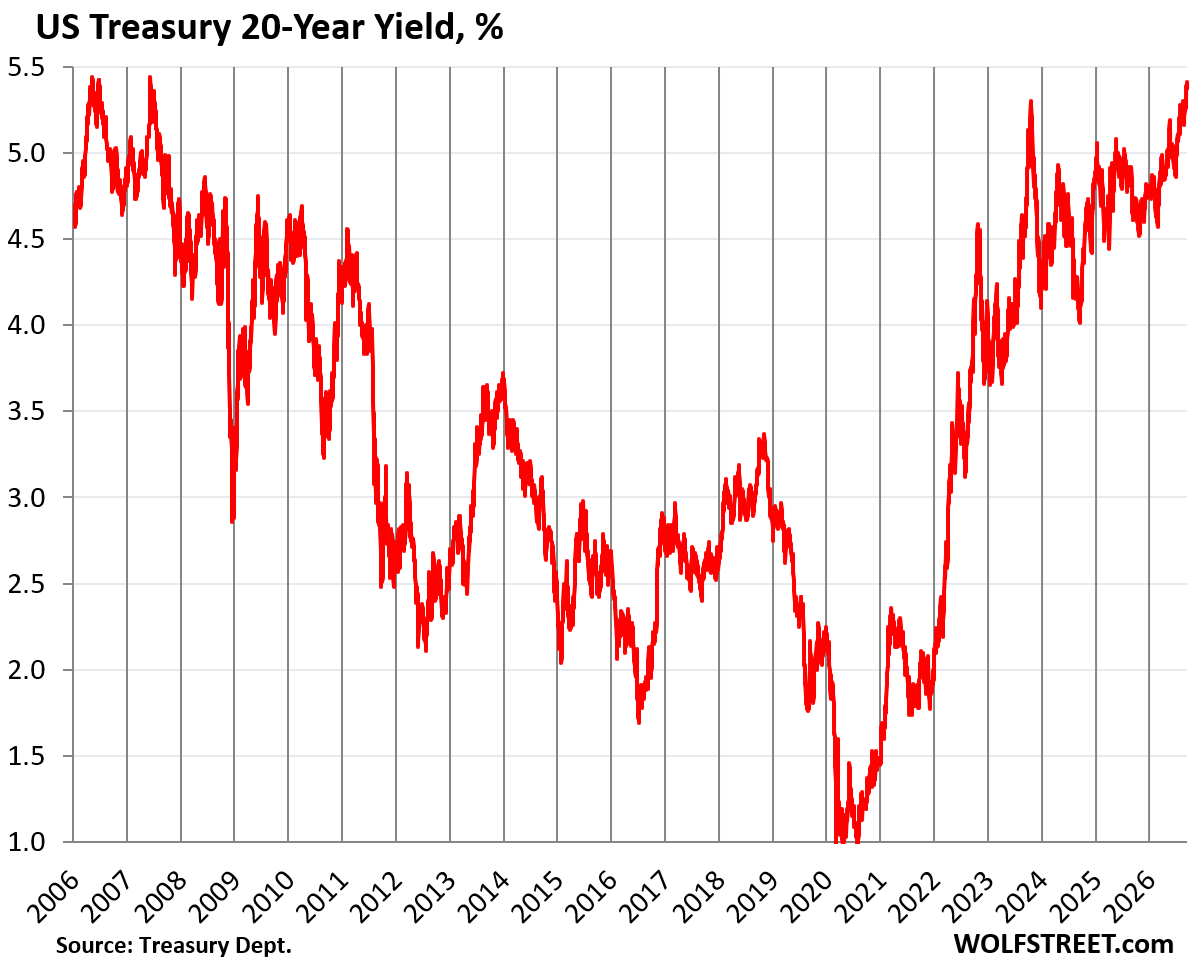
The United States Treasury Department’s recent auction of $13 billion in 20-year bonds underscored the mounting pressure on the federal government to attract capital in an environment characterized by persistent inflation and high fiscal deficits. The auction concluded with a high yield of 5.42%, marking the highest level for this maturity since the Treasury re-introduced the 20-year bond in March 2020. This result highlights the market’s requirement for significantly higher compensation to absorb government debt, serving as a barometer for the broader challenges facing the U.S. bond market.
Chronology of Yield Escalation
The trajectory of the 20-year bond yields has been steadily upward, reflecting a market that is increasingly demanding higher premiums for long-dated government securities. Just one month prior, at the August 19 auction, the bond cleared at 5.204%. The July auction saw a yield of 5.163%. The current 5.42% figure eclipses the previous benchmark set in October 2023, when the yield reached 5.245%—a period during which the 10-year Treasury yield briefly breached the 5% threshold.
Historically, this latest auction serves as a stark reminder of the volatility inherent in the long end of the yield curve. Following the October 2023 peak, secondary market yields experienced a rapid correction, falling by approximately 130 basis points over the subsequent 11 months. Current market participants are now evaluating whether the 5.42% print represents a localized peak or the start of a more sustained period of elevated borrowing costs.
Technical Indicators and Auction Mechanics
The auction results revealed a "tail" of 2.0 basis points, a metric that indicates the difference between the "when-issued" yield—where the bond traded in the days leading up to the auction—and the final yield accepted by the Treasury. The when-issued yield stood at 5.40%, meaning the final 5.42% result was 2 basis points higher. While not a record-breaking tail since the 2020 re-introduction, a 2.0 basis-point divergence is considered substantial and points to weaker-than-anticipated demand at the precise moment of the auction.
The Bid-to-Cover ratio, a key measure of market appetite, reached 2.57, calculated from $33.38 billion in total bids against $13.00 billion in accepted bonds. While this represents a marginal improvement over the 2.53 ratio recorded in August, it remains below the 2.64 seen in July, suggesting that institutional investors remain cautious about locking in long-term capital despite the attractive headline yields.

Shifting Institutional Participation
Perhaps the most notable data point from the auction was the participation of indirect bidders, which accounted for 52.5% of the total allocation, or $6.78 billion. This is the lowest level of indirect participation in the six-year history of the modern 20-year Treasury bond.
Indirect bidders, a category that includes foreign central banks and major international institutional investors, are critical to the stability of U.S. debt markets. Their reduced presence suggests a cooling of foreign interest in U.S. long-term sovereign debt. Analysts suggest this lack of enthusiasm may be linked to geopolitical shifts, concerns over the sustainability of U.S. debt-to-GDP ratios, and the availability of competing yields in other sovereign bond markets.
The Macroeconomic Environment
The current yield environment is deeply influenced by the Federal Reserve’s transition away from the era of Quantitative Easing (QE) and near-zero interest rate policy. For the decade following the 2008 financial crisis, the bond market was largely defined by central bank intervention. Since 2022, however, the Federal Reserve has pivoted toward a restrictive monetary stance to combat the highest inflation rates witnessed in four decades.
As a result, yields have returned to levels not seen since 2007. In the current landscape, the 20-year yield is trading at approximately 5.41% in the secondary market, placing it roughly 4 basis points higher than the 30-year Treasury bond (5.37%). This inversion or flattening of the long end of the curve reflects the specific liquidity constraints of the 20-year bond, which is often viewed as an "unloved" maturity compared to the highly liquid 10-year and 30-year benchmarks. The Treasury has even included these securities in its recent buyback programs specifically to enhance liquidity in this segment of the market.
Fiscal Implications and Policy Outlook
The necessity of a 5.42% yield to clear a relatively small $13 billion auction highlights the structural tension between the Treasury’s borrowing needs and the market’s capacity to absorb that supply. Economists have long argued that the function of yield is to create demand; when institutional appetite wanes, yields must rise until the price point becomes attractive enough to clear the market.
However, this dynamic presents a significant challenge for the federal government. With fiscal deficits remaining high and no immediate signs of a comprehensive long-term deficit reduction strategy from Congress, the cost of servicing the national debt is rising rapidly. Each auction at these elevated levels increases the interest expense portion of the federal budget, potentially crowding out other fiscal priorities.
There is a growing consensus among market analysts that if yields remain at or above 5% for an extended duration, the pressure on fiscal policy will become unavoidable. Historically, such yield environments force a reckoning, either through monetary policy adjustment or through legislative action aimed at fiscal consolidation. While the current administration and Congress have yet to implement significant changes to the nation’s long-term fiscal trajectory, the bond market is increasingly signaling that the era of "free" or low-cost capital has concluded.
Comparative Market Context
To understand the current magnitude of these yields, one must look back to the pre-2007 era. Before the financial crisis, 5% yields on long-term Treasuries were considered normal. The period of rate repression from 2008 to 2021 was an anomaly in the broader history of American finance. The market is currently undergoing a painful "re-normalization" process, where investors must recalibrate their expectations for risk-free rates.
For the Treasury, the immediate concern is the cost of rolling over maturing debt. As older, lower-coupon bonds reach maturity, they are being replaced by new issues at these significantly higher rates. This "interest rate reset" is occurring across the entire maturity spectrum, from the 2-year note to the 30-year bond, effectively locking in higher debt-servicing costs for the next generation of fiscal budgets.
Conclusion
The latest 20-year Treasury auction serves as a stark marker of the current financial reality. It is a world where demand must be bought at a price, and where the market’s patience for fiscal deficits is being tested. While the auction successfully found buyers, the record-low participation of indirect bidders and the notable "tail" indicate that the market for long-term U.S. debt is becoming more selective. As the economy continues to navigate the aftermath of the inflationary surge and the shift in monetary policy, the Treasury’s ability to maintain orderly auctions at reasonable yields will remain a critical focus for global financial stability. The market has delivered its message: to secure the funding necessary to sustain current fiscal paths, the government must be prepared to pay, and the cost of that payment is reaching levels that will define the economic policy debates of the coming years.