The Resurgence of Fixed Income: Evaluating the 5.3 Percent Yield Environment in the Total Bond Market

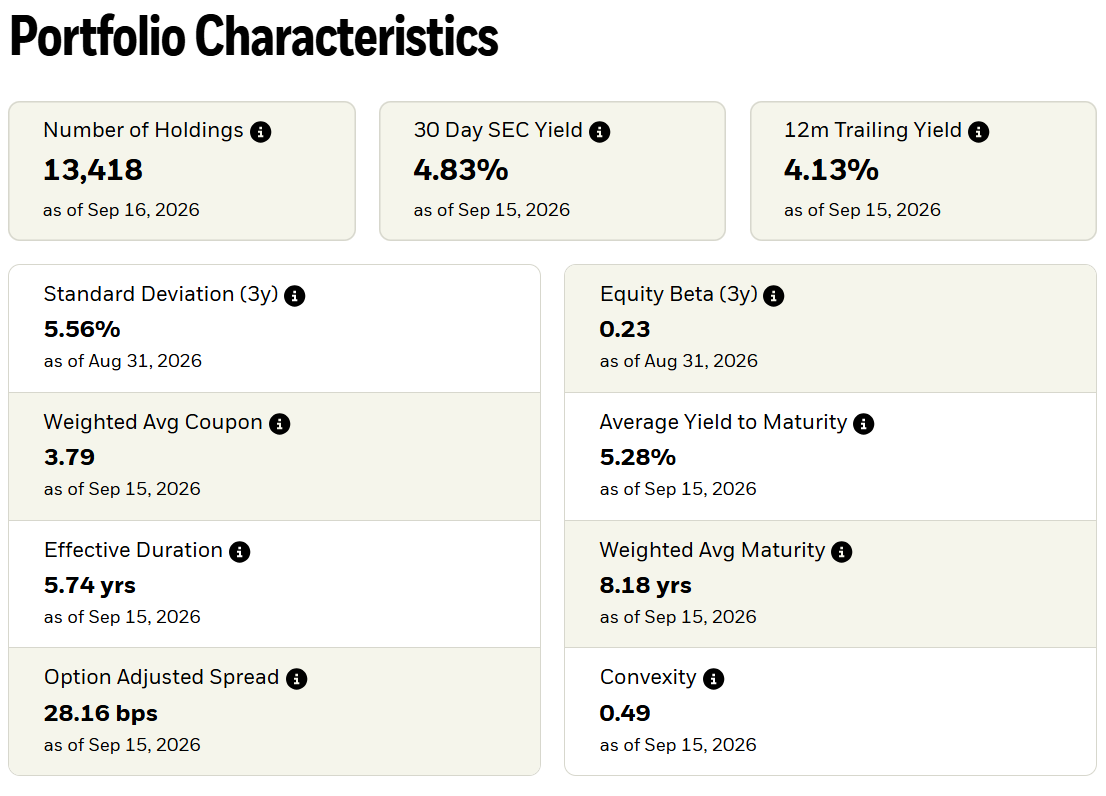
The investment landscape for fixed-income securities has undergone a profound transformation as of September 2026, marking a significant departure from the ultra-low interest rate regime that defined the decade following the 2008 Great Financial Crisis. Investors currently eyeing the iShares Core U.S. Aggregate Bond ETF (AGG) are encountering an average yield to maturity of approximately 5.3%, a stark contrast to the sub-2% yields that persisted during the early 2020s. This shift brings into focus the mechanics of bond market returns, the influence of interest rate volatility, and the fundamental shift in capital allocation strategies for retail and institutional investors alike.
The Evolution of Bond Yields: A Historical Context
To understand the current significance of a 5% yield, one must consider the historical backdrop. Throughout the 2010s, central bank policies designed to stimulate economic growth pushed bond yields to historic lows. For much of that period, the yield on the "Agg"—a broad benchmark for the investment-grade U.S. bond market—remained below 3%. The onset of the COVID-19 pandemic further exacerbated this trend, as aggressive monetary intervention forced yields on the Agg below 2% for an extended duration.
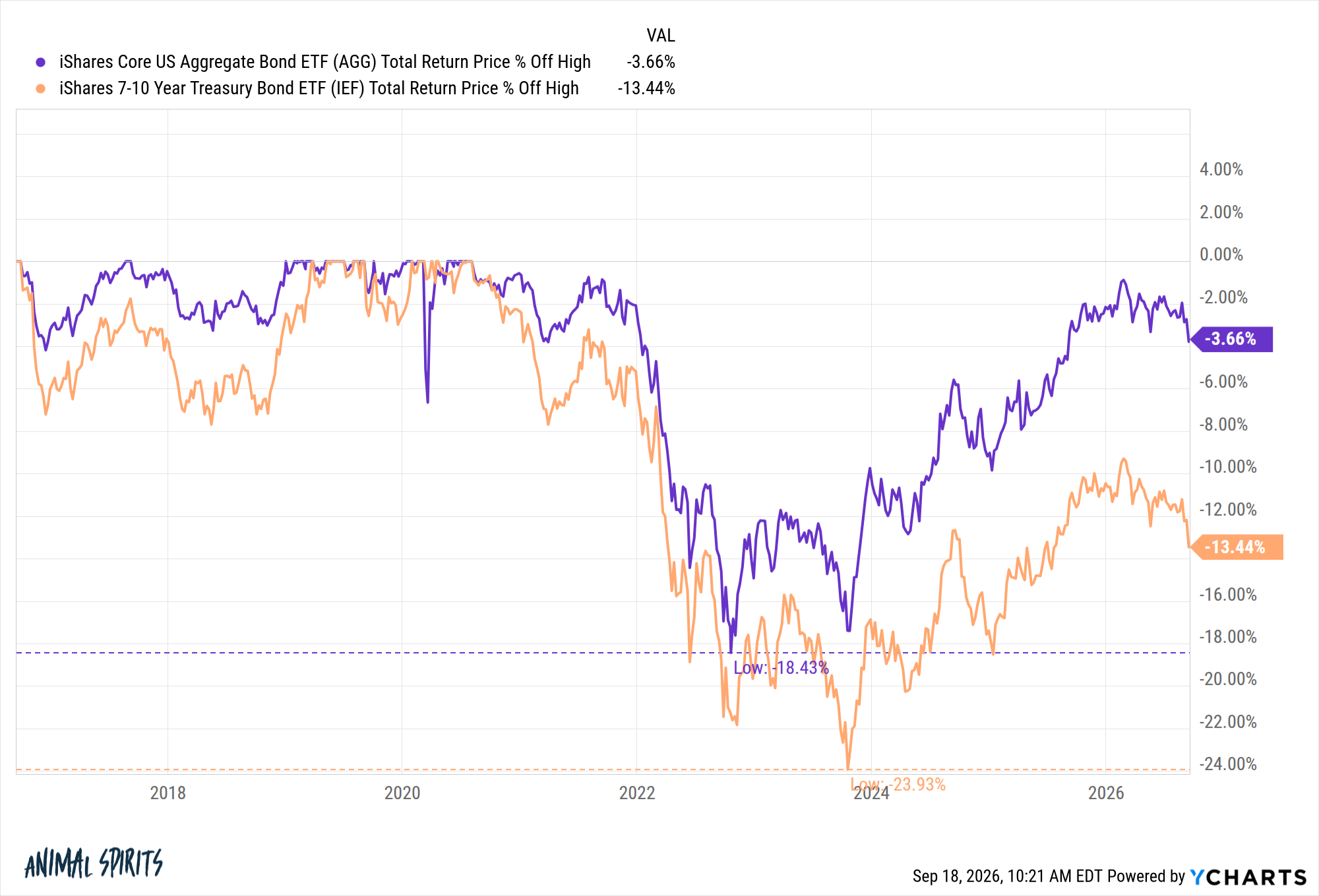
During this era, investors seeking income were often forced to venture further out on the risk spectrum, moving into high-yield corporate debt or equity markets to achieve return targets. However, the economic volatility of the mid-2020s necessitated a change in monetary policy. As inflationary pressures mounted, central banks moved to normalize interest rates, leading to a rapid repricing of fixed-income assets. This transition period was objectively painful for bondholders; as rates climbed, the market value of existing bonds plummeted. The Agg experienced a drawdown approaching 20%, while longer-duration assets, such as 10-year Treasuries, saw declines exceeding 20% in total return terms. This period is now widely characterized by analysts as the most significant bond bear market in modern history.
The Mathematics of Fixed-Income Returns
Unlike the equity market, where forward returns are frequently obfuscated by shifting investor sentiment, valuation multiples, and the subjective nature of "market mood," the bond market operates primarily on mathematical certainty. While an equity investment relies heavily on the "emotional component"—the price investors are willing to pay for future earnings—bonds are governed by the relationship between the starting yield and the duration of the security.
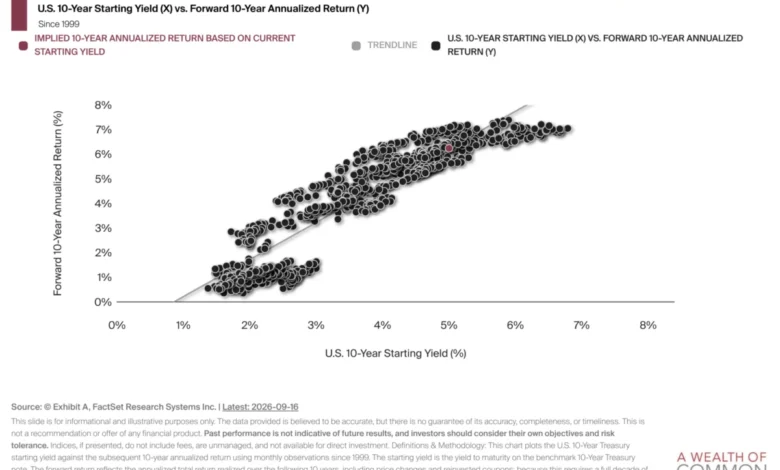
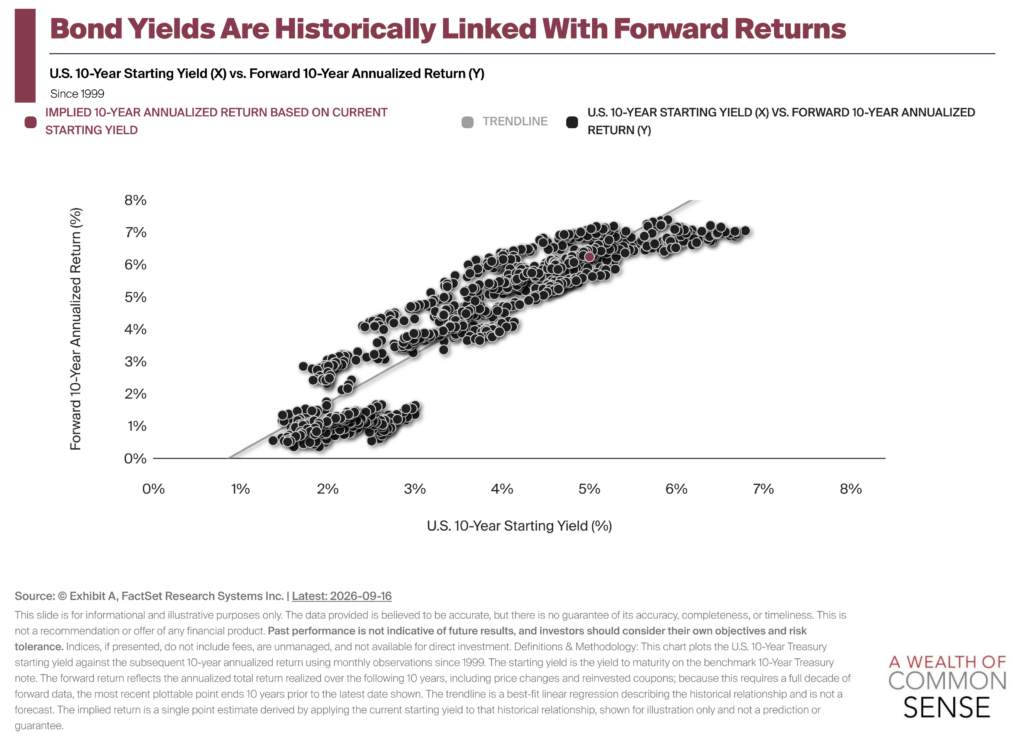
When an investor purchases a bond index fund, the current yield to maturity serves as a robust proxy for the expected annualized return over the life of the bond, provided the underlying credit quality remains intact. Data from industry researchers, including the team at Exhibit A, demonstrates a strong historical correlation between the starting yield of a 10-year Treasury and its subsequent 10-year annualized return. While this relationship is not a precise one-to-one guarantee—due to fluctuations in inflation expectations and interest rate volatility—the "starting yield" remains the single most reliable indicator for intermediate-term performance.
Navigating Interest Rate Risk and Volatility
The current yield of 5.3% on the Agg is not a static, guaranteed figure, as bond prices and interest rates maintain an inverse relationship. If central banks continue to raise rates in response to persistent inflation, the net asset value (NAV) of bond funds may face downward pressure in the short term. However, this risk must be balanced against the income component of the investment.
For instance, throughout the current calendar year, 10-year Treasury yields have climbed from roughly 4.2% to 5.0%. Despite this 20% increase in yield, the total return impact on a 10-year government bond has been relatively contained, with losses limited to approximately 3%. This "softening" effect is a direct result of the coupon income earned by the investor. As rates stabilize, the reinvestment of this income into higher-yielding assets creates a compounding effect that historically offsets the volatility of the underlying bond prices over a 5-to-7-year horizon.
Broader Economic Implications and Institutional Perspectives
The return of a "risk-free" or low-risk 5% yield has shifted the calculus for financial advisors and institutional portfolio managers. For the past fifteen years, the "TINA" (There Is No Alternative) trade forced investors into stocks, inflating valuations. With bonds now providing a competitive yield, the opportunity cost of holding fixed income has diminished.
Alex Morris, a prominent strategist at F/m Investments, notes that the current environment requires a more granular approach to duration management. Speaking on the Ask the Compound series, Morris emphasized that while the headline yield is attractive, investors must remain cognizant of the difference between short-term duration risk and the long-term benefit of locking in higher coupons. For many retirees or conservative investors who relied on bonds for capital preservation during the low-rate era, the current market represents a stabilization of income streams that were previously unavailable.
Analysis: What Lies Ahead?
The current 5.3% yield environment offers a dual opportunity: income generation and a hedge against equity market volatility. While short-term fluctuations in the Treasury market remain a possibility, the long-term outlook for intermediate-term bonds is more constructive than it has been in over a decade.
- The "Yield Floor": Because the starting yield is significantly higher, the "cushion" provided by interest payments is substantial. Even in scenarios of moderate interest rate volatility, the income stream acts as a stabilizer for portfolios that were previously reliant solely on capital appreciation.
- Duration Sensitivity: Investors must distinguish between the Agg, which holds a mix of government and investment-grade corporate bonds, and long-term Treasury funds (such as the TLT). While the Agg has seen a 20% drawdown, long-term Treasuries have endured even steeper declines, with some metrics showing drawdowns of 40% from previous peaks. This underscores the necessity of matching bond duration with the investor’s specific time horizon.
- Inflation Expectations: The primary risk to the 5% thesis remains an unexpected surge in inflation. If the market prices in a higher terminal rate, bond prices will adjust downward. However, the "mathematical" advantage of the current yield means that the time required to recover from such a drawdown is significantly shorter today than it was in 2021 or 2022.
In conclusion, the fixed-income market has entered a new phase of maturity. For the individual investor, the current 5.3% yield on the Agg serves as a benchmark for re-evaluating risk-adjusted returns. While the "worst bond bear market in history" left many investors wary of the asset class, the math suggests that the current environment is arguably the most attractive entry point for fixed-income exposure since the early 2000s. As the market continues to recalibrate to these higher rates, the emphasis for investors should remain on the long-term compounding of income rather than the immediate, noise-driven fluctuations in market price. The era of near-zero returns has concluded, and in its place, the traditional role of bonds—as a reliable provider of income and a ballast for risk—has been restored.