The 2-year and 3-year yields indicate that the 10-year yield could go way higher over the next few months.


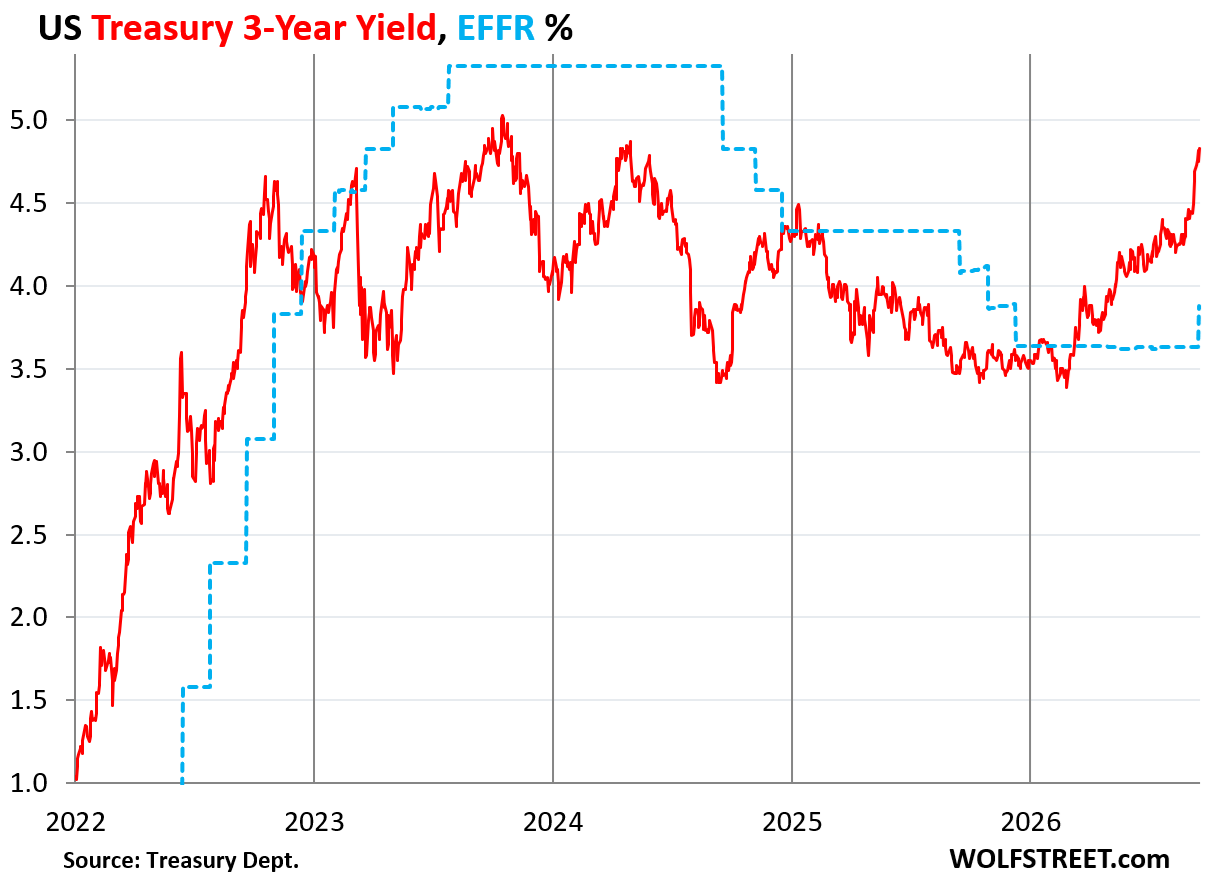
The U.S. Treasury market is currently exhibiting signs of profound structural tension as yields across the short-to-intermediate maturity spectrum surge toward levels not seen in years. As of the close of trading on September 19, 2026, the 3-year Treasury yield reached 4.86%, a level unseen since April 2024, while the 2-year Treasury yield climbed to 4.76%, reflecting a market that is aggressively pricing in a hawkish shift in Federal Reserve policy. This movement follows a volatile period characterized by the Fed’s recent interest rate hike and a notable shift in rhetoric from central bank officials, most notably following the late August speech by former Fed Governor Kevin Warsh.
A Chronology of Rising Yields
The upward trajectory of yields began in earnest following the Jackson Hole symposium in late August 2026. During that event, remarks by Warsh regarding the "non-restrictive" nature of current financial conditions served as a catalyst for a repricing of risk across the bond market. Since August 28, the 3-year Treasury yield has spiked by 56 basis points, contributing to a staggering 144-basis-point increase since the end of February.
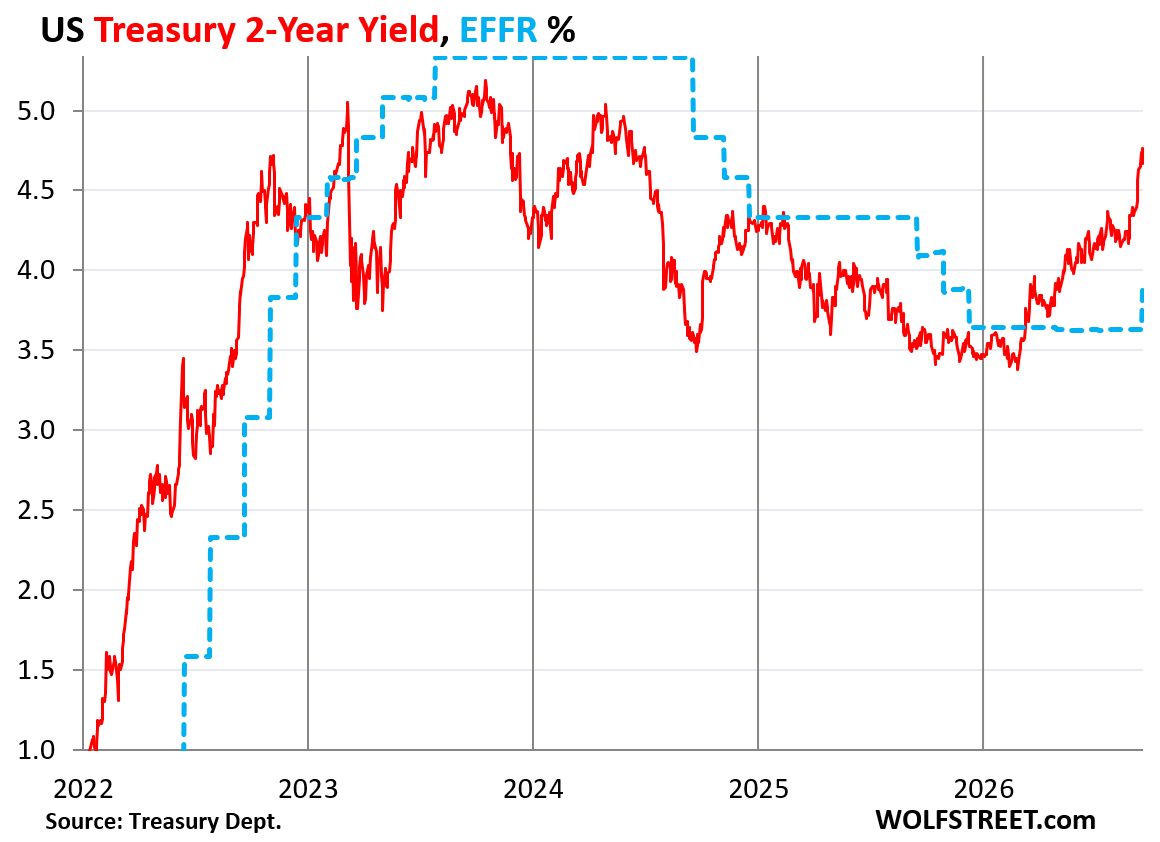
The 2-year Treasury yield has mirrored this volatility, climbing 56 basis points since the Jackson Hole address and 134 basis points since February. The consistent climb in these short-term yields signals that bond market participants are no longer operating under the assumption that the Federal Reserve has finished its tightening cycle. Instead, the market is actively discounting the probability of multiple additional rate hikes, positioning itself for a "higher-for-longer" interest rate environment that challenges the accommodative assumptions that dominated the previous two years.
The Dynamics of the Yield Curve
A critical point of concern for analysts is the narrowing spread between short-term instruments and the benchmark 10-year Treasury yield. As the 3-year yield sits merely 15 basis points below the 10-year, and the 2-year yield trails by only 25 basis points, the yield curve is experiencing a significant distortion. Historically, during periods of economic expansion and moderate inflation, the spread between the 2-year and 10-year notes has typically ranged between 100 and 250 basis points.
The compression of these spreads suggests that the market is currently in a state of transition. The "bulge" in the middle of the yield curve—specifically within the 2-year to 4-year maturities—indicates that investors are increasingly convinced that long-term rates must eventually adjust upward to maintain traditional risk premiums. While the 10-year Treasury yield has found a temporary psychological ceiling at 5%, the continued upward pressure from shorter maturities suggests this level may prove unsustainable in the coming months.
The 5% Threshold: A Psychological Barrier
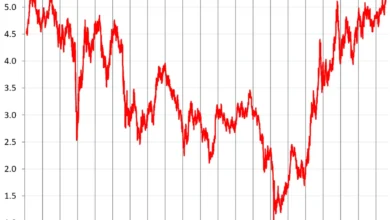
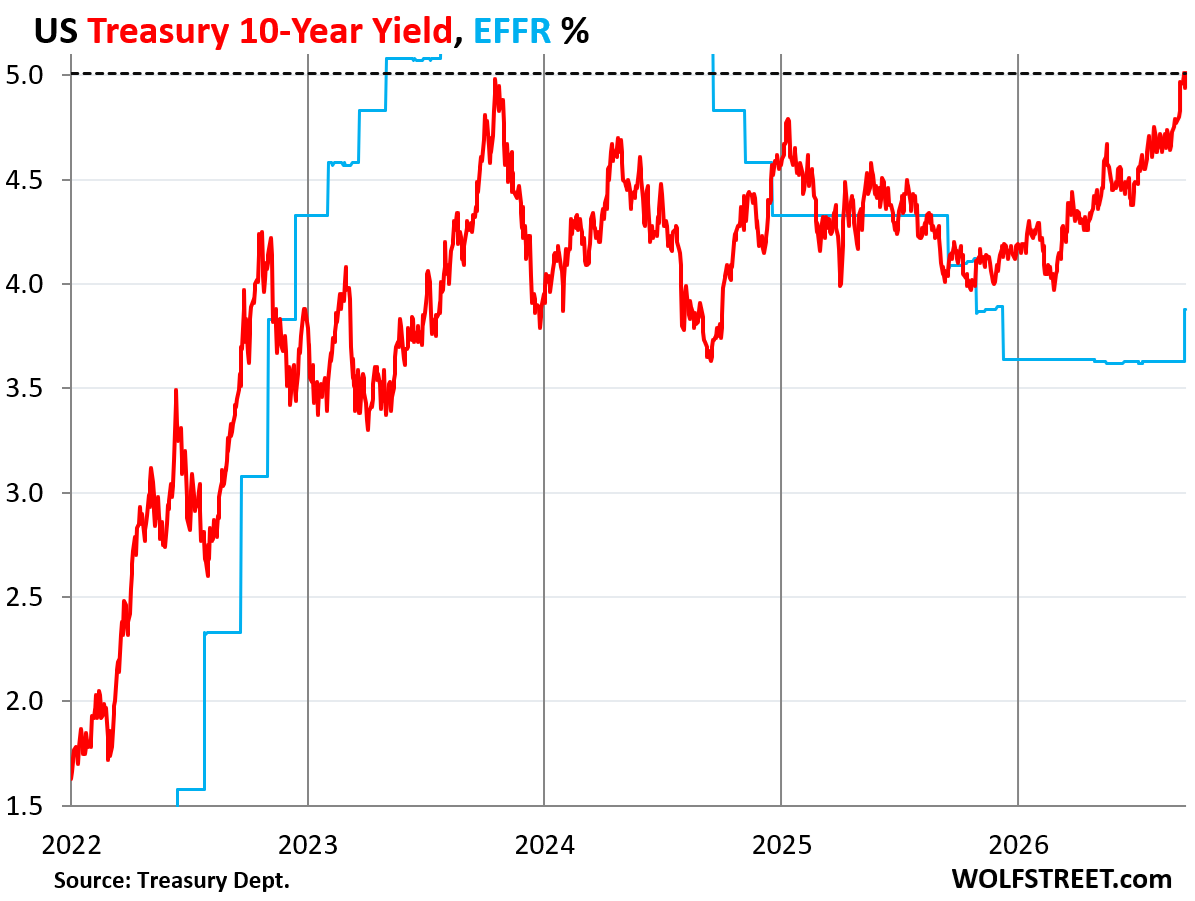
The 10-year Treasury yield’s struggle to break decisively above 5% serves as a barometer for market sentiment. This "magic line" has acted as a critical support level; whenever yields have touched 5%, renewed demand has emerged, effectively curbing further spikes. This was notably observed on October 23, 2023, when an intraday breach of 5% triggered a massive influx of buying, leading to a sustained two-month decline in yields.
However, the current market climate differs significantly from previous episodes. Despite the current surge in short-term rates, the anticipated "floodgates" of demand for 10-year notes have been more muted. While there is sufficient buying activity to balance selling pressure, the persistent upward movement in the rest of the curve suggests that market participants are becoming increasingly wary of holding long-term debt at current valuations. Should the 10-year yield break through 5% with sustained volume, it could signal a broader capitulation by bondholders, leading to a repricing of mortgage rates, corporate borrowing costs, and valuation multiples in equity markets.
The Legacy of Financial Repression
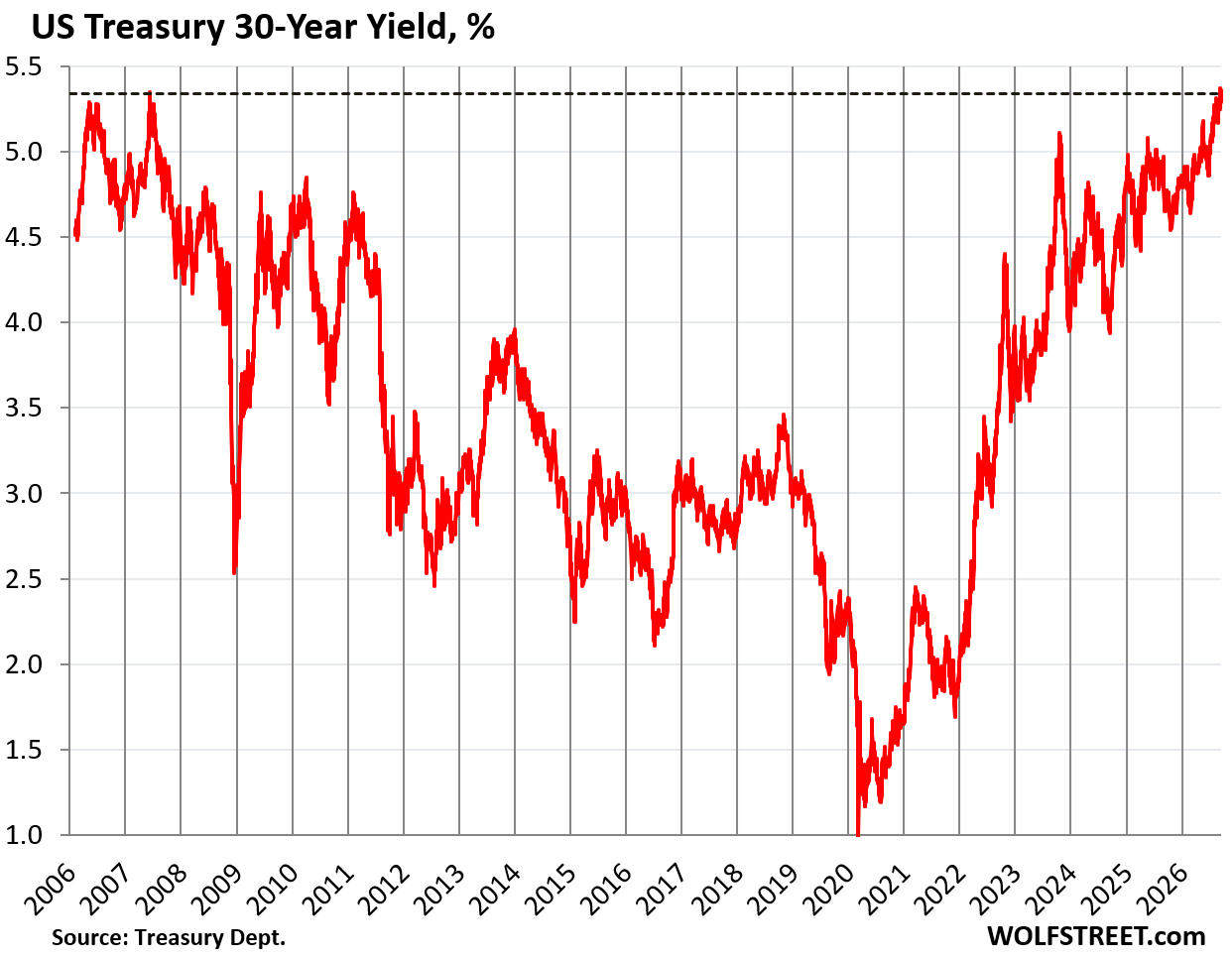
To understand the current environment, one must consider the era of "financial repression" that began in 2008. For over a decade, the Federal Reserve’s use of Quantitative Easing (QE) and Zero Interest Rate Policy (ZIRP) artificially suppressed long-term yields. This policy was designed to stimulate the economy following the 2008 financial crisis but also had the effect of distorting market signals and inflating asset prices, particularly in the housing market, contributing to the current affordability crisis.
The current rise in yields is viewed by some economists as a "normalization" process. With inflation remaining a stubborn variable and the Fed moving away from its post-2008 interventionist stance, the bond market is essentially reclaiming its role as a price-discovery mechanism. The shift toward higher yields is not merely a reaction to current inflation data but a fundamental recalibration of what constitutes a "fair" return on capital in an economy no longer buoyed by massive central bank balance sheet expansion.
Policy Implications and Official Reactions
The Federal Reserve’s recent decision to hike rates, accompanied by an updated "dot plot" that signals further potential tightening, has removed much of the ambiguity that previously clouded investor outlooks. Statements from officials like Kevin Warsh emphasize that financial conditions must remain restrictive enough to ensure that inflation returns to the target rate.
This hawkish pivot is reflected in the Effective Federal Funds Rate (EFFR) data. The current 3-year yield is 95 basis points above the EFFR, and the 2-year is 88 basis points above it. These premiums are direct reflections of market expectations regarding future Fed actions. When bond yields trade significantly above the target federal funds rate, it is a clear indicator that the market expects the central bank to hike rates further. Conversely, when yields are below the target rate, the market anticipates a pivot or a rate-cutting cycle. The current data strongly confirms the former.

Broader Macroeconomic Impact
The implications of a sustained move in the 10-year Treasury yield above 5% are far-reaching. As the primary benchmark for 30-year fixed-rate mortgages and many corporate debt instruments, the 10-year yield acts as the "risk-free" rate for the entire economy. A higher 10-year yield translates directly into higher borrowing costs for businesses and households.
For the housing market, which is already grappling with the fallout of the affordability crisis, a move toward 5.5% or 6% on the 10-year note could further depress transaction volumes and put downward pressure on home prices. For corporations, higher yields increase the cost of debt service, which may lead to reduced capital expenditure, lower share buyback activity, and compressed profit margins.
Furthermore, the federal government faces its own fiscal challenges. As a significant portion of the U.S. national debt matures, it must be refinanced at these higher market rates. This increases the federal interest burden, creating a feedback loop where higher deficit spending—necessary to cover rising interest payments—potentially keeps inflation expectations elevated, thereby maintaining upward pressure on long-term yields.
Conclusion: A Market in Flux
The behavior of the Treasury yield curve in the third quarter of 2026 highlights a fundamental shift in the macroeconomic landscape. The combination of rising short-term rates, a flattening yield curve, and the persistent pressure on the 10-year benchmark suggests that the era of ultra-low interest rates is firmly in the rearview mirror.
While the 5% level for the 10-year yield remains a significant psychological and technical barrier, the mounting evidence from the 2-year and 3-year maturities suggests that the market is preparing for a new reality. Investors, policymakers, and market analysts remain focused on the interplay between incoming inflation data and the Federal Reserve’s commitment to its current trajectory. As the bond market continues its process of normalization, the volatility observed in recent weeks is likely to persist until a new equilibrium is established, one that reflects both the risks of sustained inflation and the cost of debt in a non-repressive environment.