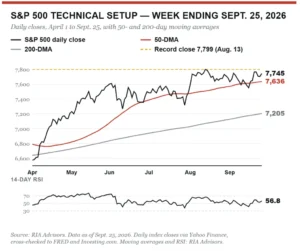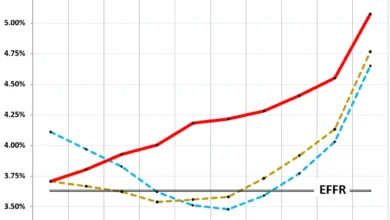
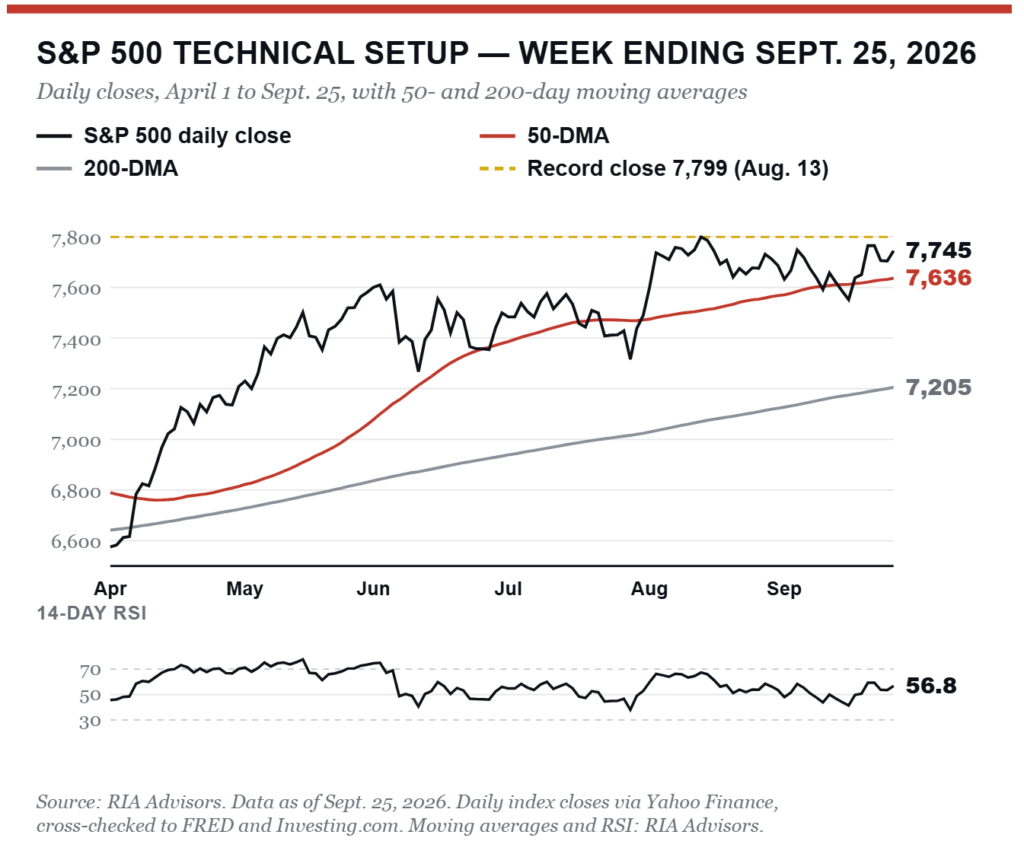
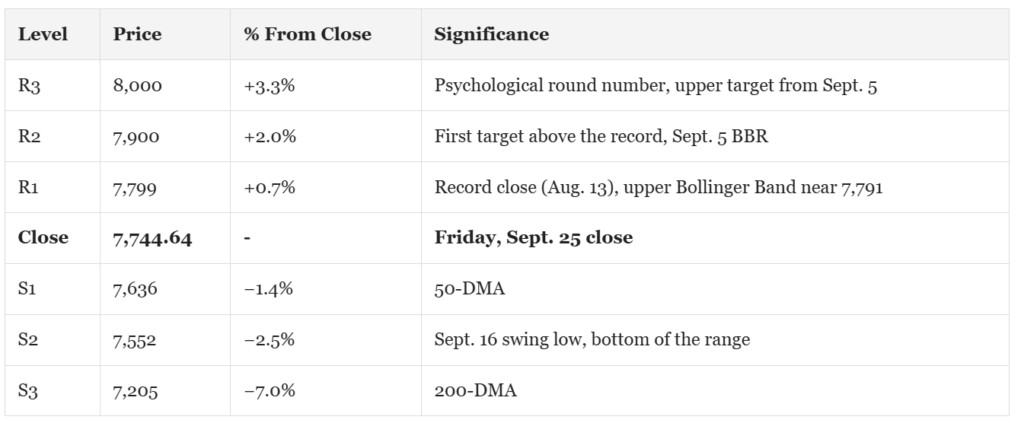
The S&P 500 advanced 1.2% over the trading week ending September 26, 2026, closing at 7,744.64 and bringing its year-to-date gains to 13.1%. The benchmark index finished just 0.7% shy of its record high of 7,798.99, reached on August 13. However, this headline-driven resilience masked a profound shift within fixed-income markets, where Treasury yields surged to multi-decade highs. The 10-year Treasury yield rose from 5.01% at the start of the week to close at 5.18%, touching an intraday peak of 5.225%—its highest level since 2007. Concurrently, the 30-year Treasury yield climbed to 5.50%, a level not seen since 2004, while bond market volatility, measured by the MOVE index, jumped from 80 to 104.
Underpinning the upward trajectory in yields was a robust domestic economy. S&P Global’s flash composite Purchasing Managers’ Index (PMI) for September accelerated to 58.4 from 56.0, marking the fastest pace of output growth in over five years. Additionally, initial jobless claims dropped to 197,000, echoing labor market tightness reminiscent of the late 1960s. These robust economic indicators prompted interest rate futures markets to price in a roughly 70% probability of a Federal Reserve rate hike at the upcoming October FOMC meeting, up from approximately 50% the previous week. Consequently, market participants faced the dual dynamic of resilient corporate earnings supported by strong economic activity, juxtaposed against a sharply rising discount rate.
Consumer sentiment presented a stark contrast to macroeconomic activity. The University of Michigan’s final September consumer sentiment index declined to 48.1, hitting a four-month low. Inflation expectations for the year ahead ticked upward to 4.6%, driven largely by elevated energy prices, with gasoline hovering near $4.50 per gallon. Crude oil markets experienced heightened volatility amid geopolitical developments surrounding ongoing U.S. and Iranian negotiations concerning the Strait of Hormuz. West Texas Intermediate (WTI) crude settled at $91.96 per barrel on Friday, while international benchmark Brent crude remained elevated near $100 per barrel.
Market Breadth and Sector Divergence
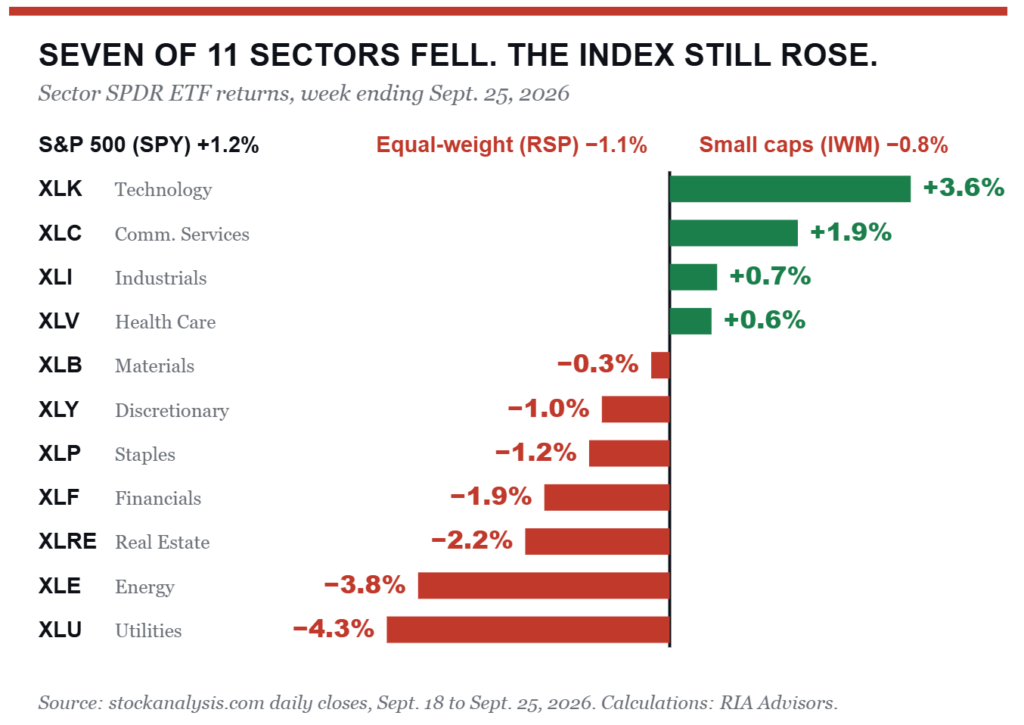
Beneath the headline index performance, market participation remained exceptionally narrow. Technology shares advanced 3.6%, and communication services added 1.9%, serving as the primary pillars supporting the broader index. Conversely, defensive and rate-sensitive sectors suffered notable declines, with utilities falling 4.3%, energy dropping 3.8%, and real estate contracting 2.2%. In total, seven of the eleven major S&P 500 sectors finished the week in negative territory.
The divergence between capitalization-weighted and equal-weighted indices highlighted this concentration risk. While the cap-weighted S&P 500 gained 1.2%, the equal-weight S&P 500 fell 1.1%, and small-cap equities slipped 0.8%. This narrow leadership underscored the structural vulnerability of the equity market as higher risk-free rates exerted downward pressure on rate-sensitive asset classes.

Historical seasonal patterns also played out with a twist. Analysts had previously warned of potential late-September weakness, noting that the period often harbors seasonal volatility. While the S&P 500 did pull back 2.5% from its September 3 close to an intraday low of 7,551.81 on September 16, the subsequent 2.6% recovery defied expectations of persistent calendar-based weakness heading into the final days of the month.

Technical Backdrop and Momentum Indicators
From a technical perspective, the S&P 500 maintained a constructive posture, holding approximately 1.4% above its 50-day moving average (DMA) of 7,636 and 7.5% above its 200-DMA of 7,205. The index continued to trade within a well-defined consolidation range between 7,550 and 7,800 established in early August.
Momentum indicators showed measurable improvement over the week. The 14-day Relative Strength Index (RSI) climbed from 50.7 to 56.8, remaining within neutral territory and leaving ample room before reaching overbought conditions. Furthermore, the Moving Average Convergence Divergence (MACD) indicator generated its first buy signal since August 3, crossing above its signal line with a reading of +18.9 against a signal line of +10.8. However, overhead resistance remains formidable near the upper Bollinger Band and previous record highs, specifically within the 7,790 to 7,800 price corridor.

The Consensus Calculus Behind Jefferies’ 9,000 S&P 500 Target
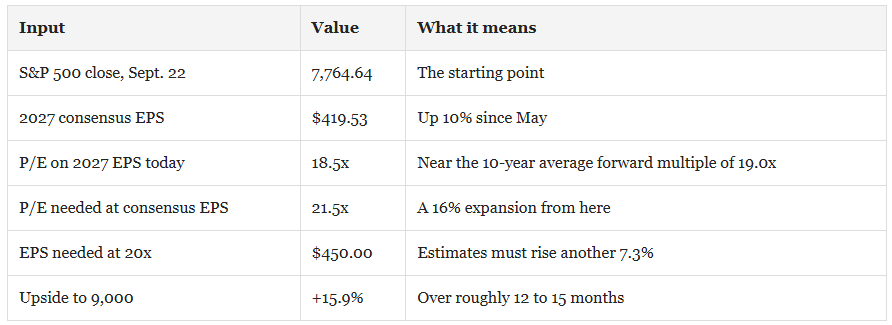
As the equity market consolidates near historic highs, sell-side institutions have increasingly revised their long-term forecasts upward. Notably, investment firm Jefferies published a comprehensive outlook projecting the S&P 500 to reach 9,000 by the end of 2027, representing an approximate 15.9% upside from late-September trading levels. FactSet’s bottom-up analyst consensus target stands even higher at 9,261, signaling a rapid transformation of aggressive upside projections into mainstream market consensus.

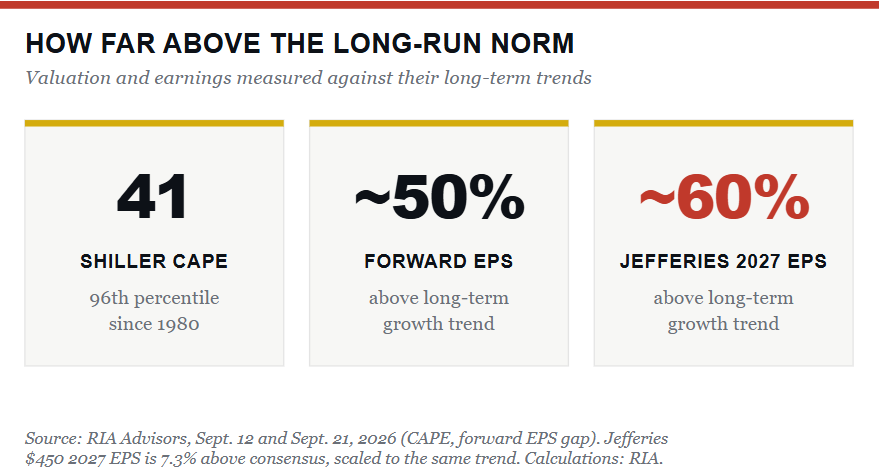
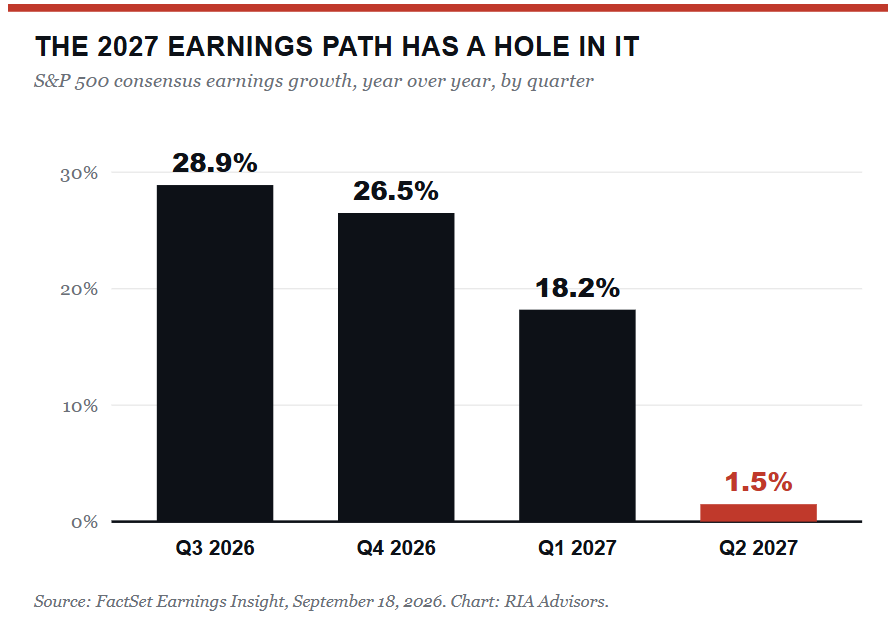
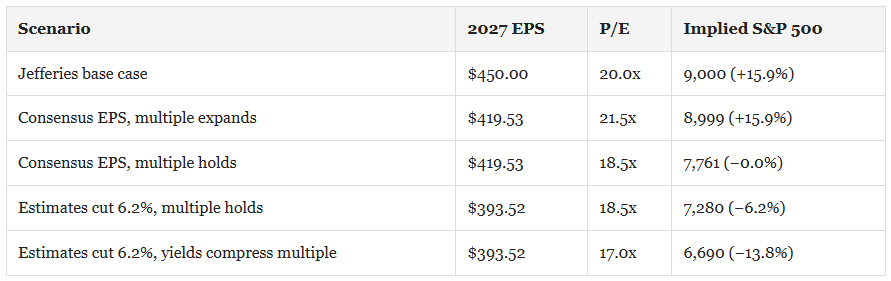
The underlying arithmetic of the Jefferies target relies heavily on projected corporate earnings per share (EPS) of $450 for fiscal year 2027, coupled with a forward price-to-earnings (P/E) multiple of 20. This projection assumes 20.8% earnings growth in 2027, building upon an anticipated 2026 EPS estimate of $373. FactSet consensus estimates currently position 2027 aggregate earnings at $419.53, reflecting a 10% upward revision since May. Consequently, achieving the 9,000 index level requires either a 16% expansion in valuation multiples or an additional 7% upward revision to earnings forecasts.
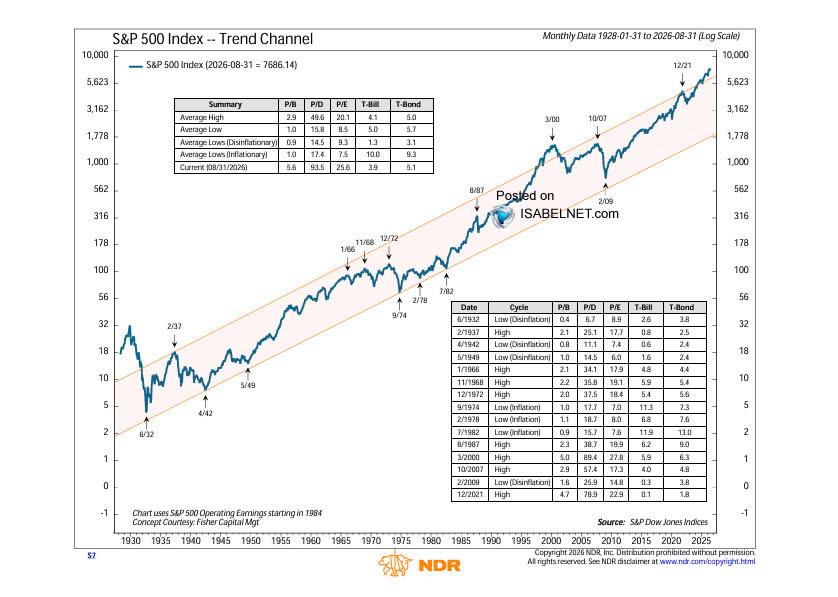
Historical precedents suggest that such aggressive upward revisions are highly unusual. According to Goldman Sachs research tracking global earnings estimates between 2016 and 2025, final annual earnings figures fell short of initial projections in eight out of ten years, with the remaining two years flat. The persistent upward revision cycle observed for 2026 and 2027 estimates—running roughly 17% and 27% above initial baselines—provides the primary fuel for these bullish targets, yet introduces significant vulnerability to macroeconomic shocks.
Structural Assumptions and Potential Vulnerabilities
The foundation of the 9,000 market target rests on several critical macroeconomic and corporate assumptions that leave little margin for operational or economic error.
First, corporate profit margins are projected to remain near record levels. Net profit margins for the S&P 500 reached 17.0% in the second quarter of 2026, the highest level recorded since FactSet began tracking the data in 2009. While consensus estimates anticipate a slight moderation to 15.0% in the third quarter, achieving long-term profitability targets requires margins to defy historical mean-reversion tendencies.

Second, capital expenditures directed toward artificial intelligence (AI) infrastructure represent a significant driver of corporate earnings growth. FactSet data indicates that hyperscaler capital expenditures are on pace to approach $800 billion for the year, with free cash flow generation remaining near or below zero for several major technology spenders outside of Alphabet and Microsoft. Furthermore, corporate reliance on debt financing for these initiatives has expanded from 9% of capital expenditures to 32%. Analysts warn that standard depreciation schedules of 5 to 6 years for server hardware may underestimate technological obsolescence; accelerated depreciation cycles of 3 to 4 years would materially compress 2027 net income figures.
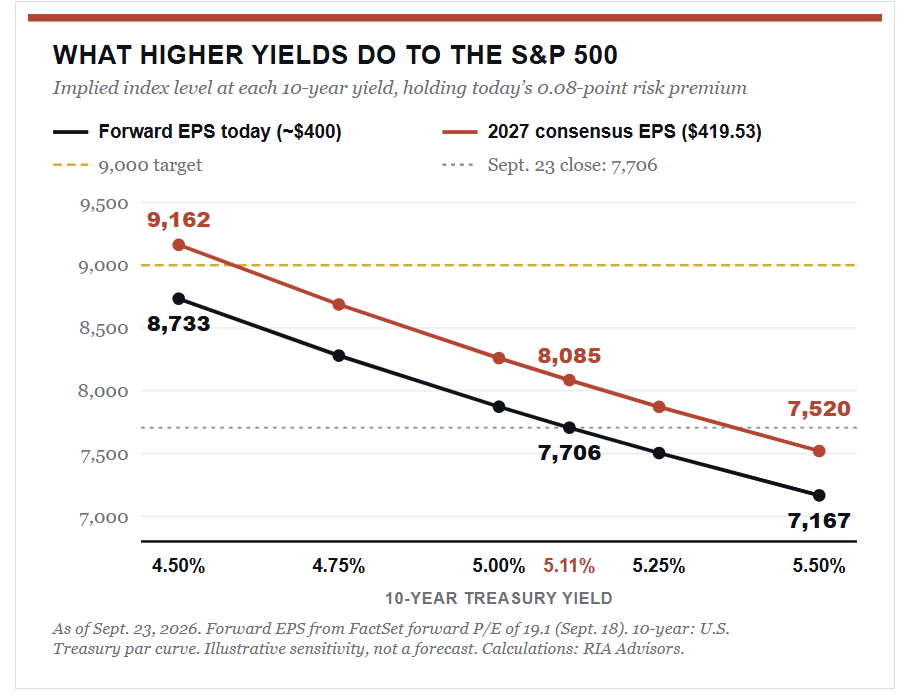
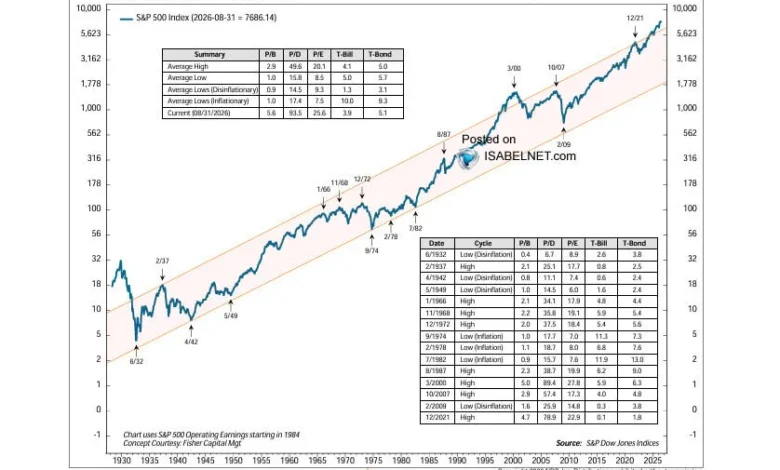
Finally, macroeconomic factors, including persistent energy price inflation and elevated borrowing costs, threaten consumer discretionary spending and corporate borrowing margins. With Brent crude trading near $100 per barrel and benchmark 10-year Treasury yields exceeding 5.2%, the earnings yield of the S&P 500—implied by a forward P/E ratio of 19.1—stands at approximately 5.2%. This provides an extremely narrow risk premium of roughly 8 basis points over risk-free government debt, restricting the market’s capacity to absorb unexpected monetary tightening or economic deceleration.
Federal Reserve Policy Stance and Economic Catalysts
The macroeconomic landscape is further complicated by the policy stance of the Federal Reserve. Following the Federal Open Market Committee (FOMC) meeting on September 16, the central bank implemented a unanimous quarter-point rate hike, establishing a target federal funds rate range of 3.75% to 4.00%. Federal Reserve officials emphasized a commitment to returning inflation sustainably to the 2% target, with economic projections indicating limited expectation for policy easing through the medium term.
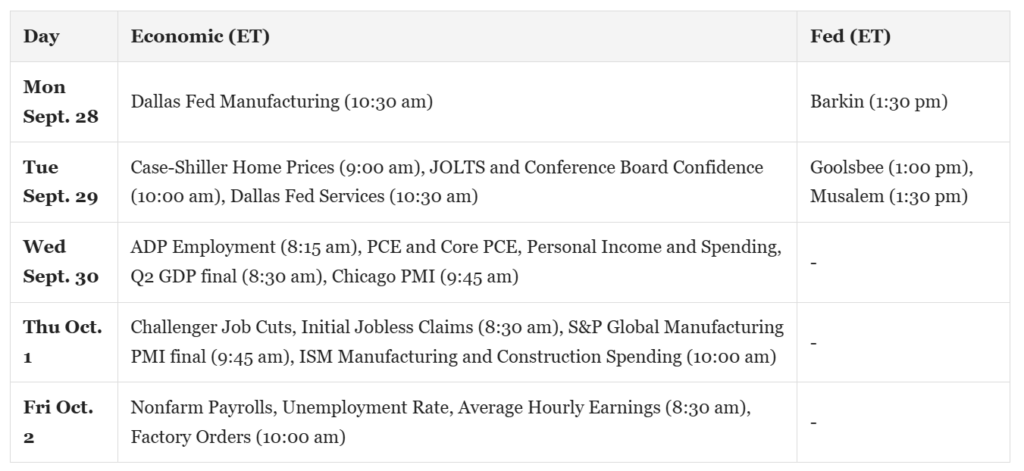
Market participants will closely monitor upcoming economic releases to gauge the likelihood of subsequent monetary tightening. Key data points scheduled for release include the August Personal Consumption Expenditures (PCE) price index—the Federal Reserve’s preferred inflation gauge—alongside personal spending figures, second-quarter GDP revisions, and the September non-farm payrolls report. A combination of persistent core inflation and stronger-than-expected employment growth would likely solidify expectations for additional policy tightening, presenting a challenging environment for both fixed-income and equity markets.

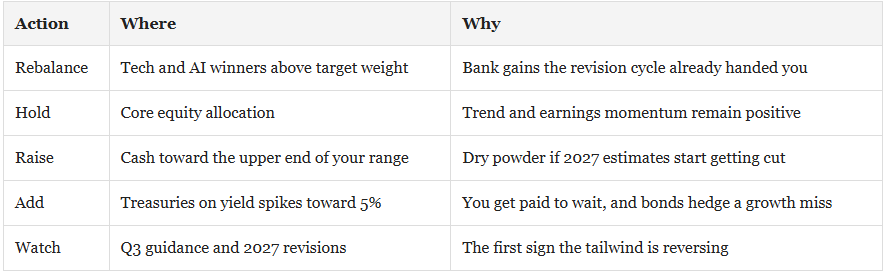
In summary, while the prevailing market trend remains supported by strong corporate earnings momentum and technical resilience, the narrowing participation and demanding valuation metrics necessitate disciplined portfolio risk management. As institutional forecasts increasingly price in perfection across earnings, margins, and macroeconomic stability, investors face a market environment where maintaining strict exposure controls remains paramount to navigating potential volatility.