Scaling Agentic AI in Enterprise Customer Experience: Overcoming the Valley of Death Through P&L Discipline, Connected Knowledge, and Hybrid Teams

As artificial intelligence matures from basic automated scripts to autonomous enterprise systems, organizations across industries are racing to implement agentic AI within their customer experience (CX) operations. Yet, despite immense corporate enthusiasm, many enterprise implementations stall at the critical point of scale. Fragmented legacy architectures, disorganized institutional knowledge, and inconsistent governance frameworks frequently transform promising technological pilots into costly operational dead ends.
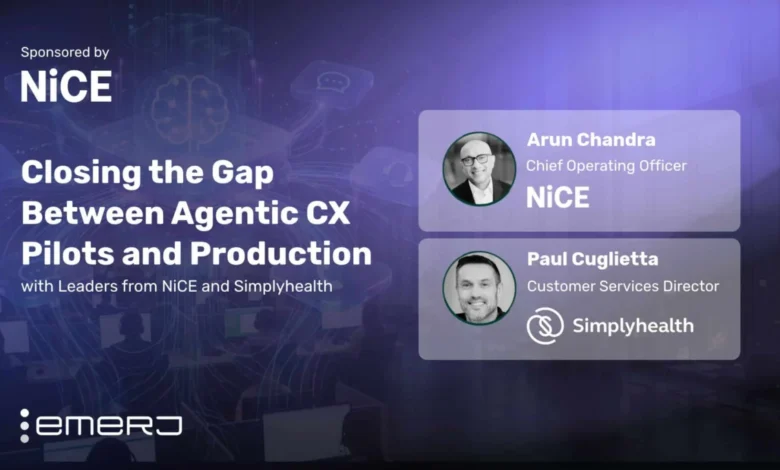
To explore the mechanics of turning enterprise knowledge into production-ready AI agents for large-scale transformations, Emerj recently hosted Arun Chandra, Chief Operating Officer at NiCE, and Paul Cuglietta, Customer Services Director at Simplyhealth, on the AI in Business podcast. Their insights outline a definitive roadmap for overcoming the systemic barriers that block enterprise AI adoption, shifting the conversation from isolated tech experiments to rigorous, P&L-anchored strategies.
The Promise and Perils of Scaling Customer Support AI
The economic imperative for deploying generative AI in customer support is supported by empirical research. A landmark study conducted by the National Bureau of Economic Research (NBER), encompassing 5,179 customer support agents, demonstrated that providing workers with a generative AI assistant increased the number of issues resolved per hour by an average of 14%. For novice and low-skilled workers, productivity surged by 34%. These efficiency gains explain why enterprise leadership teams continue to prioritize AI investments.
However, the risks associated with rapid, poorly controlled deployments are equally well-documented. A comprehensive 2023 report from the Consumer Financial Protection Bureau (CFPB) revealed that all of the ten largest U.S. commercial banks have deployed customer service chatbots. While these tools aim to reduce operational friction, the report highlighted significant negative outcomes stemming from technological limitations. The CFPB cautioned that financial institutions deploying inadequate chatbots risk violating legal obligations, eroding essential consumer trust, and inflicting direct financial and emotional harm on customers.
This dichotomy between productivity gains and scaling risks defines the modern CX landscape. Bridging this gap requires enterprises to navigate what industry leaders describe as the valley of death between initial prototyping and enterprise-wide production.
P&L-Anchored Use Case Selection to Secure CFO Investment
Over the past 12 to 18 months, many organizations have rushed into AI pilots driven primarily by external vendor pressure or executive mandates to incorporate emerging technologies. According to Arun Chandra, whose extensive executive background includes modernizing customer experience for Disney’s streaming services—reaching over 200 million subscribers—and building global shared services across 45 locations for Meta, successful AI adoption requires applying classic operations management principles.
Chandra asserts that enterprise CFOs are ultimately persuaded by only two primary metrics: measurable revenue growth and hard cost savings. Crucially, he warns that projected automation savings are frequently miscalculated. Organizations often assume they have permanently reduced human labor costs without factoring in the ongoing operational expenditure of the AI agents themselves, primarily driven by token consumption costs.
"AI is not free," Chandra noted during the podcast series. "We’re talking about AI can automate something, and so we assume that we’ve reduced the cost of the humans, but wait a minute, the AI agents have their own operating cost, which is in token costs."
To secure sustained executive buy-in, CX leaders must treat customer experience as a value-creating center rather than a traditional cost center. At Disney, Chandra approached CX as a general manager focused on long-term business value creation rather than short-term handle times. His strategic objective was to bend the cost curve so that as subscriber volumes scaled upward, the overarching cost structure flattened.
For organizations lacking internal baseline results, Paul Cuglietta—who brings over two decades of customer service and contact center leadership across healthcare, insurance, and finance at Simplyhealth—recommends building the business case through strategic alignment and like-for-like industry case studies. Backing a clear vision with verifiable comparative data gives leaders a formidable foundation for winning internal corporate support.
Connected Knowledge and Systems for Autonomous Agent Workflows
Moving beyond isolated AI pilots requires more than clean data; it demands rigorous knowledge management and deep architectural integration. Chandra identifies three pillars essential for autonomous agent workflows: data cleanliness, structured and accessible institutional knowledge, and explicit operational context.
"My knowledge has to be organized and available, because that knowledge and data is the lifeblood of what AI can produce for you in terms of outcomes," Chandra explained. "And then the third related thing is context also. So context has to be pretty well provided so that the AI can understand who reports to whom, what decision rights do I have versus what decision rights you have."
This internal requirement mirrors external customer expectations. Cuglietta emphasizes that modern consumers interact with enterprises across multiple channels—voice, email, and live chat. If these touchpoints operate in silos, customers are forced to repeatedly explain their issues, severely degrading satisfaction. Integrating these channels via robust APIs ensures a continuous thread of communication. However, because comprehensive back-end integration is complex, Cuglietta advises organizations not to delay deployment until absolute perfection is achieved. Instead, leaders should analyze customer data to identify the most utilized channels and coordinate closely with Chief Technology Officers to prioritize connectivity rollouts.
Furthermore, architecture choices dictate the longevity and flexibility of these deployments. Chandra advocates strongly for open systems and open protocols, such as the Model Context Protocol (MCP), noting that traditional Software-as-a-Service (SaaS) models historically relied on vendor lock-in. Open-source Large Language Models (LLMs) are expected to exert continuous downward pressure on token costs, giving enterprises greater leverage and operational flexibility.
Rigorous Real-Conversation Testing and Risk Governance
Because customer-facing channels represent critical brand touchpoints, premature rollouts carry severe reputational risks. Cuglietta emphasizes the unforgiving nature of consumer adoption: "From my experience, you get one chance to get a new channel right. Otherwise customers may switch off to that channel and think, you know what, I think I’ll just stick to utilising the telephone or utilising another channel that I’m more familiar with."
A common pitfall in conversational AI development is designing agents exclusively around rigid Frequently Asked Questions (FAQs). In practice, consumers rarely use standardized language; they phrase inquiries colloquially, bundle multiple questions into a single interaction, and utilize varying vocal tones. To mitigate this, Simplyhealth subjects all AI deployments to extensive user acceptance testing (UAT), evaluating sandbox scenarios against real-world data through iterative test-and-learn cycles. Agents must demonstrate absolute certainty and alignment with corporate intent before going live.
Governance frameworks provide the necessary boundaries for this experimentation. Every new AI deployment at Simplyhealth must navigate an internal AI governance protocol, requiring explicit sign-off from all relevant stakeholders. These sessions are formally minuted and recorded to ensure total operational transparency and auditability. Moreover, risk appetite dictates deployment pace; sensitive customer scenarios—such as bereavement handling—automatically bypass automated agents to ensure immediate human intervention.
When deciding how to structure the deployment sequence, leaders generally follow two philosophies: starting with simple, contained use cases to build organizational momentum, or tackling the most complex, high-value enterprise problems immediately. Chandra advocates for the latter approach, arguing that confronting systemic challenges early exposes organizational gaps and data deficiencies, ultimately accelerating the path to true enterprise-scale maturity.
Hybrid Optimization Teams and Change Management
Executing complex AI deployments requires bridging traditional organizational divides. To drive its transformation initiatives, Simplyhealth established a dedicated hybrid optimization team composed of personnel drawn from both technical backgrounds and front-line customer service operations.
"This team was made up of people who were, from a technical background in our organization, but also from my front line as well," Cuglietta explained. "Those on the front line that had the knowledge, they had the passion, they had the career ambitions to move into a slightly more technical role. Bringing those together, technology and service, into an optimization team, they helped execute the AI deployments in our organization."
This collaborative structure addresses a foundational driver of technology adoption: change management. Chandra notes that successful enterprise transformation requires answering fundamental questions regarding human roles, career progression, and operational coexistence. As agentic AI assumes routine transactional burdens, customer service advisors are liberated to focus on tasks requiring genuine human empathy, emotional intelligence, and complex problem-solving.
Ultimately, the successful integration of agentic AI across enterprise customer experience relies on a synthesis of disciplined financial oversight, open system architecture, rigorous pre-launch testing, and cross-functional collaboration. By treating AI agents not as isolated technological novelties, but as managed operational assets embedded within connected enterprise workflows, organizations can safely scale automated customer experience and deliver measurable, long-term value.