The Intersection of Paper Wealth and Artificial Intelligence: A Venture Capital Case Study

The rapid acceleration of private market valuations in the artificial intelligence sector has reignited debate over the psychological and financial impacts of unrealized paper gains compared to liquid, tangible assets. While traditional investment theory dictates that wealth remains hypothetical until converted into spendable currency or physical property, recent hyper-growth trajectories among early-stage startups are challenging long-held assumptions among private equity and venture capital limited partners.
This shift in perspective is underscored by the meteoric rise of Instinct, a text-based artificial intelligence assistant that has achieved a historic funding velocity, moving from inception to multi-billion-dollar status in a matter of months.
The Mechanics of Hyper-Growth: The Instinct Timeline
The trajectory of Instinct exemplifies the unprecedented capital inflows currently concentrating in generative artificial intelligence. Founded in April 2026 by 23-year-old former Sierra research scientist Noah Shinn, the company bypassed the traditional, protracted software development cycle by introducing an AI assistant accessible natively through standard text messaging interfaces, eliminating the friction of dedicated application downloads.
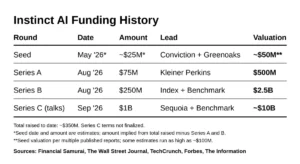
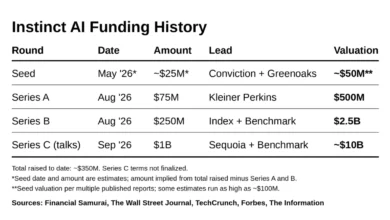
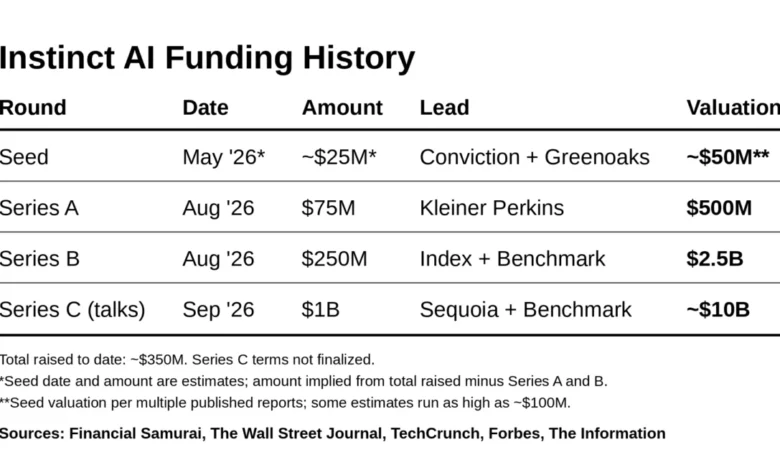
The company’s funding history illustrates a compression of valuation timelines previously unseen in venture capital markets:
- April 2026: Noah Shinn formally registers the company. A seed round is secured, backed by Conviction and Greenoaks, establishing an initial valuation of $50 million.
- Early August 2026: Kleiner Perkins leads a Series A funding round, injecting $75 million and elevating the company’s valuation to $500 million.
- Late August 2026: Index Ventures and Benchmark co-lead a substantially larger Series B round, contributing $250 million and pushing Instinct’s valuation to $2.5 billion.
- September 2026: Reports emerge indicating advanced discussions for a $1 billion financing round at a $10 billion valuation, with Sequoia Capital and Benchmark reportedly positioned to lead.
This compressed timeline represents a potential 200-fold gross return for initial seed investors over a span of approximately five months. Market observers note that such velocity outpaces even the historic growth metrics typically associated with elite startup accelerators like Y Combinator, signaling a distinct phase in the broader technology market cycle.
Evaluating Unrealized Gains: MOIC, TVPI, and DPI
For institutional and individual limited partners (LPs) exposed to these venture funds, evaluating the health of an investment requires navigating specialized financial nomenclature. The distinction between liquidity and valuation metrics is critical in understanding the true nature of private market wealth.

Financial analysts typically rely on three primary metrics to assess venture fund performance:
- Multiple on Invested Capital (MOIC): This metric measures the total value of an investment relative to its initial cost, calculated prior to management fees and carried interest deductions. In scenarios involving rapid valuation markups—such as Instinct’s progression through successive financing rounds—gross MOIC figures can expand exponentially, translating modest initial capital allocations into significant paper fortunes after factoring in dilution from subsequent preferred stock issuances.
- Total Value to Paid-In Capital (TVPI): Operating as a fund-level scorecard, TVPI accounts for both distributed cash and the net asset value (NAV) of remaining holdings relative to the capital actually drawn down by the fund. Because capital calls occur incrementally over several years, early-stage fund scorecards frequently reflect high TVPI figures driven by aggressive markups on single portfolio outliers. However, industry veterans emphasize that valuation marks characteristically lag behind real-time market developments until formal quarterly statements are published following closed funding rounds.
- Distributions to Paid-In Capital (DPI): DPI measures actual cash returned to investors divided by paid-in capital. In the context of hyper-growth early-stage enterprises, DPI frequently remains at zero. Because underlying equity cannot be readily liquidated prior to an initial public offering (IPO) or secondary market transaction, these substantial paper gains cannot be deployed for immediate liquidity needs such as real estate acquisitions, taxation liabilities, or consumer expenditures.
Macroeconomic Implications and the Real Estate Divergence
The growing disparity between liquid assets—such as residential real estate—and illiquid private equity holdings highlights a fundamental dichotomy in modern wealth management. Real estate investors traditionally benefit from the psychological and tangible utility of physical properties, coupled with localized appreciation and immediate utility. Conversely, private company paper gains offer no immediate cash flow, creating a distinct psychological phenomenon where investors experience the emotional and behavioral benefits of wealth accumulation without the corresponding liquidity.
Market analysts note that this wave of concentrated technology wealth is having localized economic impacts, particularly in primary innovation hubs such as San Francisco. Despite broader macroeconomic headwinds, including elevated mortgage interest rates, regional housing markets continue to exhibit resilience as capital creation outpaces borrowing costs. For private capital allocators, exposure to top-tier venture funds serves as a hedge against structural displacement in an economy increasingly dominated by automated systems and artificial intelligence infrastructure.
Infrastructure Constraints and Alternative Exposure
As software applications face increasing competition and compute constraints, institutional focus is simultaneously shifting toward the foundational infrastructure required to sustain generative artificial intelligence. Industry stakeholders emphasize that the long-term viability of AI applications depends heavily on physical data centers, electrical grid capacity, and regulatory permitting.
Consequently, many investors are balancing high-risk, high-reward venture capital allocations with investments in physical real assets and digital infrastructure funds. This dual approach aims to capture the exponential upside of proprietary software models while maintaining downside protection through cash-flowing, tangible assets capable of generating immediate yield.
As the venture capital ecosystem continues to adapt to compressed funding cycles and historic valuations, the fundamental rule of private equity remains unchanged: paper valuations provide psychological validation and portfolio momentum, but long-term financial security ultimately relies on realized liquidity and disciplined capital allocation.