Executing large orders in the fragmented cryptocurrency market often feels like a losing battle against one’s own capital. Traders looking to move $300,000 worth of Ethereum perpetual futures on a platform like Hyperliquid face a binary choice: execute a "market" order and suffer the inevitable price slippage, or manually slice the order over an hour, risking market movement that could invalidate the trade’s intent. Tread.fi has emerged as a middle-ground solution, providing an order and execution management system (OEMS) designed to automate these complex tasks. By integrating with major centralized exchanges (CEXs) and decentralized perpetual exchanges (DEXs), the platform aims to bridge the gap between retail accessibility and institutional-grade trading infrastructure.
Tread.fi acts as a non-custodial terminal, meaning it does not hold user assets or operate its own order book. Instead, users connect their existing exchange accounts via API keys—or wallet connections in the case of decentralized venues—allowing the platform to route orders on their behalf. In essence, it serves as a sophisticated middleware that executes algorithmic strategies such as Time-Weighted Average Price (TWAP), Volume-Weighted Average Price (VWAP), participation rate, and iceberg orders. This approach, once the exclusive domain of hedge funds and proprietary trading desks using high-end software like Talos, is now being democratized for the individual trader.
The Institutional Pedigree and Platform Development
The genesis of Tread.fi can be traced back to 2022, founded by a team with deep roots in traditional finance and decentralized infrastructure. David Jeong, a former vice president at Morgan Stanley, and Weishuai Yang, who previously contributed to algorithmic execution at Coinbase and Uniswap Labs, lead the project. Their objective was clear: to bring the precision of institutional trading to the chaotic, high-volatility environment of crypto.
In July 2024, the project secured a $3.5 million pre-seed funding round led by New Form Capital. This infusion of capital allowed the team—comprising approximately eight personnel split between Bangkok and New York—to scale its operations and refine its user interface. The platform currently supports a wide array of venues, including Binance (with Portfolio Margin support), OKX, Deribit, Bybit, Gate, Bitget, and Coinbase Exchange, alongside a suite of perpetual DEXs such as Hyperliquid, Extended, Nado, Ondo, Perpl, RISEx, and Pacifica.
Despite this technical breadth, the platform remains highly focused. It does not support Binance.US or other regional variations of major exchanges, and its coverage of traditional spot options remains thin. For the retail user, the interface is accessible via a web terminal and a Telegram-integrated bot, while enterprise-grade clients can access a REST API or license a self-hosted version for fixed-fee arrangements.
Deconstructing the Execution Algorithms
The core value proposition of Tread.fi lies in its algorithmic execution suite. Unlike a standard exchange "buy" or "sell" button, these algorithms allow for granular control over order flow.
- TWAP (Time-Weighted Average Price): This strategy executes trades in equal slices over a specified duration, minimizing the impact on market depth.
- VWAP (Volume-Weighted Average Price): This approach adjusts order sizing based on typical market volume, ensuring the trade participates in the market in proportion to liquidity flows.
- Implementation Shortfall: A more advanced strategy that seeks to minimize the difference between the decision price and the final execution price, balancing the urgency of the trade against the risk of price slippage.
Perhaps the most critical feature for the sophisticated trader is the Transaction Cost Analysis (TCA) reporting. After an order is completed, the terminal generates a detailed report comparing the executed fills against the arrival price, the market-wide VWAP, and the closing market price. By providing this transparency, Tread.fi allows users to empirically determine whether the algorithm provided a net benefit, effectively quantifying the cost of liquidity versus the cost of execution time.
Fee Structures and Economic Incentives
Tread.fi maintains a bifurcated fee model. On centralized exchanges, the platform charges no additional fees beyond the standard trading costs imposed by the exchange itself. This strategy is intended to lower the barrier to entry, encouraging users to integrate their existing Binance, OKX, or Bybit accounts into the terminal.
However, the model shifts significantly for decentralized perpetual exchanges. On venues such as Hyperliquid, Extended, or Nado, Tread.fi levies a builder fee ranging from 1 to 2.5 basis points (bps). This fee structure is dynamic; the rate decreases based on the user’s rolling 14-day trading volume on those specific venues. Furthermore, the platform utilizes its native TREAD token as an incentive mechanism. Holding TREAD allows users to unlock tiered discounts: 10% off for 1,000 tokens, up to a full waiver of builder fees for those holding 1,000,000 tokens. It is important to note that these holdings are verified via daily snapshots, ensuring the discount remains aligned with actual platform commitment.
Market Usage and Data Discrepancies
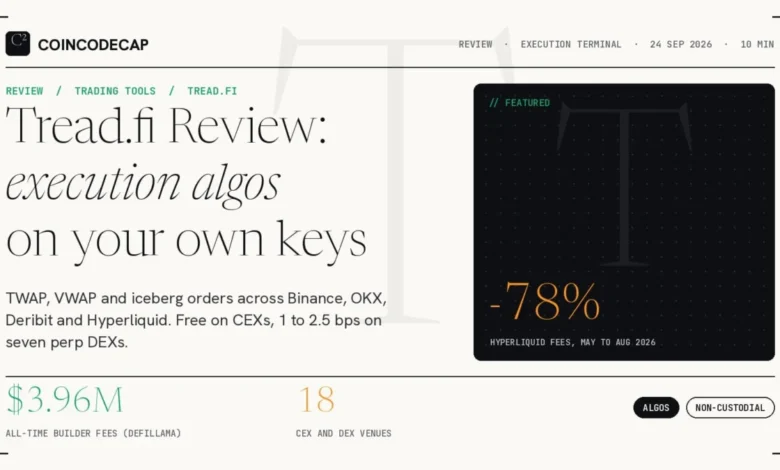
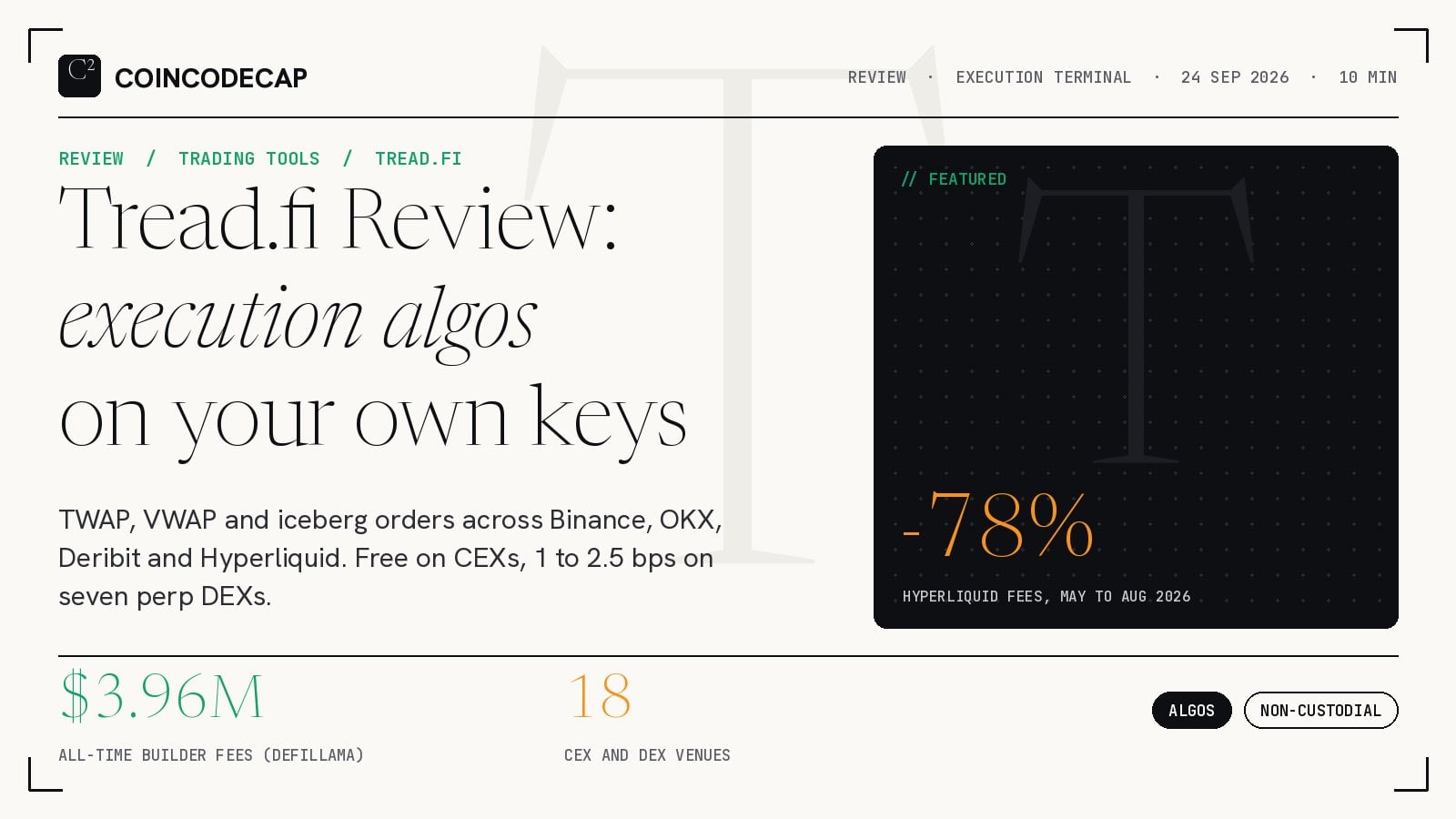
A review of the platform’s usage metrics reveals a clear, points-driven growth trajectory followed by a post-incentive cooling period. Public data from DeFiLlama tracking builder fees paid by Tread.fi users shows a significant peak in activity between November 2025 and May 2026, coinciding with the platform’s inaugural "points season." During this period, monthly fees on Hyperliquid ranged between $203,000 and $367,000.
Following the conclusion of the points program on May 18, 2026, volume dropped precipitously, with August 2026 figures showing a 78% decline from the May peak. This volatility in usage highlights the transient nature of incentivized liquidity in the DeFi ecosystem. Interestingly, the company has contested the accuracy of these public figures. In September 2026, a team member submitted a pull request to DeFiLlama, arguing that the builder-code numbers did not accurately reflect the platform’s actual revenue due to fee-sharing arrangements and discounts. While the request was closed without merger, the debate underscores the challenges of measuring real-world usage in decentralized finance.

Security and Risk Considerations
Because Tread.fi is a non-custodial service, it inherently mitigates the risk of platform-wide insolvency—a common concern in crypto trading. However, the reliance on API keys introduces a different set of vulnerabilities. The setup documentation mandates the use of read-only and trade-only permissions, explicitly advising users to disable withdrawal capabilities and restrict access to specific IP addresses.
Despite these security best practices, the lack of a public, third-party security audit remains a significant gap in the platform’s transparency. For a tool that effectively manages trading keys for high-value accounts, the absence of an external, verified security assessment is a factor that potential users must weigh carefully. It is highly recommended that users employ sub-accounts with limited, capped balances when first connecting to the terminal to mitigate potential exposure.
Strategic Outlook: Who is Tread.fi For?
Tread.fi serves a specific niche: active traders, market makers, and smaller funds that frequently deal with size large enough that slippage represents a material loss. For these users, paying 2.5 bps for improved execution is not merely a cost—it is an investment in capital efficiency.
Conversely, the platform is likely ill-suited for the casual retail trader or those seeking signal-based copy trading bots. The complexity of the interface and the focus on execution scheduling rather than market prediction suggest that it is a tool meant for those who already have a clear strategy and are primarily concerned with the "how" of execution rather than the "what."
As the market continues to evolve, the sustainability of Tread.fi will depend on its ability to maintain its value proposition beyond the allure of points and token incentives. By providing institutional-grade TCA reporting and low-cost execution on centralized venues, the platform has carved out a professional space. However, for long-term adoption, demonstrating consistent, audited security and clear, data-backed execution advantages will be paramount. Traders looking to integrate the terminal should view it as a precision instrument: one that can significantly enhance performance in high-volume scenarios, provided it is managed with the rigorous risk controls necessary for modern algorithmic trading.